THE batteries of my tape recorder fail me just as my lunch with Emeritus Senior Minister Goh Chok Tong begins.
I had put in new ones earlier so I can’t understand why the recorder is dead. Goh looks on while I fiddle with it.
Sorry, I say, grimacing.
He laughs. “Sometimes it’s just the contact,” he says helpfully.
I give up after a while.
Never mind, I tell him, I have another recorder on the table and there’s also my phone. My heart sinks, though, because the errant recorder has been the most reliable of the three devices I always use at interviews.
“Have a look?” he smiles and reaches over to take the recorder from me.
He turns it over, examines it – “where’s the power?” – but the recorder refuses to respond.
I tell him it’s okay, so we settle down to eat and chat.
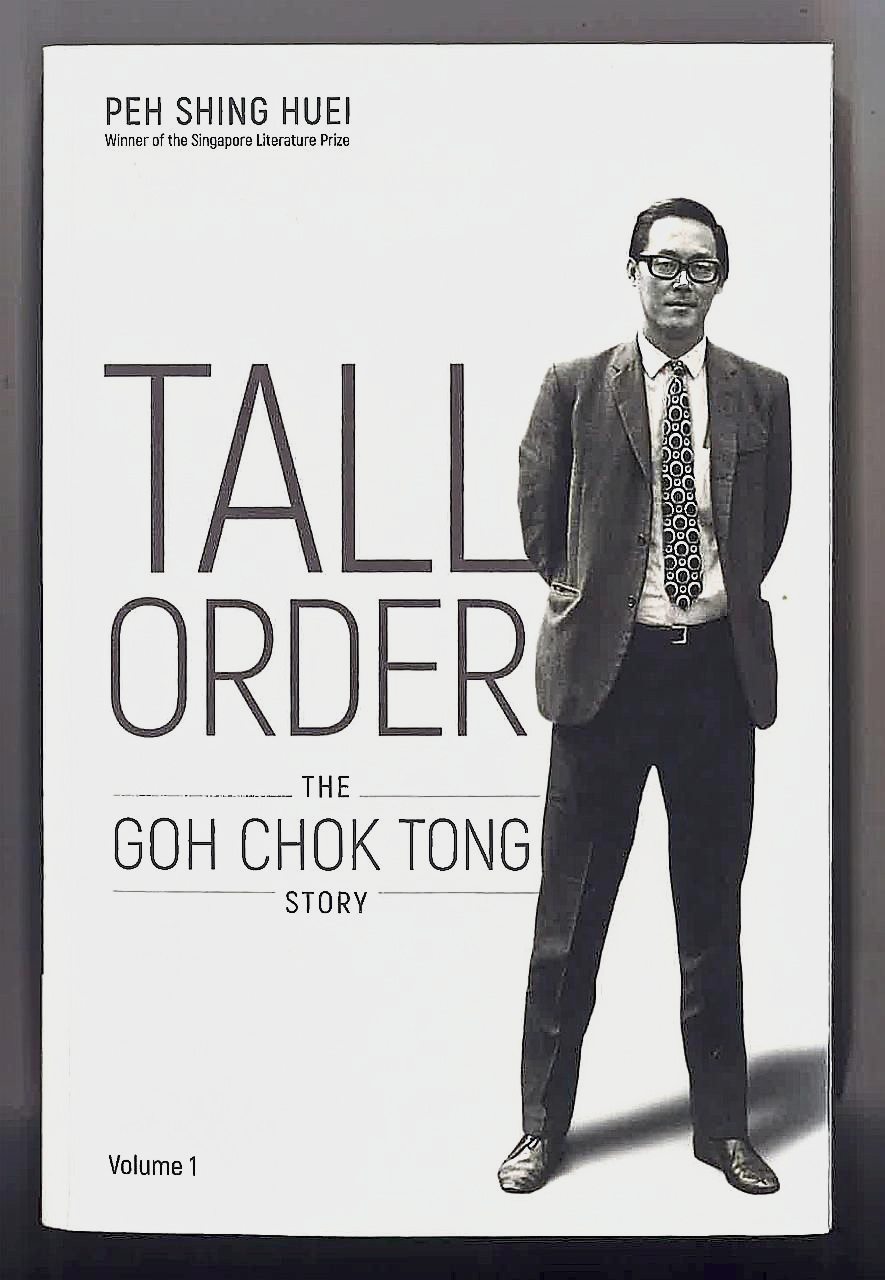
The reason for lunch is the release of Goh’s authorised biography, Tall Order: The Goh Chok Tong Story, written by journalist Peh Shing Huei.
It comes 14 years after Goh stepped down as prime minister and looks back on his childhood, early career, entry into politics and road to becoming Singapore’s second prime minister in 1990.
In the book – as during his prime ministership – the late Lee Kuan Yew, Singapore’s first PM, looms large, featuring in no fewer than 75 pages in a 272-page tome.
Much has always been made of how different the two men were.
Lee was a forceful presence who didn’t suffer fools gladly – reporters with malfunctioning recorders included, no doubt.
Goh is famous for his geniality. He favoured what was then termed a more consultative style of government after the top-down approach of the first-generation leaders.
Where Lee was an eloquent and fiery speaker, Goh was a poor orator who swallowed his words and mangled his sentences. He relied on a folksy charm and Everyman appeal to win audiences over.
Yet, he must have impressed Lee sufficiently to have risen so quickly. He presented his first of three Budgets in 1979, three years after entering politics.
It took him just 14 years to be PM in an era where Lee was still around, beating down competition from talented peers like Dr Tony Tan and Ong Teng Cheong along the way.
He stayed in control for 14 years, overseeing a further period of economic growth. In 2004, he stepped down and Lee’s son, Lee Hsien Loong, became the country’s third PM.
Goh has choosen to meet at the Feast@East Buffet Restaurant in the Grand Mercure Singapore Roxy hotel in Marine Parade, his ward since 1976.
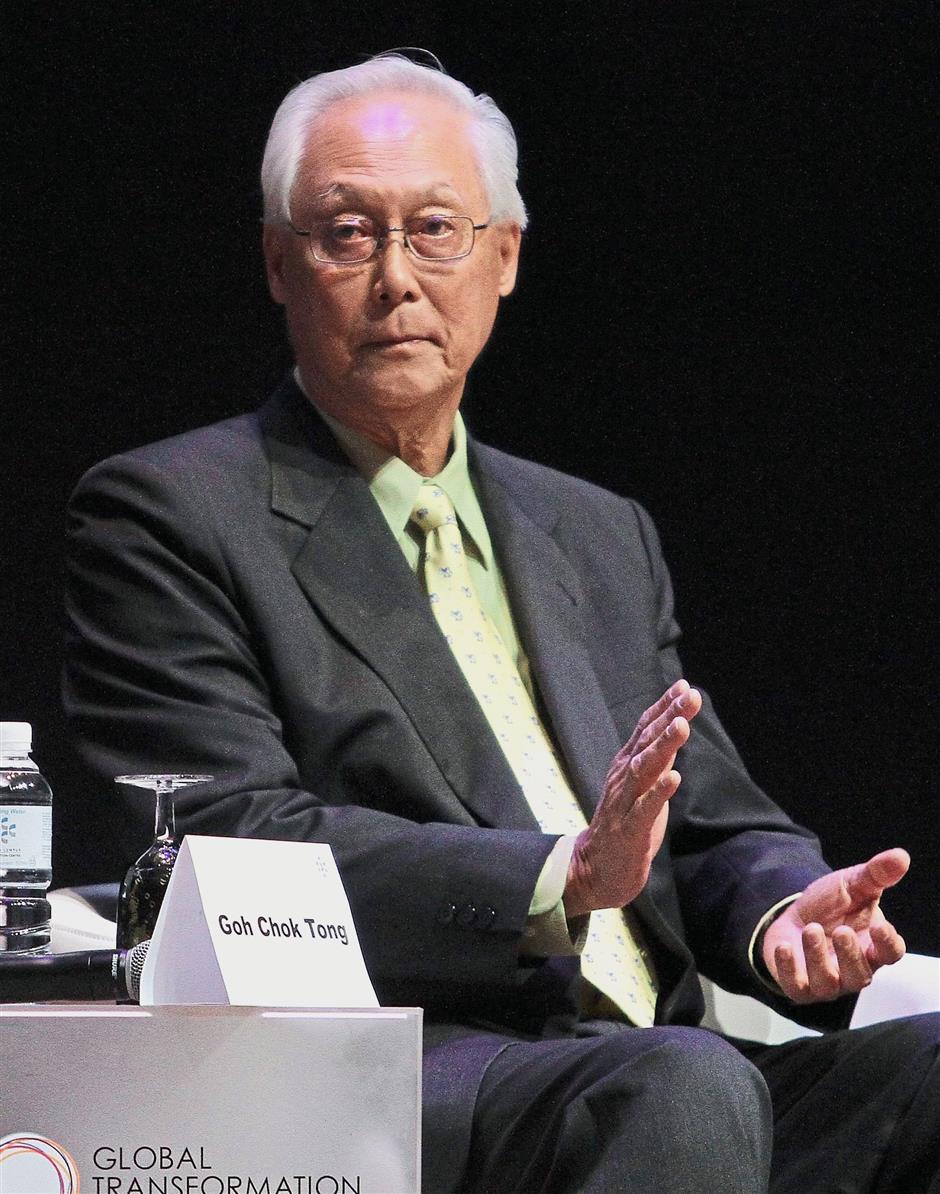
Lunch is at 1pm and I arrive at 12.30pm. At 12.45pm, the information officer gets a call that his car is near the hotel and we head to the lobby to meet him. Goh likes to be early for appointments, she says.
When he sees me, he quips: “Oh you are already here. I was coming early to greet you.”
At 77, his 1.89m frame is still strong and upright. His hair is white but other than that he hasn’t changed that much physically from the 1990s when I was on The Straits Times political desk and had covered him regularly. His manner is as relaxed and friendly as I remember.
He is a familiar face at the hotel and stops to speak to staff as we make our way to the restaurant on the third floor.
We start off by touring the buffet stations where he explains some of the dishes to me. He gets sashimi while I opt for fried spring rolls.
He says that for years he hadn’t wanted to do a book but friends and grassroots leaders kept urging him to write one.
He didn’t want to do a memoir because it would mean “looking at yourself, injecting your own thoughts, and the tendency will be to write good about yourself”.
Two years ago, he agreed on an authorised biography. “By then I was 75 and I thought, will there be something from my experience which I could share?”
I ask what legacy he wants to leave with the book and he says it is the idea of service to the nation, which in his case was to enter politics.
Those who have done well in life should do their part to manage Singapore for others who need help, he says. “When called upon, please do it as a sense of duty. Do it as your responsibility.”
His own entry into public service was because of that sense of obligation.
His father died of tuberculosis when he was 10, his mother was a school teacher with five children to feed, and a government bursary helped him go to the University of Singapore where he got a first-class honours degree in economics.
“Without the bursary and a meritocratic system, I wouldn’t have a chance to go up. No guanxi (connections). I didn’t know anybody.”
He knew politics wasn’t a natural fit – “I could write but to speak, I mean I was not good, got to face it” – but he kept at it because his mantra was always to help “keep Singapore going”.
If people read the book and realise that they, like him, could overcome challenges and serve the country, Tall Order would have done its job, he feels.
He also wants to put on record his interactions with Lee.
The older man’s passing in 2015 at the age of 91 left him with a sense of personal loss. Perhaps more than any other second-generation leader, he had worked most closely with Lee, meeting him three to four times a week and having lunch regularly.
“It was as though I lost somebody from the family... I worked with him for so many years and I did feel that a part of me had died.”
I suggest that Lee had been like a father figure to him. He agrees. “I don’t know whether he regarded himself as a father figure to me, but I regarded him as a father figure (although) publicly I used the term mentor, teacher.”
He points out that he has also likened Lee to a kung fu master. “That’s when you got slapped here and there as well.” But he accepted all the “reprimands and the lashes” as part of learning from Lee.
I’m curious what it was exactly that made him get along with the older man, for clearly they must have got on even if they were temperamentally different.
“What you learn is never try to be clever when you do not know something,” he says. “A fool trying to be intelligent who knows everything, he will find out very quickly. He doesn’t suffer fools.”
Were there qualities you had that made Lee take to you?
He says character and personality were important to Lee.
On the first point, “he would ascertain whether I was an honest person, diligent, hardworking and have the commitment, sense of duty”.
But Lee had a “negative” view of some aspects of his personality.
“I am friendly. I wave to people. I get on well with people. But he thought that sometimes I would entertain journalists too much.”
He recalls how, during Nomination Day at one general election, some journalists had jostled and pushed their recorders in his face.
“Lee Kuan Yew saw that ... He was very worried, unhappy - ‘you should have just put your foot down ... don’t be pushed around by journalists’.”
He laughs at the memory.
“So that part he didn’t like. He thought I was trying to be nice to people. But my point is, you got to be yourself ... It’s not that I entertain all the time such questions. That was during nomination. After nomination, you better answer questions by the journalists.”
He adds: “I don’t know whether he liked it or not, but that’s immaterial. The point is, whether he found me a worthwhile person to train to be the next prime minister.”
Does he find it strange that Lee features so heavily in his biography?
“I don’t find it strange. The people who read it did tell me that this is about me, don’t write too much on Lee Kuan Yew. They were concerned that we’re trying to use Lee Kuan Yew’s photograph to project myself.”
But he believes it is useful to let readers know what Lee was like. “I cannot pretend that I’ve achieved a lot without that mentor and teacher. Without him there, I would not probably have succeeded as the prime minister.”
We break for more food and when we return to our seats, he says with a laugh: “You’re asking me a lot about Lee Kuan Yew.”
I assure him that I’m moving on to other topics.
I start with his post-PM years. When Lee Hsien Loong took over in 2004, Goh became Senior Minister. He left Cabinet in 2011 with the honorary title of Emeritus Senior Minister. It comes with no pay but he has kept his office at the Istana. He is also Senior Adviser to the Monetary Authority of Singapore.
How was the period after 2004?
“Easy to step down. Not easy to adjust,’ he replies. “You got to go through a period of withdrawal. There are withdrawal symptoms.”
He was used to a life of making decisions and taking responsibility and those pressures disappeared. “You felt that, suddenly, what’s my worth?” he says. “You have to take a little while (to adjust).”
There was also the question of what he could and should do.
He had started his career at loss-making national shipping company Neptune Orient Lines, turning it around in three years, and had enjoyed corporate life. But joining a big company was not an option because he wanted to safeguard the position of prime minister.
“Had I gone into the corporate world, there was no guarantee that I would do well because it would depend on many other factors.”
If he had become chairman of a large company and it failed, people would question his prime ministership. “People would say, look, I thought he was very good. In fact, he couldn’t even run a company. So there were moral hazards.”
He also didn’t want to start a trend for future PMs entering the corporate world, as that might lead to conflicts such as a future prime minister making decisions with a view of securing a position after retirement.
I ask him what he thinks he would have become if he hadn’t been a politician. “Probably a successful corporate man,” he says without hesitation.
He has spent much of his post-PM years helping out with Singapore’s external relationships. A second volume to his biography will likely touch on his ties with foreign leaders as well as go deeper into policies he was involved in.
He has also set up two charities – EduGrow for Brighter Tomorrows and the MediaCorp Enable Fund. All his royalties will go to them.
His retirement years seem happy. His low-profile twin son and daughter have six children between them, aged 13 to 18.
He has always had a lot of friends, many dating to schooldays. “It has kept me happy.” Even when he was PM, he would play golf with them and let his hair down – “talk about golf, about many things, except politics”.
“If you don’t do that, when you retire what do you do? You don’t have friends.”
In fact, he and some friends and their families will be holidaying in Okinawa next month, all 50 of them.
Whether he will stand in the next general election is up in the air. “I will consider it when the time comes.”
It will depend on factors like his health, which he describes as “so far so good but never say good – in the end something may happen right away”. In 2014, he underwent successful surgery for prostate cancer.
He will have to consider his interest because “when you’re 80 and one full term means stretching till you are 85, you got to ask yourself, are there other priorities in your life?”
“It will also depend on the party’s position because we believe in self-renewal,” he says of the People’s Action Party. “Ideally the party should tell me, please train somebody to take over from you.”
The contest in Marine Parade will be a factor too. “If it’s going to be under severe attack, then maybe you have to do something to defend it.”
The restaurant is by now empty save for our table.
I have to settle the bill and he tells us there’s no need to see him off. He says goodbye and leaves us smiling in his wake. My photographer and videographer reminisce how Goh was always friendly to everyone when he was PM. History will judge the achievements of Singapore’s second prime minister. Did his policies emphasising economic success lead to some of the social inequalities so much discussed today? How open, really, was Singapore under his consensual style of government?
Few, though, will dispute that he was a steady pair of hands that guided the country safely through the post-LKY years.
And no one, I think, will disagree that his congeniality left many people feeling good – which is no mean feat. — The Straits Times/Asia News Network
Already a subscriber? Log in
Get 20% OFF The Star Digital Access
Cancel anytime. Ad-free. Unlimited access with perks.