



 |
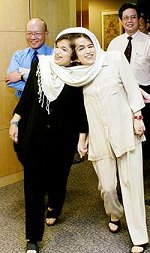
HAPPIER TIMES: A file picture dated June 11 of the conjoined Iranian twins, Ladan (left) and Laleh, sharing a light moment during a press conference in Singapore. - EPApic |
SINGAPORE: Since they were children, Ladan Bijani and her sister, Laleh, spent their lives trying to go different ways even though they were born joined at the head.
As early as eight-years-old, a friend remembered seeing the pair try to walk in opposite directions to break free from each other.
“But that was not possible. Then, they cried because of the pain it caused,” the friend said in Teheran on condition of anonymity.
To the age of 29, the sisters never stopped trying, and their dream turned to tragedy here yesterday.
Their quest had taken them far from their parents at a young age, to Germany and finally to here, where they underwent complex surgery knowing it could kill one or both of them. As the separation was coming to a close, a lot of blood was lost. Ladan died first, then Laleh hours later.
Although they had planned to live together if the surgery was successful, they dreamed of independence and pursuing their own careers.
Ladan wanted to be a lawyer, Laleh a journalist.
“When we first opened our eyes to see the light, we wanted to be separated,” Ladan, who was the more extroverted sister, said last month.
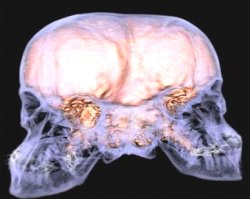 |
The twins' skulls joined together - EPA file picture |
The sisters were born into a poor family of 11 children in Firouzabad, southern Iran. They were raised by doctors in Teheran, under the spotlight of the Iranian media.
They were cheerful as little girls and always had cuts, scratches and bruises on their hands, legs and faces from falling down while they played, the friend recalled.
Despite spending every minute together, the sisters displayed strong, distinct personalities from a young age. Ladan was talkative and enjoyed cooking – something Laleh, known as a quiet thinker, didn't enjoy. Laleh loved animals, but Ladan preferred to avoid them.
“We have different ideas about our lives,” Laleh said last month, explaining why they needed to be separated.
“Actually, we are opposites,” Ladan interrupted, laughing.
As schoolgirls, they cheated on tests by whispering answers to each other. The government eventually caught on and concluded it would be nearly impossible for the sisters to compete individually in university entrance exams – so it granted them a joint scholarship to study law at Teheran University in 1994.
Despite Laleh's dream of becoming a journalist, she agreed to study law to help Ladan's ambition to be a lawyer. However, the sisters were distracted by their wish to be separated and it took them six-and-a-half years, instead of the usual four, to obtain their degrees.
Their hopes were high in 1996, when Iranian doctors helped them travel to Germany for tests ahead of possible separation surgery.
But they returned to Teheran heartbroken after German doctors told them the operation was too dangerous because the sisters shared a common vein that drained blood from their brains. On Monday, surgeons in Singapore believed they had overcome that problem after creating a new vein for Ladan.
 |
After the disappointment in Germany, their hopes for separation were rekindled after they heard about Dr Keith Goh in Singapore leading a team that successfully separated 18-month-old Nepalese twins who had been joined at the head. A reporter in Teheran helped Ladan and Laleh contact Goh last year.
The twins had told friends that even if the surgery is successful, they never could walk really away from each other, even after a lifetime of trying.
The pair had hoped to return to Iran and live in an apartment together while they pursued different careers and caught up on experiences they felt they had missed, said Bahar Niko, a confident to the sisters. – AP
Already a subscriber? Log in
Get 20% OFF The Star Digital Access
Cancel anytime. Ad-free. Unlimited access with perks.
