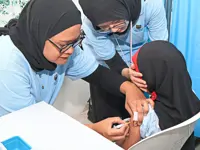
GEORGE TOWN: At a public health screening, a hawker discovered she had high blood pressure, while a retired mechanic voiced concern over his cholesterol levels.
However, as both are deaf, communicating with medical officers proved difficult.
Fortunately, a sign language interpreter was present, having picked up the skill after her younger sister was born deaf.
“With the interpreter’s help, I could ask questions and understand what I should do,” said hawker Nurain Ahmad, 46.
Born deaf, she was among 100 participants at the Aku Kasih Malaysia Komuniti Pekak (northern) programme at Universiti Sains Malaysia recently.
It was organised by Akademi Kenegaraan Malaysia for participants from deaf associations in Penang, Kedah, Perlis and Perak.
Retired mechanic Kumaravel Rajan, 58, knew his cholesterol level was high.
“Through the interpreter, I could ask about my food and exercise,” he said, referring to Penang Deaf Association interpreter Asma Nurul Ain Salim.
Asma, 49, recalled how her younger sister, born in 1981, failed to react to a thunderclap as a toddler.
A subsequent check-up confirmed she was deaf.
Asma began learning sign language and became a professional interpreter in 2001.
“For common ailments such as headaches, fever, coughs, colds, diarrhoea, stomach aches and dizziness, we have the signs.
“But with medical terms or complicated conditions, we sometimes have to spell out the words or explain them further to ensure the patient understands,” she said.
Asma added that several participants were surprised by their diagnosis – including one small eater who questioned how he could be at risk of diabetes.
But such sign language interpreters are not always available.
Asma estimated there are no more than 10 serving Penang and Kedah combined.
Farah Nadia Ismail, 37, who is deaf and also married to a deaf man, said their seven-year-old son could hear and had learnt sign language.
“Helping him with schoolwork or taking him to the doctor can be challenging. We must rely on writing or texting when communicating with others,” she said.
Malaysian Association of Sign Language Interpreters president Wan Zuraidah Abu said Malaysia has only about 60 active sign language interpreters for some 54,000 people with hearing disabilities.
“Training interpreters on a larger scale takes time, and this has always been an issue,” she said.
She stressed that knowing sign language alone did not qualify someone as an interpreter.
The profession requires a strong foundation in language, linguistics, cultural understanding and academic knowledge.
Wan Zuraidah said government agencies should budget for interpretation services when organising programmes.
Draftsman Alexa Ung, 32, said interpreters were needed beyond TV broadcasts and official events.
She said their services helped deaf people communicate with doctors, police officers and emergency personnel.
“It makes things much easier if there were people who could interpret sign language for our daily needs,” she said.