JOHOR BARU: Travellers at the Kuala Lumpur International Airport (KLIA) could be subjected to stricter head-to-toe checks in the government’s efforts to improve national security, says Datuk Seri Saifuddin Nasution Ismail.
The Home Minister said the checks would apply to passengers and baggage for destinations that are deemed high risk.
“The checks will become stricter from head to toe.
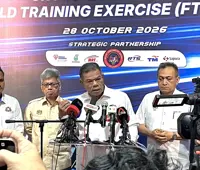
“We have a profiling of destinations that are considered high risk based on (various factors, such as) past incidents,” he said after attending the closing ceremony of the Malaysia-Singapore joint cross-border emergency response exercise for the Rapid Transit System (RTS) Link here on Wednesday (Oct 28).
According to Saifuddin, the checks are part of 17 Cabinet-approved recommendations to strengthen security controls, screening and risk management at KLIA and the country's international entry points.
The recommendations, contained in a joint memorandum by the Home Ministry and Transport Ministry, were approved Aug 19.
They include short-, medium- and long-term measures to strengthen the integrity of security controls, including targeted, risk-based screening of flights, passengers, crew and baggage considered to pose a higher risk.
On July 28, a Malaysian co-pilot was arrested for suspected drug smuggling at Indonesia's Soekarno-Hatta International Airport after arriving from Kuala Lumpur.
Inspection uncovered 14 packets containing 70,114 ecstasy pills weighing approximately 25kg, along with 4g of methamphetamine found in his carry-on bag. The seized drugs were estimated to be worth RM45mil.
Malaysian authorities said the man had undergone the required screening at KLIA, but his baggage had not been flagged for further inspection.
Police subsequently investigated possible links between airport personnel and a drug syndicate.
In October, Bukit Aman said the co-pilot’s detention in Jakarta had been extended by another 30 days. Another pilot and six other people allegedly linked to the same drug syndicate were also detained in Malaysia.
On the RTS Link, Saifuddin Nasution said travellers would pass through body scanners capable of detecting weapons and other contraband.
“I have gone through the demonstration myself and the scanner was able to detect firearms and sharp objects on our body.
“So there is no space for an individual to wrap (substances) on their body as the scanners will be able to detect them,” he said.
The RTS Link station at the Bukit Chagar immigration, customs and quarantine complex will have 100 e-gate lanes, 10 security screening lanes for body checks and 18 baggage scanners.
It will also have dedicated lanes for passengers travelling without luggage to minimise bottlenecks and ensure smooth passenger flow.
The RTS Link, scheduled to begin operations in February next year, is a 4km shuttle service connecting Bukit Chagar in Johor Baru and Woodlands North in Singapore.