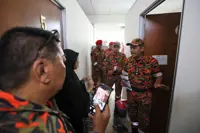
PETALING JAYA: Ten years after Malaysia’s deadliest hospital fire killed six patients, fire safety lapses continue to plague hospitals.
Fire and Rescue Department director-general Datuk Seri Nor Hisham Mohammad said the department had carried out a total of 752 inspections at hospital premises in the last decade, resulting in 1,340 fire hazard abatement notices issued.
“The highest number of notices was recorded in 2021 at 363, while 40 notices were recorded in 2024 and 43 in 2025,” he said, adding that these inspections included private and government hospitals.
“These statistics show that monitoring compliance with fire safety requirements at hospital premises must continue consistently.
“However, the number of notices alone is insufficient to determine whether the level of fire risk has increased or decreased.
“Assessments must also take into account the types of non-compliance, their severity and the status of corrective action taken.”
Nor Hisham said hospitals face unique fire risks as they accommodate patients who may not be able to evacuate easily, including bedridden and critically ill patients, as well as those dependent on life support equipment.
“The fire tragedy at Hospital Sultanah Aminah in Johor Baru on Oct 25, 2016, which claimed the lives of six patients, serves as a stark reminder to us all that fire safety in hospitals is not merely about protecting buildings, but saving lives,” he said.
ALSO READ: Dedicated to a safer, kinder facility
“Fire detection and protection systems must be operational, maintenance must be properly carried out, exit routes must be kept clear of obstructions and hospital staff must be trained to deal with emergencies, including evacuating patients who are unable to do so themselves.”
He said the department will continue to conduct inspections, monitor and enforce of the law.
However, he said hospital management must also ensure that prompt and effective corrective action is taken for every instance of non-compliance identified.
“Our goal is not simply to ensure that hospitals have fire safety systems in place, but to ensure that these systems function effectively.
“We cannot change what happened in 2016, but we have a responsibility to ensure that the lessons learnt from the tragedy are translated into tangible action to prevent similar incidents from happening again.”
Retired health ministry director Datuk Dr Zainal Ariffin Omar said hospitals must ensure aggressive safety checks as malfunctions have triggered hospital fires, adding that a vast majority of occupants are incapacitated, non-ambulatory or dependent on life-support systems, which makes rapid evacuation impossible.
“High-risk materials such as compressed oxygen cylinders, nitrous oxide and flammable laboratory chemicals must be stored securely in well-ventilated, designated zones away from potential ignition points.
“Kitchens must be kept entirely clear of grease buildup. Clean laundry lint traps daily, and ensure that elevator shafts and generator rooms remain free of combustible waste like plastic and personal protective equipment kits.”