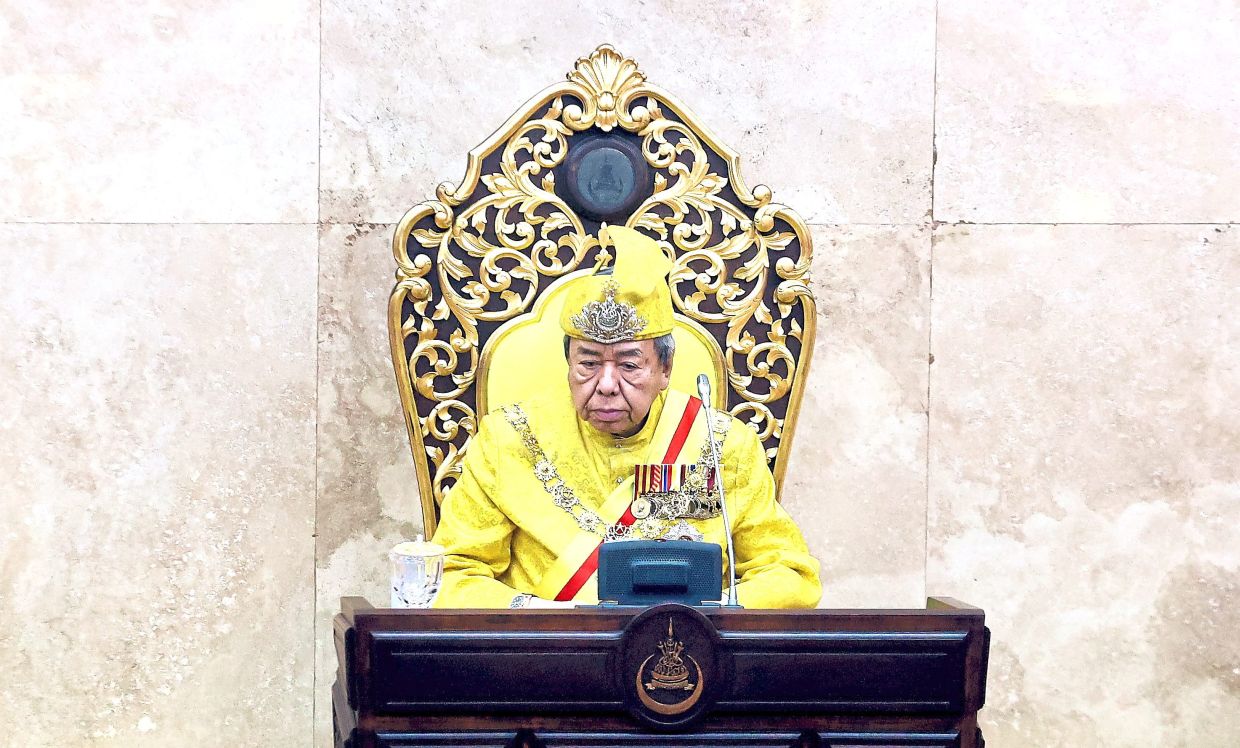
EVERY year, during Selangor Ruler Sultan Sharafuddin Idris Shah’s royal address at the opening of the state legislative assembly session, many people, especially journalists, wait in anticipation to hear the Ruler’s views on various issues concerning the state.
After Sultan Sharafuddin delivers his address on the state’s performance and other matters, His Royal Highness goes on to share his concerns and observations, which will invariably make headlines the following day.
In 2020, when the nation was still reeling from the shock of the Sheraton Move, which saw the then Pakatan Harapan federal government toppled and replaced by the Perikatan Nasional government, the Ruler reminded everyone in his address to the state assembly not to describe the latter as a backdoor government.
Sultan Sharafuddin had personally followed the developments surrounding the transition of power, which the then Yang di-Pertuan Agong had handled with great care through open consultations in accordance with the Federal Constitution.
“Allegations that this federal government was a ‘backdoor government’ or that its formation was a power grab must cease immediately, as His Majesty the Yang di-Pertuan Agong is empowered to exercise his discretion as provided by law,” the Ruler had said.
His Royal Highness had also reminded Selangor assemblymen to protect the state’s political stability as the people were tired of the political strife that struck the nation following the 14th General Election.
The Sultan added that politicians were frequently seen bickering over endless issues and neglecting their core responsibility of fulfilling the mandate entrusted to them by the people.
In 2021, Tuanku once again reminded the state’s elected representatives not to become overly preoccupied with politicking or the pursuit of power and position.
The Ruler reminded them not to neglect their primary responsibility, which was to look after the welfare of the people who had voted them into office.
“I cannot conceal my sorrow and regret at witnessing the political turmoil, infighting and instability that have become so evident in the country of late.
“It appears that the ‘Yang Berhormats’ are unwilling to learn from history about the collapse of nations caused by power struggles that lead to societal division,” said Sultan Sharafuddin at the time.
The Ruler asked the state’s elected representatives whether they realised that when political leaders vied for power and the political climate became unstable, the people would be forced to bear the consequences.
The Sultan had also addressed reports of Malaysian Anti-Corruption Commission (MACC) investigations into allegations of corruption and abuse of power involving politicians.
The Ruler expressed dismay over the fact that there were still those in office who lacked integrity in fulfilling the trust placed in them as public servants and political leaders.
Sultan Sharafuddin also warned that he did not wish to hear any more reports regarding the involvement of Selangor government officials or political leaders in corrupt practices.
“We have directed the MACC to conduct a comprehensive investigation to cleanse the State of Selangor of corruption,” Sultan Sharafuddin said then.
In 2022, the Sultan said in his address that elected representatives should not engage in politics solely for their respective parties’ benefit while neglecting their duty to champion the welfare of the people.
“Do not be preoccupied with politicking day and night for personal gain,” Sultan Sharafuddin had said.
In 2023, His Royal Highness reminded the state’s elected representatives not to turn mosques and suraus into platforms for partisan politics.
“I have repeatedly issued decrees and reminded MAIS (Selangor Islamic Religious Council) and J (Selangor Islamic Religious Department) to ensure that mosques and suraus remain free from any political elements that could undermine the unity and harmony of the Muslim community.
“Mosques and suraus should not become sources of conflict and discord that ultimately create rifts among Muslims based on differing political views and endless political animosity,” Sultan Sharafuddin had said.
According to the Ruler, discord had arisen because some speakers made snide remarks and sometimes even slandered others when addressing congregations at suraus and mosques.
“I am deeply concerned that, if left unchecked, such a culture will continue to divide the Muslim community, particularly the Malays,” the Sultan had said then.
Tuanku added that only individuals who are qualified and accredited by the MAIS Accreditation Committee should be allowed to speak, preach and conduct religious classes in mosques, suraus or any other place within Selangor.
The Sultan said deviant teachings and slander could be curbed by granting teaching accreditation only to those who were proficient and possessed extensive knowledge of Islam.
In 2024, Sultan Sharafuddin advised the state’s civil servants to embrace a paradigm shift in carrying out every task and responsibility entrusted to them.
“I want bureaucratic red tape and cumbersome regulations in government dealings to be reduced immediately,” Sultan Sharafuddin had said.
The Ruler added that public-facing services must be delivered promptly and flawlessly, with negligence and sluggishness completely eradicated.
“There must be a sense of urgency and prompt action to ensure that services dealing directly with the public are completed swiftly and flawlessly,” Tuanku had said.
Sultan Sharafuddin added that negligence and sluggishness among civil servants must be wiped out, as these had led to delays or complications in numerous development projects, such as flood mitigation initiatives and the repair of public facilities.
“I am concerned that if such attitudes and mindsets prevail among civil servants, it is the people who will continue to bear the consequences.”
The Ruler also recommended that at least 50% of local council appointments be professionals rather than politicians.
The following year, Sultan Sharafuddin expressed hope that the state government would handle disasters, such as floods and landslides, appropriately.
The Ruler had added that the state government must implement meticulous planning to address disaster-related issues and prevent devastating floods from recurring.
“I wish to see the acceleration of the Flood Mitigation Plan, a joint initiative by the federal and state governments with an estimated cost of RM1.774bil.
“We cannot afford to delay the implementation of flood mitigation efforts, as doing so could result in massive losses for my people and the state government,” Sultan Sharafuddin said.
The Ruler also reminded state government officials and civil servants, especially those in the district offices and local councils, to carry out their duties with a strong sense of responsibility and to steer clear of corruption and misconduct.
“I do not wish to hear of any further instances in which land ownership matters or the issuance of business licences are manipulated for personal gain.
“Heads of departments must ensure that abuse of power does not occur within their respective departments,” Sultan Sharafuddin said.
At the opening of the 2026 state legislative assembly session, Sultan Sharafuddin did not mince his words when lambasting the state government for failing to act swiftly to address the flooding problem.
Tuanku had chided them, saying that his repeated advice had fallen on deaf ears.
“I had previously advised the state government to consult experts from abroad, particularly from the Netherlands, to obtain the best ideas for addressing the flood problem in Selangor.
“Regrettably, however, my advice was disregarded and unheeded,” Sultan Sharafuddin had said.