KUALA LUMPUR: The government faces tough choices over which development projects to fund in Budget 2027, as ministries and agencies seek RM80.4bil in development spending.
The hefty project pipeline comes as the government also faces higher fuel subsidy costs and pressure to provide more household relief, prompting economists to call for sharper spending prioritisation.
The RM80.4bil represents development expenditure requested for 9,955 new and ongoing projects under the 13th Malaysia Plan (13MP) (2026-2030).
The requests cover projects proposed by ministries and agencies, and the government will allocate the final amount based on its priorities and available fiscal space.
Socio-Economic Research Centre (SERC) executive director Lee Heng Guie said the fiscal room for broad-based handouts was “very narrow”, although stronger-than-expected revenue growth and subsidy rationalisation could provide some room for targeted household assistance.
“The government needs to balance fiscal prudence with social and growth priorities, relying on targeted redistribution rather than broad-based stimulus,” he said in an interview yesterday.
Lee noted that the government should prioritise vulnerable households and essential services, while also preserving funding for infrastructure, education, healthcare, digitalisation and strategic industries.
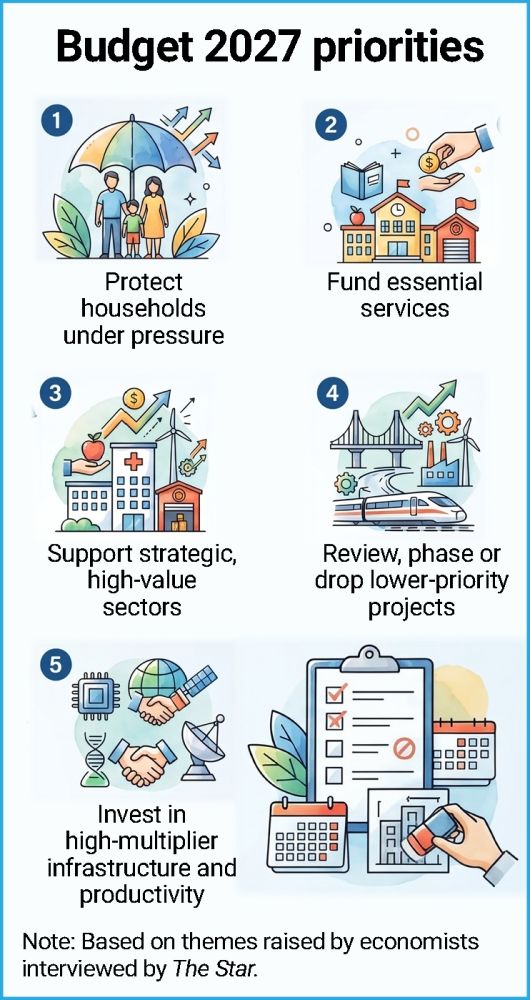
“Most importantly, high-multiplier capital projects should be ring-fenced, while lower-priority or non-critical projects should be reviewed, phased or dropped rather than spreading resources too thinly.Project selection should be guided by three principles – economy, efficiency and effectiveness – to ensure spending delivers measurable outcomes and long-term impact.”
Lee said volatile energy prices could increase fuel subsidy allocations, leaving less room for healthcare, infrastructure and education.
“With higher fuel subsidy costs, there is a risk of crowding out other important spending priorities,” he said.
The government could still provide targeted assistance to households facing cost-of-living pressures, particularly if subsidy rationalisation and stronger revenue growth provide some headroom.
“The key is to prioritise support for vulnerable households while protecting investments that raise productivity and strengthen future growth,” he said.
SERC is the independent, non-profit think tank established by the Associated Chinese Chambers of Commerce and Industry of Malaysia (ACCCIM).
Economist Prof Emeritus Datuk Dr Zakariah Abdul Rashid said development expenditure was critical to long-term economic growth, particularly through infrastructure, digitalisation and basic facilities that support private sector activity.