
GEORGE TOWN: Against the backdrop of the island’s historic streets, a more than 5m-tall paper effigy of the King of Hades made a striking final appearance before being set ablaze during the Hungry Ghost Festival.
Paper ingots were also stacked to form the “gold and silver mountains” offering as devotees bid farewell to the deity, popularly known as Tai Su Yeah in Hokkien.
Penang Kwangtung and Tengchow Association president Datuk Lio Chee Yeong said the Cantonese-style Hungry Ghost Festival rites had been observed for more than a century.
He said it was the only association here to house a Tai Su Yeah effigy and display spirit-invoking banners outside its premises.
“The premises were donated by Guangdong traders in 1921 on the condition that the annual rites be continued,” he said, adding that the festival was also stipulated in the association’s constitution.
Lio said the rites began on Tuesday, the 13th day of the seventh lunar month, when committee members visited cemeteries in Mount Erskine and Teluk Bahang, as well as the sea, to summon wandering spirits.
“The main significance is to offer food and clothing to wandering souls and pray for those without descendants to pay tribute to them,” he said.
He said the Cantonese-style Tai Su Yeah had a kind-looking face and a rounder body, and regarded as the “Wen Da Shi Ye”, or scholarly version.
The Hokkien version, he added, typically has a fierce face, blue features and prominent fangs, and is known as the “Wu Da Shi Ye”, or warrior version.
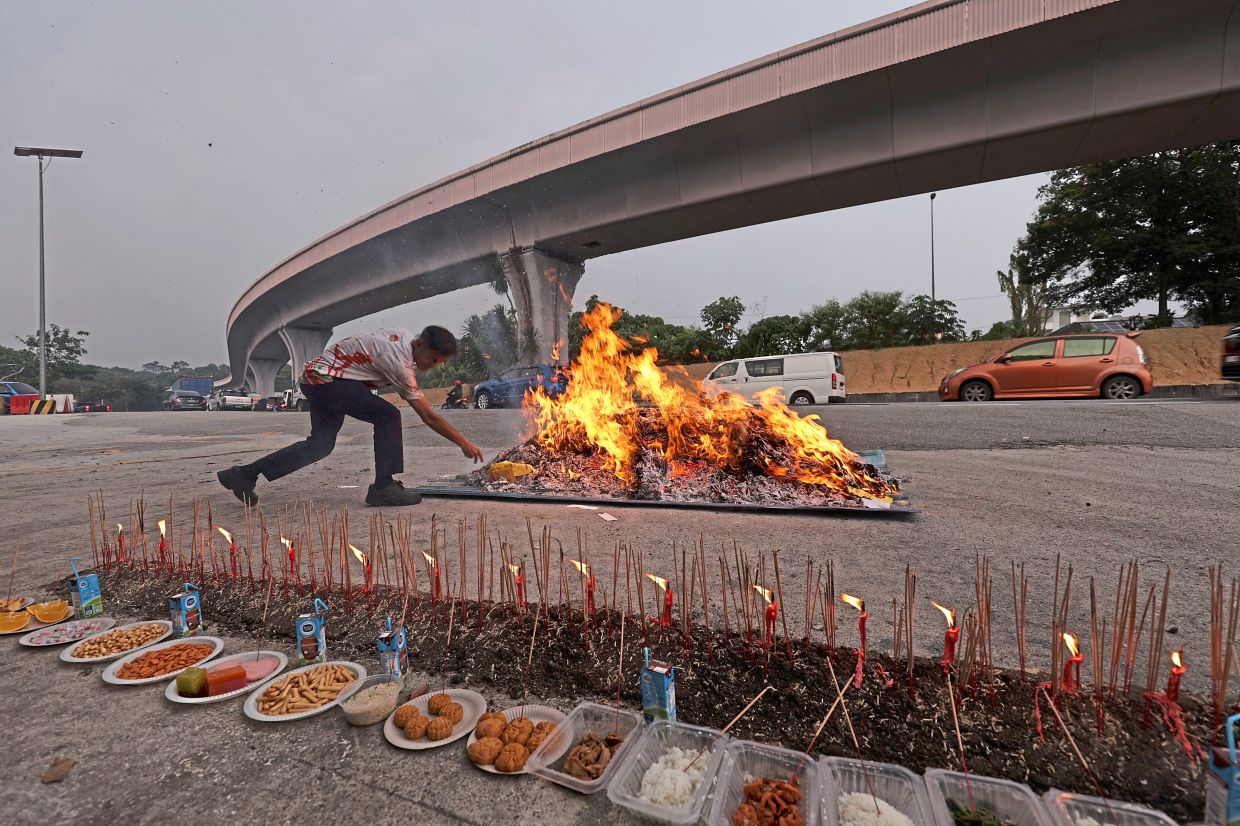
Traditionally, Chinese families conduct roadside prayers on the 14th or 15th day of the seventh lunar month, offering incense and joss paper to appease wandering spirits.
Among them was 18-year-old Oh Ja Xin, who was seen burning incense and joss paper at a designated area at Sri Saujana Apartment near Lebuh Macallum on Wednesday.
Her family had also prepared biscuits, sweets and chocolates as offerings.
Earlier in the morning, they offered prayers to their ancestors.
“It is something that has naturally been passed down from one generation to the next,” she said.
Observed during the seventh month of the lunar calendar, the Hungry Ghost Festival, known as Phor Thor in Hokkien and Yu Lan in Mandarin, is widely celebrated across East and South-East Asia.
According to Taoist belief, the Gates of Hell will open during this period, allowing spirits to roam freely among the living.
The festival, which began on Aug 13, will end on Sept 10.