CYBERJAYA: Forget nuclear power plants for a moment – Malaysia is also harnessing nuclear science to grow the plants that feed its people.
Rice, cassava and bananas may seem worlds apart from nuclear technology, but science is bringing them together to safeguard Malaysia’s food supply against crop diseases, extreme weather and a growing population.
Among its successes is NMR 152, a rice variety developed using nuclear technology that has been commercialised and is already being planted by Malaysian farmers.
Malaysian Nuclear Agency research officer Norazlina Noordin said scientists were now developing cassava that could be harvested in six months, nearly halving the usual growing period of between 11 and 12 months.
“After five to six years of research, we obtained several new lines that could reduce the harvesting period to six months without compromising yield.
“The yields were higher than those of the control plants,” said Norazlina, who is attached to the agency’s Agrotechnology and Biosciences Division.
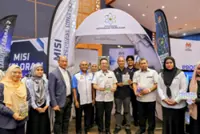
She said this when met at the “Nuclear Advocacy Programme: Nuklear Untuk Rakyat (N.U.R) Women’s Edition” here yesterday.
The research, which began in 2021, involves exposing cassava stem cuttings to gamma radiation to induce random genetic changes.
The cuttings are subsequently planted and screened over several generations for desirable traits, such as earlier maturity, higher yields and resistance to disease, pests and climate change.
Norazlina said at least 1,000 plants may need to be screened because the genetic changes occur randomly, with the entire process taking between six and seven years before researchers can confirm that the desired characteristics are stable.
“If we want early maturity, we must ensure that the trait remains stable alongside the desired yield.
“Through nuclear technology, we can also produce new plant varieties that are resistant to diseases and pests, as well as resilient to climate change.
“This technology is important to strengthen Malaysia’s food security and agricultural safety,” she said.
She stressed that irradiating the planting material did not make the resulting crops radioactive.
“The radiation only passes through the material, much like an X-ray.
“There is no radioactive residue left behind,” she said, adding that the agency was also researching disease-resistant bananas and other food crops, including taro.
The cassava project received about RM100,000 from the International Atomic Energy Agency for five years and is being undertaken with the Agriculture Department, which assists with land and large-scale screening.
Malaysian Nuclear Agency director-general Dr Muhammad Rawi Mohamed Zin said nuclear technology was one of the tools being deployed to bolster national food security.
“We focus on crops that can have a significant impact, particularly those needed by the country and those with economic value.
“For food, there is rice, while for livestock, we are also developing grass and animal feed.
“The scope is broad, but the priority is food crops and plants that contribute to the national economy,” he said.
Muhammad Rawi said nuclear techniques could also verify the authenticity and geographical origin of food products such as honey, edible bird’s nests and prawns.
“If a product is claimed to come from Malaysia, we have the methods and data to determine whether it was actually produced here,” he said.
The technology, he added, could protect Malaysian produce from foreign products falsely labelled as locally sourced – extending its role from growing hardier crops to safeguarding the integrity of the country’s food supply.