
PETALING JAYA: Replacing foreign labour with machines sounds like a straightforward solution to reduce reliance on migrant workers, but employer groups warn that automation is neither cheap nor suitable for every sector.
“We support the government’s objective of reducing Malaysia’s structural dependence on foreign workers through greater automation, digitalisation and productivity.
“Automation should be viewed as a gradual transition rather than an immediate substitute for foreign workers,” said Malaysian Employers Federation (MEF) president Datuk Syed Hussain Syed Husman.
The transition had to be gradual particularly for micro, small and medium enterprises (MSMEs), he said.
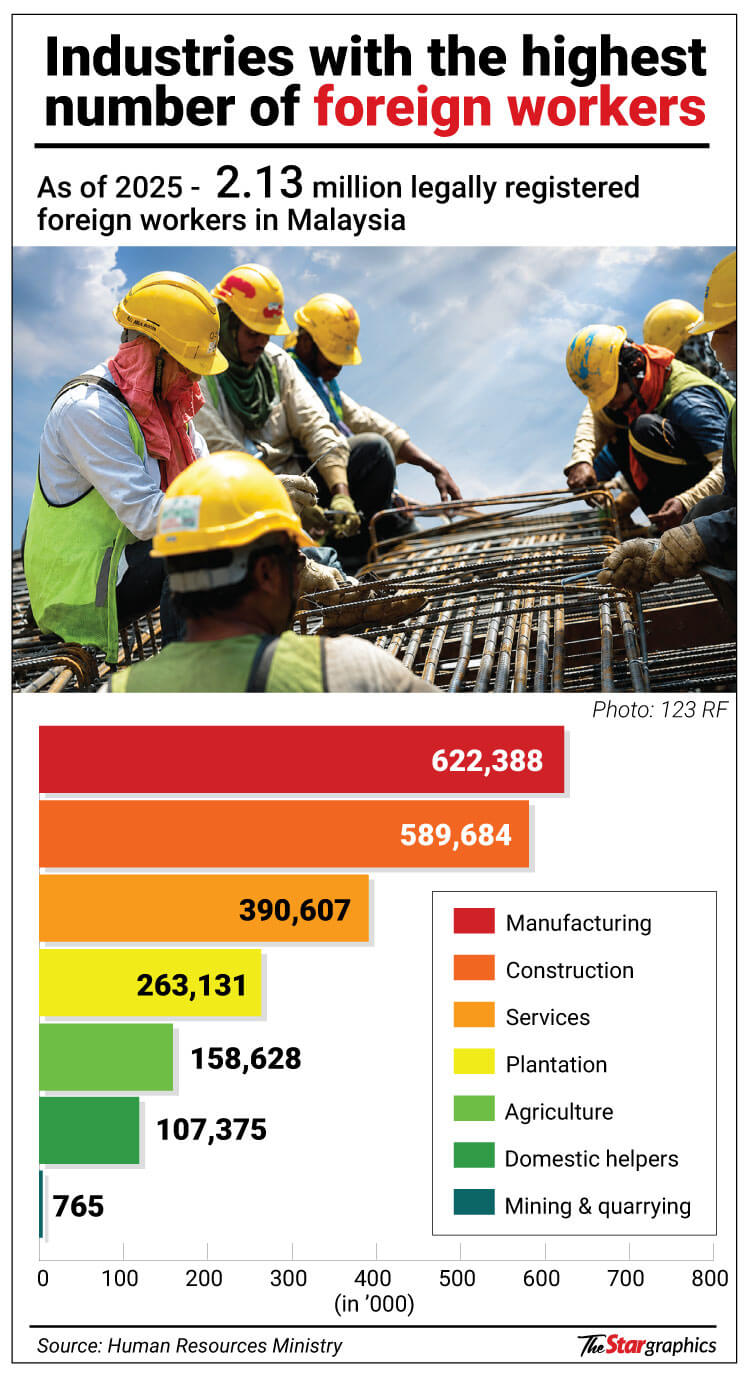
Deputy Investment, Trade and Industry Minister Sim Tze Tzin on Thursday said Malaysia aims to reduce foreign workforce reliance to 10% by 2030, down from the current 13% cap.
“We want businesses to understand the importance of automation, the importance of moving up the value chain; they must make their company more efficient,” Sim was quoted as saying.
Syed Hussain pointed out that large companies and capital-intensive industries were better positioned to automate repetitive, hazardous and predictable tasks but smaller businesses faced high upfront costs for machinery, robotics, software integration, maintenance and worker training.
He said that “automation where commercially and technically viable” should be the approach rather than expecting all foreign-worker-dependent jobs be automated.
Syed Hussain noted that automating remains uneconomical for many roles across construction, plantations, food services, cleaning, security, hospitality, maintenance and logistics.
Employers should instead combine better wages and working conditions with job redesign, technology and skills training to attract more Malaysians.
“Malaysia should not approach the issue as ‘foreign workers versus automation’. The more sustainable approach is productivity, technology and Malaysian workers working together,” he said.
Syed Hussain said government grants and tax incentives were good but access, affordability and suitability remained challenges for MSMEs.
“The issue is whether the investment provides an acceptable return. An MSME cannot justify a RM500,000 or RM1mil outlay if production volume is small or demand is uncertain,” Syed Hussain explained.
He proposed longer-tenure financing, a one-stop mechanism for incentives and technical advisory support to help smaller companies identify suitable technologies.
SME Association of Malaysia president Chin Chee Seong agreed that automation could gradually reduce SMEs’ reliance on foreign workers but said it was unrealistic to expect machines to replace foreign labour across the board in a short period.
He said cost remained the biggest obstacle for smaller businesses as automation involved not only machinery but also software, system integration, maintenance, and training.
“For a small SME, the investment can be substantial, while the return on investment may take several years. Many SMEs are already facing higher wages, rental, utilities and other operating and compliance costs. Their priority is often managing day-to-day cash flow rather than making large capital investments,” he said.
Chin said SMEs, particularly in manufacturing, were already adopting automated production lines, robotics, self-service technology and AI-enabled software, although adoption varied according to the size and resources of each business.
“The objective should not simply be to replace foreign workers with machines. It should be to raise productivity per worker.”
Automation, he said, should enable one worker to produce more and allow businesses to gradually move workers away from repetitive, low-value tasks towards higher-skilled and higher-value jobs.
If the government wants SMEs to accelerate the transition, he said it should provide easier access to automation grants, low-interest financing and tax incentives while considering the use of higher foreign-worker levy collections to support automation and workforce reskilling.
Chin suggested that foreign-worker restrictions be introduced progressively and on a sector-specific basis.