
A childhood spent helping the family business has grown into a lifelong mission to put Tenom on the map.
LOOKING at how far the Yong family’s Yit Foh Coffee has come today, few would imagine that some of the 12 siblings once packed coffee with tears in their eyes.
They were still in primary and secondary school. When examinations approached, they wanted to study, but there was coffee waiting to be packed at the family’s small factory.
The children were divided into three groups of four.
If the boys disappeared to a nearby park to play basketball, their father would sometimes come looking for them and call them home.
There was coffee to pack.
Yit Foh Coffee managing director Alex Yong Fui Chiang remembers those days with amusement now, saying the experience probably convinced many of his siblings to study hard so they would never have to pack coffee again.
“Some of them were packing coffee and crying, especially during exam time. They wanted to study but there was no time. So I think they told themselves, ‘I must study hard. I must be successful so I don’t have to pack coffee anymore,’” he said jokingly.
Most eventually left, with many settling overseas. But Yong, the youngest, stayed.
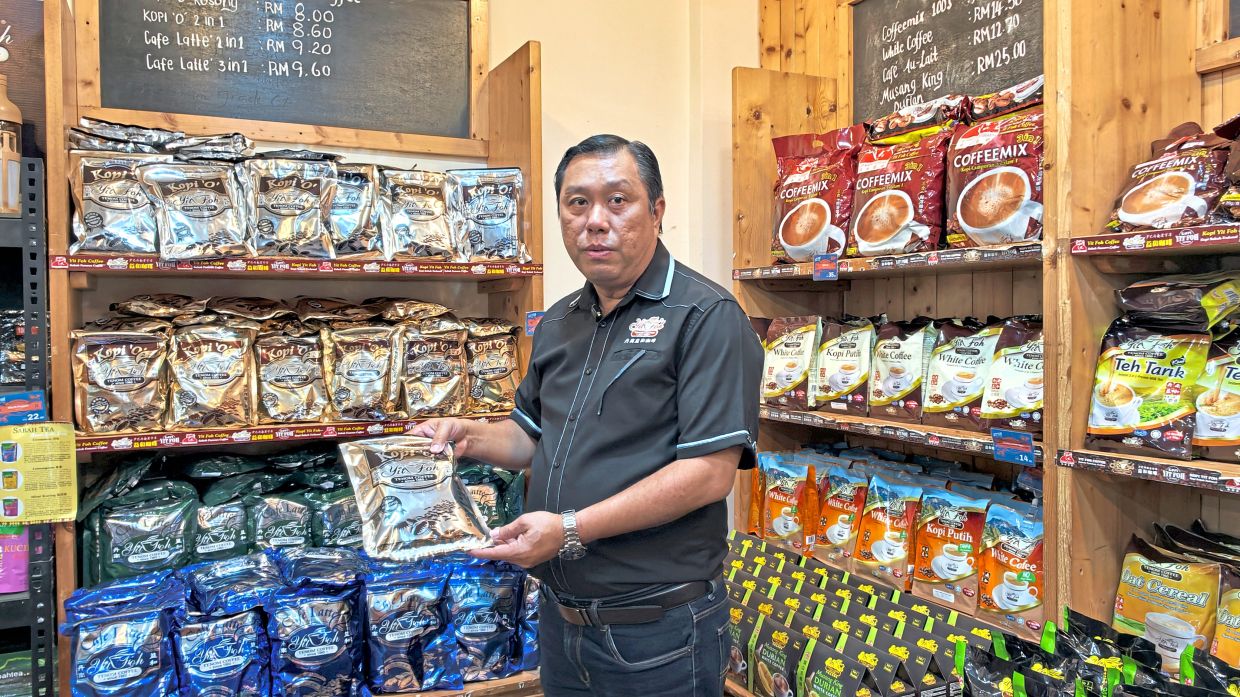
Today, he runs the coffee business his father started more than six decades ago in Tenom, an interior district about 145km from Kota Kinabalu that many informally regard as Sabah’s “coffee town”.
Not all his childhood memories were difficult ones.
As demand grew, his father began making more frequent trips to Keningau to sell and deliver coffee. The journey, which now takes about half an hour, could take close to two hours on the poor roads then.
Yong sometimes followed, occasionally bringing three classmates along, with the highlight being a stop at Kampung Bingkor to swim in the river.
“That was the fun part. My friends loved joining me for those trips,” he recalled.
The work was demanding, but coffee had also become part of his childhood. So when he finished secondary school and his father asked him to continue the family business, Yong agreed.
Part of him enjoyed it, he said, and he also felt for his parents after seeing how much they had poured into the business.
He formally took over Yit Foh in 1986.
From an oil drum to a Tenom name
Yit Foh began in 1960 when Yong’s father, Yong Loong Vun, started a small coffee operation in Kampung Chinta Mata, Tenom.
Coffee was already widely grown around the district, including Sapong and Kemabong.
Yong said many households grew and roasted their own beans, and his father saw an opportunity to prepare the coffee for them instead.
The family’s early operation was modest, with coffee packed by hand into simple paper bags. Even its distinctive roasting method began with an improvised machine.
Yong said his father once spotted what looked like an oil drum and wondered whether it could replace the wok traditionally used to roast coffee.
He modified the drum to rotate over a wood fire, creating a distinct roasted aroma that helped set the coffee apart.
Decades later, Yit Foh still retains its traditional wood-fired roasting method.
“I think it’s a legacy. It’s a mission. I don’t want to lose it,” Yong said.
Different machines produced different results, he said, and the company wanted to preserve the flavour customers had come to associate with its coffee.
By the 1980s, Yit Foh coffee was reaching Kota Kinabalu and Beaufort.
In 1993, the company moved from its original factory near the market to its present site.
That year, after seeing packaging machinery at an exhibition, Yong also began looking at ways to make Tenom coffee more convenient. Yit Foh later introduced single-serve coffee bags and instant coffee products.
From a small Tenom family factory, it eventually expanded beyond Sabah, with its products reaching Peninsular Malaysia and Brunei.
A town built around coffee
As Yit Foh grew, so did Tenom’s identity as a coffee town.
The largely agricultural district is also known for rubber, fruits and vegetables, but coffee has become one of the names most closely linked to it.
Coffee is also becoming part of the visitor experience.
Yit Foh has its own coffee park in Chinta Mata, where visitors can learn about coffee production, dine and stay overnight.
Fatt Choi Coffee Cabin is another coffee-based attraction, combining a coffee farm and factory experience with accommodation.
For Yong, who is also chairman of the Tenom Tourism Association, coffee can be the draw that leads visitors to discover the rest of the district.
“We can use coffee to attract them here,” he said.
He believes more visitors would also benefit local eateries, accommodation operators, farmers and other small businesses.
But accessibility remains a challenge.
Yong said poor road conditions had long made travelling into Tenom slower and less attractive, although improvements to the road network, including the Pan Borneo Highway, should make the district more accessible.
He hopes more Sabahans, as well as visitors from Peninsular Malaysia and overseas, will eventually include Tenom in their travel plans.
More than six decades ago, Yong’s father looked at the coffee grown around Tenom and saw a business opportunity.
His youngest son now sees another. The boy who once hoped the coffee business would become less busy has spent much of his adult life making it bigger.
But this time, instead of simply sending Tenom coffee out into the world, he wants the coffee to bring the world back to Tenom.