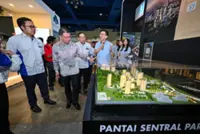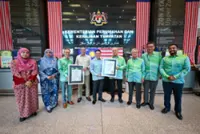
PETALING JAYA: Housing and Local Government Minister Nga Kor Ming has received the MalaysiaGBC Leadership in Sustainable Cities Award 2026 for his role in advancing sustainable urban development and Malaysia’s transition towards greener and more resilient cities.
In a statement posted on Facebook, Nga said the recognition was not a personal achievement but reflected the collective efforts of the Housing and Local Government Ministry (KPKT), local authorities, industry partners and communities.
“Sustainability is no longer a choice. In the face of rapid urbanisation, climate change and resource scarcity, it must become a fundamental pillar of how we build our homes, design our public spaces and manage our cities,” he said on Friday (Aug 14).
Nga said his ministry was embedding sustainability across the urban ecosystem, including through the National Housing Policy 2026–2035, which promotes modern construction technologies such as the Industrialised Building System (IBS) and Prefabricated Prefinished Volumetric Construction (PPVC).
The ministry will also introduce a big data analytics tool next year to identify mismatches between housing supply and demand, to address property overhang and ensure more efficient use of land and resources.
On public spaces, Nga said his ministry aims to build or upgrade 1,000 Madani Recreational Parks over the next decade, with the number expected to reach 317 by the end of this year.
Through the “MY Public Space” initiative, developed with UN-Habitat, the ministry is also seeking to create greener, more inclusive and community-focused public spaces.
Nga said smart traffic light systems and command centres were among the technology-driven initiatives being used to strengthen urban management and local governance.
On waste management, he said Malaysia generated more than 39,000 tonnes of solid waste daily, underscoring the need for the country to accelerate its transition towards a circular economy.
Under the Circular Economy Blueprint 2025–2035 and the development of waste-to-energy (WTE) facilities, he said Malaysia is seeking to move away from the traditional “take-make-use-dispose” model.
The long-term target, he said, is to establish 18 WTE facilities nationwide by 2050, capable of generating up to 600MW of renewable energy.
Nga, who is also president of the UN-Habitat Assembly, said Malaysia was well positioned to contribute to the global urban sustainability agenda through international cooperation and knowledge exchange.
He said the newly established Malaysia-Cambridge Urban Platform, together with expertise from professional bodies such as MalaysiaGBC, could help develop internationally recognised green assessment tools, particularly for adoption across Asean.
Nga said the award should not be seen as an endpoint, but as a renewed commitment to ensuring sustainability translated into cleaner air, greener spaces, better homes, stronger communities and more liveable cities.
The award was presented at the Malaysia Green Building Council Leadership in Sustainability Awards Dinner 2026 on Thursday (Aug 13), held in conjunction with Cities Climate Connect 2026.
Nga had earlier this year also received the President’s Award from the Malaysian Institute of Architects.