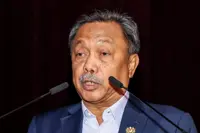
KOTA KINABALU: Deputy Chief Minister III Datuk Ewon Benedick was returned unopposed as the Upko president for a second term, as the party saw no contest for its senior posts at its just-concluded triennial 17th Upko delegates meeting on Monday (Aug 10).
The party's number two, Datuk Donald Peter Mojuntin, was also returned unopposed, along with five vice-presidents: Jairaiaz Joseph, Datuk Wong Thien Fook, Datuk Pangiran Lalung, Datuk Basari Sarikun and Datuk Dr Laurentius Nayan Ambu.
Meanwhile, several Upko wings saw leadership changes through the election process.
Carlye Lajimin was elected as the new Upko Youth chief, with Newbaxter Tibin as the deputy chief. Carlye, previously the deputy chief of Upko Youth central, replaces Felix Joseph Saang.
For the Upko Women’s Movement, Mohina Sidom retained her position as chief after successfully defending her post, while Lomiti Jahan was elected deputy chief.
The Upko Young Generation Movement also saw new leadership, with Emmanuel Atin elected as chief, replacing Seheral Linus. Alison Chan was elected deputy chief, replacing Russell Flavian.
Seheral and Russell stepped aside to allow the new leadership to take over the Young Generation Movement.
In his winding-up speech, Ewon said he respected the democratic process and the decisions made by delegates in the election.
He congratulated all elected leaders, describing the outcome as an effort to further strengthen the party.
“This election should strengthen our party, not weaken it. All our members are part of the big Upko family,” he said.
He said that Upko would continue improving its organisational structure, including the supreme council, bureaus, CLCs, and divisions nationwide.
“We are preparing the party not just for elections, but to continue our struggle and provide the best service to the country, the state of Sabah, and the people as a whole,” he said.
These leadership changes at the party’s wings provide opportunities for new leaders to bring their approaches and agendas in line with the needs of the party and the younger generation in Sabah, he said.