




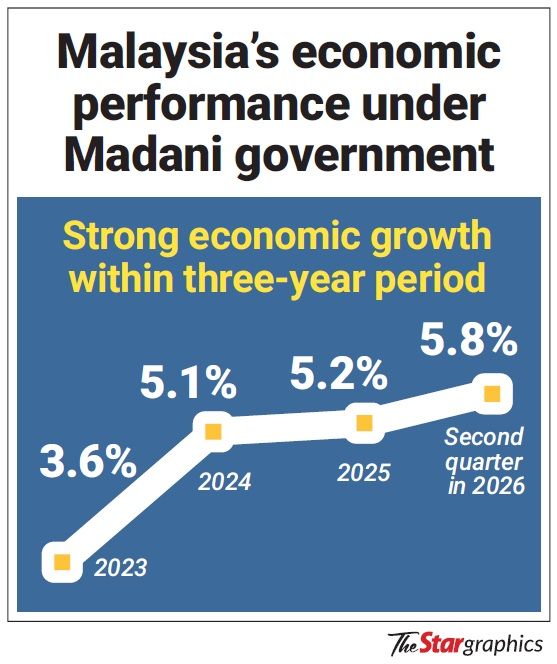
PETALING JAYA: Malaysia's economy remained on a steady growth path this year, expanding 5.4% year-on-year (y-o-y) in the first quarter of 2026 and 5.8% y-o-y in the second quarter.
The stronger-than-expected performance underscores the economy's resilience despite lingering global uncertainties, including geopolitical tensions and softer growth in several major economies, noted economists.
Household spending remained a key driver, supported by a healthy labour market and stable inflation, while private and public investments continued to underpin economic activity, they said.
Socio-Economic Research Centre executive director Lee Heng Guie said the growth so far has exceeded expectations.

“If you look at the economic growth trajectory, the first half of 2026 averaged 5.6%, exceeding expectations despite ongoing West Asian geopolitical tensions and volatile energy costs.
“This was primarily underpinned by buoyant exports on the AI-related demand,” he said.
Lee noted that sustained domestic demand, stable labour market conditions, and the implementation of catalytic blueprints like the New Industrial Master Plan, National Energy Transition Roadmap and National Semiconductor Strategy had underpinned the overall economy in recent years, including the first half of 2026, pushing full-year gross domestic product (GDP) estimates toward the upper end of Bank Negara Malaysia’s 4% to 5% target range.
Despite stellar headline GDP figures and export-led economic strength, Lee observed uneven growth in domestic sectors.
He also noted that higher costs of living, operating costs and the expanded Sales and Service Tax have begun applying pressure to small and medium enterprises and consumer spending.
"When we look at the lower arm of the economy like the domestic retail industry, restaurants, and accommodation, their performance is mixed.
"While major shopping malls remain crowded, checks on smaller retailers outside and near residential areas reveal a noticeable slowdown and lower foot traffic since late last year," Lee explained.
Looking ahead, economists expect Malaysia's growth momentum to remain intact through the rest of the year, although external risks such as trade uncertainties and geopolitical developments could weigh on exports.
Nevertheless, sustained domestic demand, ongoing infrastructure projects and investment inflows are expected to provide a firm foundation for economic expansion in 2026.
Economics professor at Sunway University Business School Dr Yeah Kim Leng said it is important to view the context regarding Malaysia’s second-half trend output growth.

“We not only navigated the post Covid-19 pandemic, but also the geopolitical crisis, US President Donald Trump’s tariff war, the energy crisis and the US-Iran war.
“The growth is higher than expected, and this is a testament to the resilience of the government in its policy direction,” he said.


