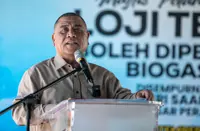
IPOH: The people must guard against the exploitation of religious sentiment for narrow political ends for the sake of integrity in Malaysia and the wider Muslim world, says Sultan Nazrin Muizzuddin Shah.
The Sultan of Perak said that true national integrity rests on every citizen, regardless of ethnicity or faith, who feel that they have an equal stake in their nation’s future.
"Where that sense of belonging is absent, no amount of security apparatus can substitute for it.
"At this point, the principle of 'Everyone Matters' comes back into focus, completing the picture we have been building," His Royal Highness said in his keynote address during the 8th World Conference on Islamic Thought and Civilisation here on Tuesday (July 21).
"National integrity is not maintained by uniformity or by silencing dissent, but by ensuring that every community, race, religion has a genuine stake in the nation's success and can see itself reflected fairly in its laws, economy, schools and leadership," he added.
His Royal Highness also said that investment in hygiene and sanitation infrastructure, clean water systems, proper waste management and accessible healthcare facilities, especially in underserved and rural areas, should never be treated as a lesser priority until more glamorous projects are complete.
The Perak Ruler urged cultivating a culture of hygiene from an early age through schools, community programmes, and examples set by families and local leaders.
"Public health is not the responsibility of ministries and hospitals alone, but a shared discipline, practised in homes, markets, mosques and community halls," he added.
The Sultan said that Malaysia’s experience in achieving near-total access to clean water and sanitation offers useful lessons in infrastructure investment, regulatory coordination, and public health messaging.
"Public health, moreover, must extend beyond infrastructure to public health governance itself.
"As the Covid-19 pandemic demonstrated with brutal clarity, the ability of governments to coordinate, communicate honestly with their populations and mobilise resources swiftly is itself a test of good governance, closing the circle between our sub-themes and reminding us that these issues cannot be addressed in isolation from one another," he said.
On education, Sultan Nazrin said that challenges of the coming decades, namely automation, climate change, and an economy increasingly built on knowledge and innovation would reward societies that have invested deeply and broadly in human capital, and will be unforgiving towards those that have not.
"As we progress into the age of artificial intelligence, our education systems face a further urgent challenge.
"Rote memorisation and standardised testing, which served an earlier industrial economy reasonably well, are poorly suited to a world in which information retrieval is instantaneous and nearly free.
"What the young need now is the capacity for critical thinking, ethical reasoning, creativity and adaptability precisely the human capacities that AI cannot replicate and precisely the capacities that a properly conceived Islamic education, rooted in both revealed knowledge and rational inquiry, has always sought to cultivate," His Royal Highness added.
The Sultan also said that social empowerment through education demands that society closes the gaps that persist.
"A government that proclaims equal opportunity while allowing vast disparities to persist between boys and girls in certain communities, between well-funded urban schools and neglected rural ones, has not yet fulfilled its obligation.
" 'Everyone Matters' is more than a slogan to be celebrated for a single day or a single conference.
"It is a standard against which every policy, every budget, every school, every hospital, and every law should be measured. Does it include, or does it exclude? Does it dignify, or does it diminish? Does it widen the circle of belonging, or narrow it?
"May we be granted the wisdom to build such a society, and the humility to remember, always, that everyone matters," Sultan Nazrin added.