
Early childhood education is undergoing a shift, driving a vital transformation in the traditional role of the preschool teacher.
As digital and AI-enabled tools increasingly support content delivery, the distinctly human dimensions of early childhood education including relationship, emotional regulation, inclusion and social-emotional development become even more important.
This changing landscape is creating demand for professionals who understand child development while also being able to design experiences, environments and systems around children.
This broader perspective underpins the Children Experience Economy (CEE), a lens developed by Sunway University's School of Education to examine how organisations create value through experiences that influence children's learning, well-being and development.

"CEE is not a new industry. It is a lens," says Sunway University School of Education dean Prof Malissa Maria Mahmud.
"It helps us see how value is increasingly being created through children's experiences rather than through products alone, and how those experiences are being designed, packaged and monetised across multiple domains."
The idea is rooted in the experience economy concept put forward by Pine and Gilmore in 1998, where economic value evolved beyond goods and services into intentionally staged, memorable experiences.
For children, however, an experience is more than a commercial offering; it is also a developmental environment that can shape identity, relationships, capabilities and a sense of belonging.
CEE therefore calls for developmental science and experience design to be integrated in ways that are inclusive, ethical and responsive to children's rights.
Rather than describing a single industry, CEE maps a broad ecosystem that spans education, child-friendly spaces, children's content and media, play and recreation, and products and services designed specifically for young minds.
This positions early childhood education beyond the narrow, conventional roles of the classroom. If childhood is being designed across services, products and spaces, then education must pay attention to how that design happens, who is doing it and what assumptions it carries about children's rights, dignity, agency and belonging.
Early childhood education sits at the centre of this ecosystem, changing what tomorrow's professionals need to know beyond lesson plans and classroom management.
From this perspective, educational value is found not only in what a child is taught, but also in how the child experiences agency, mastery, connection and growth.
Future early childhood education professionals' roles therefore do not stop at the classroom. They must grasp child development, family dynamics, environmental design, technology and inclusion as interconnected dimensions of children's lives.
The need for professionals equipped with such expertise is increasing, as they move not only into early childhood centres and inclusive education settings, but also into child development services, educational content creation, learning experience design and other child-focused organisations.
Inclusion is at the heart of this evolving landscape. As every child develops differently, the ability to recognise these differences early can make a meaningful difference to their learning journey.
ECE professionals will need the knowledge and skills to recognise varying developmental needs, adapt learning approaches and create environments where every child has the opportunity to participate and thrive.
The question for universities is no longer simply how we prepare teachers for the classroom. It is how we prepare professionals to shape the wider environments, technologies, services and experiences through which children learn and develop, Prof Malissa said.
Responding to this changing landscape, Sunway University, the top university in Malaysia for graduate employability for 2026 by Talentbank, offers two new pathways: the Diploma in Early Childhood Education and the Bachelor in Early Childhood Education with Special Needs (Honours).
The two-year diploma gives students a solid grounding in early childhood education, covering child development, play-based pedagogy, curriculum design and inclusive practices for children with special needs.
Students are also introduced to edupreneurship and to designing learning for diverse cultural contexts, preparing them to deliver impact in early childhood settings, anywhere in the world.
Those who seek a more specialised path should consider the Bachelor of Early Childhood Education with Special Needs (Honours) pathway, which combines early childhood pedagogy with a focus on inclusive and special-needs education.
Its curriculum introduces Universal Design for Learning, assistive technology and neurodiversity, preparing graduates to help create learning environments where inclusion goes beyond access to meaningful participation and belonging.
Sunway’s broader ecosystem exposes students to real-world, child-focused industries and interdisciplinary areas, connecting classroom learning to careers beyond it.
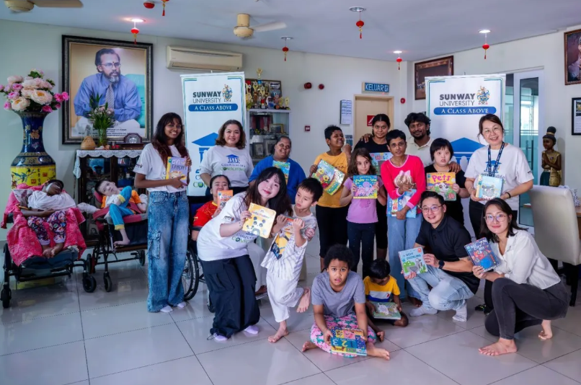
Graduates can pursue roles in education while exploring wider child-focused industries, from children's programmes and content to learning products, technology and experience design.
As the CEE continues to expand, so too does the value of graduates who understand it from the ground up.
“Before asking whether children will enjoy an experience, we should ask what it shapes, whose agency it enables, who might be excluded and whether children themselves have had voice in its design.
“That is the difference between an experience designed for children and one designed with responsibility to children,” said Prof Malissa.
Applications are now open for both programmes.
To learn more, visit Sunway University’s official website for more information. https://sunwayuniversity.edu.my/school-of-education