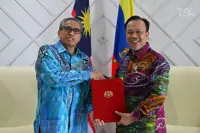
KOTA KINABALU: Sabah is inviting investors to establish win-win partnerships in the state, says Datuk Seri Hajiji Noor.
The Chief Minister said with the state economy transforming remarkably from an economy rooted primarily in the primary sectors into a multifaceted powerhouse, it was vital to attract investors that can produce developments with real results.
“Sabah looks forward to investors who can blend expertise, experience, and funding to advance inclusive, social and ecological development with real results,” he said at the Sabah Asia-Pacific Impact Investing for Sustainable Development Summit here on Monday (July 13).
His speech was delivered by Deputy Chief Minister II and Finance Minister Datuk Seri Panglima Masidi Manjun.
Hajiji said as Sabah aligns with Malaysia’s broader economic objectives, its commitment to growth remains unwavering.
“Sabah is open for business,” he said, adding that the summit was timely as it provided a forum for thought leaders to discuss impact investing as a key pillar of sustainable development.
“We recognise that impact investing, at its core, means deploying capital into investments that generate measurable social and environmental benefits alongside a financial return,” he added.
Hajiji said the summit marked an important step in Sabah’s journey to become one of the Asia-Pacific’s leading labs for sustainable development and impact investing.
Just two months ago, he said he had spoken at a Sustainability Summit here and explained that, long before sustainability became an international agenda, Sabah had already been protecting its forests, oceans, wildlife, and some of the richest ecosystems in this region.
“Today, we are proud that almost 30 per cent of Sabah’s landmass is under Totally Protected Areas,” said Hajiji.
He said Sabah also maintains its status as a net carbon sink (carbon-negative state) based on greenhouse gas inventory data, supported by the significant forested areas that strengthen the nation’s carbon-absorption capacity.
He said Sabah’s inclusive forest management approach, built with local communities, enables it to strike a balance between environmental conservation and the socio-economic wellbeing of its people.
At the same time, the Chief Minister emphasised that Sabah’s development needs remain real and urgent.
“We need better roads, more reliable electricity, cleaner water, and greater economic opportunity. Our people require tangible improvements in livelihoods. And we are clear: we cannot pursue growth that sacrifices the environment on which we depend in the longterm.
“The question before us is not sustainability or development. It is how we build and practise an unexplored model where sustainability becomes the engine of real economic growth,” said Hajiji.
He said the Asia-Pacific region is poised for remarkable growth, driven by dynamic economies, rapid urbanisation and expanding market potential, making it a magnet for investment opportunities.
“The world is looking to the Asia-Pacific not only for economic potential, but also for thought leadership in key sectors such as technology, green energy, and sustainable development,” Hajiji said.