
GEORGE TOWN: Beware of healthcare treatments offered in hotel rooms, private homes and beauty salons at prices far below market rates.
Also be wary of providers operating solely through social media without registered physical clinics.
These were among the key red flags highlighted by Association of Private Hospitals Malaysia president Datuk Dr Kuljit Singh (pic).
With demand for healthcare services, particularly aesthetic treatments, on the rise, he said patients, especially foreigners, should check providers carefully before booking appointments.
ALSO READ: Tighter checks urged on aesthetic industry
“Digital platforms have made it easier for unlicensed operators to market their services directly to consumers.
“There are unauthorised aesthetic and dental procedures, particularly veneers, teeth whitening and orthodontic treatments, offered outside registered dental clinics,” he said.
“These operators often target consumers through aggressive online marketing, attractive prices and promotional offers rather than established healthcare channels.”
It was earlier reported that Malaysia was ranked the world’s sixth-best medical tourism destination, with Penang remaining the country’s leading medical tourism hub, contributing about 45% of the industry’s nationwide revenue.
According to the Penang Centre of Medical Tourism, the state’s 16 participating private hospitals treated 527,176 foreign patients in 2025, a 25.9% increase from 418,608 in 2024.
Medical tourism revenue in Penang rose 26.6% year on year, from RM898.07mil in 2024 to RM1.14bil in 2025.
Dr Kuljit urged foreign patients to seek treatment from recognised healthcare providers, including Malaysia Healthcare Travel Council (MHTC) member hospitals, which operate within the country’s regulatory framework and have experience caring for international patients.
“Use MHTC membership as the first filter. Every member hospital is licensed and vetted to provide services for international patients.
“Check the practitioner registries for doctors and dentists, as well as the facility’s licence.
“Under the Private Healthcare Facilities and Services Act 1998, all healthcare services must be provided at registered or licensed premises,” he said.
Dr Kuljit said patients could ask to see the facility’s licence and the practitioner’s Annual Practising Certificate, which must be renewed annually and displayed at the clinic.
He said the Health Ministry had taken proactive enforcement action against unlicensed healthcare providers in recent years.
“Malaysia’s healthcare travel industry operates within a well-regulated ecosystem, and facilities serving international patients are subject to the same regulatory and licensing requirements as those serving local patients,” he said when contacted.
For aesthetic treatments, the public can check the National Registry of Registered Medical Practitioners Practising Aesthetic Medical Practice at https://www.moh.gov.my/en/public/national-registry-of-rmp-practising-aesthetic-medical-practice.
The registry contains spreadsheets listing general practitioners, specialists and surgeons registered to practise aesthetic medicine in Malaysia.
Penang health committee chairman Daniel Gooi said the Health Ministry monitored the sector through the Private Medical Practice Control Section, or CKAPS.
“They carry out periodic inspections, integrated operations and enforcement against premises and individuals providing healthcare services without proper registration or licences.
“When complaints are received about unregistered premises, the Health Ministry, through CKAPS, investigates and takes appropriate action,” he said.
Gooi said providing healthcare services without registration or a licence under the Private Healthcare Facilities and Services Act 1998 was an offence punishable by a fine of up to RM500,000, imprisonment of up to six years, or both.
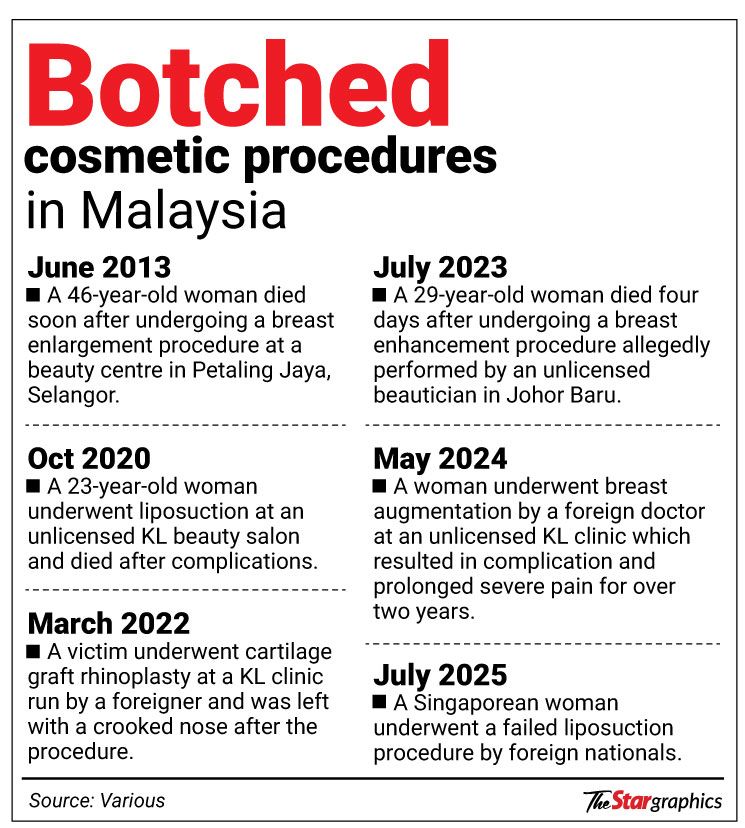
He said complaints had been received involving premises illegally offering aesthetic procedures and plastic surgery.
“The public is advised to seek treatment only from registered medical practitioners and licensed healthcare facilities,” he said.