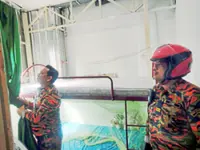
KUALA LUMPUR: Perched on rooftops, their homes are the size of mere storerooms – cramped spaces for which they pay a monthly rent of RM200 to RM400.
But these rooftops, crowning three- and four-storey buildings, have been illegally converted into a dangerous maze of rental units. Resembling “bird’s nests”, these fire traps are now at the centre of an intense crackdown by authorities under an operation codenamed Ops Sarang Burung.
So far, 27 of these rooms across three buildings here have been found packed with tenants, with each unit housing more than two occupants, according to the Fire and Rescue Department’s Fire Safety Division director Datuk Norazam Khamis.
Alarmingly, some occupants even use these tiny spaces for cooking, severely escalating the threat of a disaster, he noted.
“Rental rates depend on the room size, ranging from RM200 to RM400 a month,” Norazam said.
“These rooms are death traps because they are constructed using highly combustible materials such as plywood and timber.”
The units measure between six-by-four feet and 10-by-10 feet, and most occupants are believed to be foreigners, he told reporters following a recent enforcement sweep.
When contacted later, Norazam warned that the department will expand these integrated enforcement operations nationwide if similar high-risk illegal settlements are detected in other states.
“Our approach is proactive and based on strategic inter-agency cooperation to ensure compliance with fire safety regulations and to protect lives and property.”
He said illegal settlements on premises such as converted “bird’s nest” houses posed a serious fire hazard, as such buildings were not designed or approved for residential use.
“Many of the premises lacked adequate escape routes, emergency exits, fire alarm systems and emergency lighting, among other critical fire safety installations.
“Some of the buildings also did not have sufficient fire compartmentation. Such deficiencies could cause flames, heat and smoke to spread rapidly throughout the structure, reducing the time available for occupants to escape and increasing the risk of fatalities,” he added.
He also warned of unsafe electrical wiring in cramped interior spaces and flammable materials stored inside the rooms.
“These conditions also make search-and-rescue and firefighting operations more difficult for our personnel, thereby increasing the risk to both occupants and firefighters,” he said.
Norazam urged the public not to use commercial premises that had been converted for residential purposes without approval from the authorities, as these buildings might not be equipped with the necessary features for housing.
He also reminded building owners to ensure that their premises were used only for purposes approved by the authorities and that all fire safety requirements under the Uniform Building By-Laws 1984 and the Fire Services Act were fully complied with.
“Any change in the designated use of a building must first be approved by the relevant authorities with support from the department,” he said.
During the operation on June 30, Norazam said the inspection found that access to the upper floors was monitored by closed-circuit television (CCTV) cameras while stairways were dimly lit and secured with locked metal grilles that restricted access.
Norazam said each premises was believed to have a caretaker responsible for managing the accommodation.
“These structures were built without approval, particularly from the Kuala Lumpur City Hall. We found the rooftop structures to be unsuitable for occupation,” he said.
He said the department had been conducting inspections to identify such buildings in Selangor, Kuala Lumpur, Penang and Johor, assessing their fire safety risks under “Ops Sarang Burung”.