
PETALING JAYA: The United Nations Economic Commission for Europe’s (UNECE) World Forum for Harmonisation of Vehicle Regulations adopted the first global regulatory framework for fully autonomous driving systems (ADS) on June 24, marking a major step towards the safe deployment of self-driving vehicles.
According to UN News, the vehicle standards forum’s approval establishes common safety requirements and a shared method for validating vehicles equipped with ADS.
The framework aims to strengthen trust among governments, industry and the public by ensuring that automated systems meet rigorous, outcome-focused safety standards.
“By preventing fragmented national approaches, the regulation offers clarity for manufacturers, confidence for consumers and a pathway to scale innovation safely across markets,” the UNECE said.
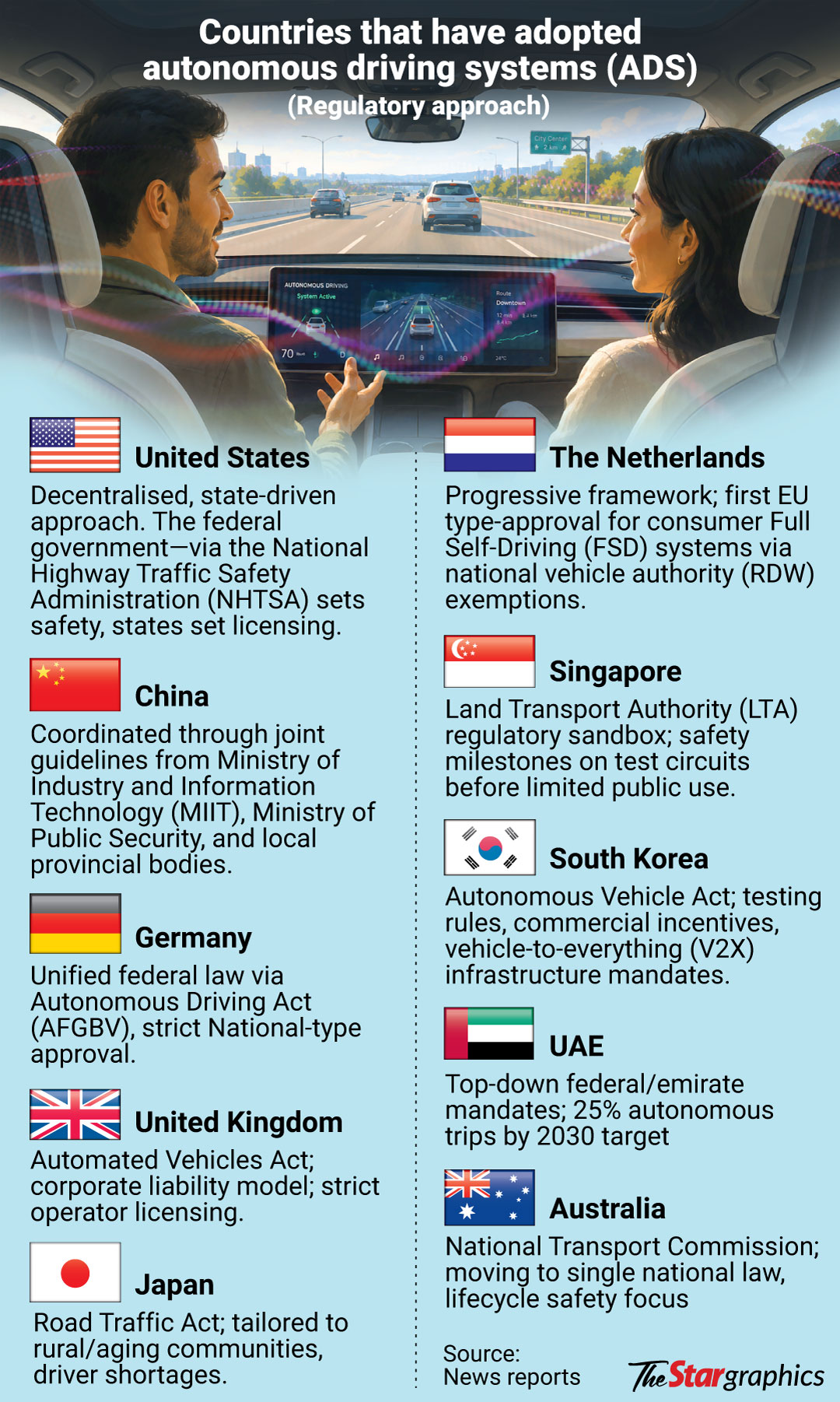
The regulation has drawn support from major auto markets, including Canada, China, European Union, Japan, the United Kingdom and the United States, and is expected to enter into force in roughly a month.
Under the new rules, manufacturers must implement audited safety management systems covering the full life cycle of an automated driving system.
These systems will govern design, testing, deployment and ongoing operation, ensuring that safety is managed continuously rather than as a one-time approval.
They must also ensure test environments, including virtual testing tools, meet strict credibility criteria and demonstrate that their ADS pose no unreasonable risk.
Simulation models, digital toolchains and track testing will be assessed to confirm that they accurately reflect real-world conditions and can reliably predict system behaviour.
Continuous performance monitoring and reporting will be required so that the real-world performance of automated vehicles can be assessed after deployment.
This includes tracking how the system handles normal and unusual situations, logging incidents and providing regular updates to regulators.
Vehicles must also be equipped with a data storage system for automated driving, ensuring that safety-relevant data is recorded and available for oversight, the UNECE said.
Such data will help authorities investigate incidents, evaluate system performance and verify compliance with safety standards.
The regulation requires autonomous driving performance to match or exceed that of a competent human driver across the situations in which the system is designed to operate.
Because the ADS will handle all driving tasks, including steering, accelerating, decelerating and signalling, manufacturers must demonstrate robust design, validation and compliance with traffic rules through simulation, track testing and real-world trials, the new rules state.
These trials must cover a wide range of scenarios, from highways to complex urban environments.
Alongside the new regulatory framework, the UN forum also adopted amendments to roughly 90 existing UN vehicle regulations.
These amendments introduce clarifications that ensure current vehicle rules remain applicable to vehicles equipped with ADS, including those without traditional driver controls such as steering wheels or pedals.
“This approach will ensure continuity of the regulatory framework while enabling innovative vehicle designs, including fully driverless configurations,” the UNECE said.
The adoption of a global ADS framework is expected to help countries, including those in Asia, develop national rules that align with international standards to possibly facilitate the future introduction of automated mobility services while maintaining high safety expectations for road users.