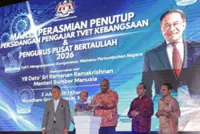
KUALA LUMPUR: The Human Resources Ministry intends to convert the financing of the Skills Development Fund Corporation (PTPK) into grants, instead of loans as it is currently.
Its minister, Datuk Seri R. Ramanan, said the proposal will be brought to Cabinet for consideration.
"We will seek the consideration of the Honourable Prime Minister and Cabinet members to convert this RM100mil PTPK loan into a grant, if possible.
"Because there are PTPK borrowers who are following the Technical and Vocational Education and Training (TVET) programme, they have to give up their jobs. When they are not working, their income is affected, and if at the same time they need to pay fees through loans, it somewhat burdens them," he told the media after officiating the National TVET Instructors and 2026 Accredited Centre Managers Conference here Thursday (July 2).
Earlier in his speech, Ramanan said that the conference was not just an ordinary gathering but a manifestation of the national policy commitment, a clear signal that TVET is now a key pillar in the Malaysia Madani human capital development strategy.
"TVET is a game changer in ensuring there is no skills mismatch, driving the country towards becoming a Regional Innovation Hub and subsequently attracting high-value investments.
"Therefore, our target is clear, which is to achieve a Gross National Income per capita of around RM77,200 per year," he said.
At that conference, Ramanan also launched the Internationalisation Action Plan for the Skills Development Department for the years 2026 to 2030.
According to him, the plan is driven by six strategic pillars that focus on global recognition, upgrading the Centre for Instructor and Advanced Skill Training (CIAST) to a world-class institution, promoting international innovation, and excellence in TVET programmes supported by governance based on Sustainable Development Goals (SDG), Environment, Social and Governance (ESG), and Diversity, Equity and Inclusion (DEI).
"The critical focus of this plan is to ensure the mapping of the National Occupational Skills Standards (NOSS) with international standards, making the Malaysian Skills Certificate (SKM) recognised by foreign professional bodies with Global Excellence status," he added. - Bernama