
PETALING JAYA: Malaysia may face an increased risk of transboundary haze in the coming months due to the south-west monsoon and the expected strengthening of the El Nino weather cycle, warn climate experts.
Universiti Kebangsaan Malaysia climatologist Emeritus Prof Dr Fredolin Tangang said the El Nino cycle could heighten the risk of transboundary haze regionally.
“Transboundary haze usually occurs July to September during the south-west monsoon as the wind blows from the south.
“Should large‑scale fires occur, smoke and haze may be transported by south-westerly winds towards Peninsular Malaysia, Sarawak, Brunei and Singapore, significantly affecting air quality and public health,” he said.
This year’s dry and hazy period, however, will be exacerbated by the El Nino cycle.
Meteorological agencies around the world have confirmed that ocean temperatures and atmospheric indicators have crossed El Nino thresholds, and accordingly, less rainfall is expected in this region.
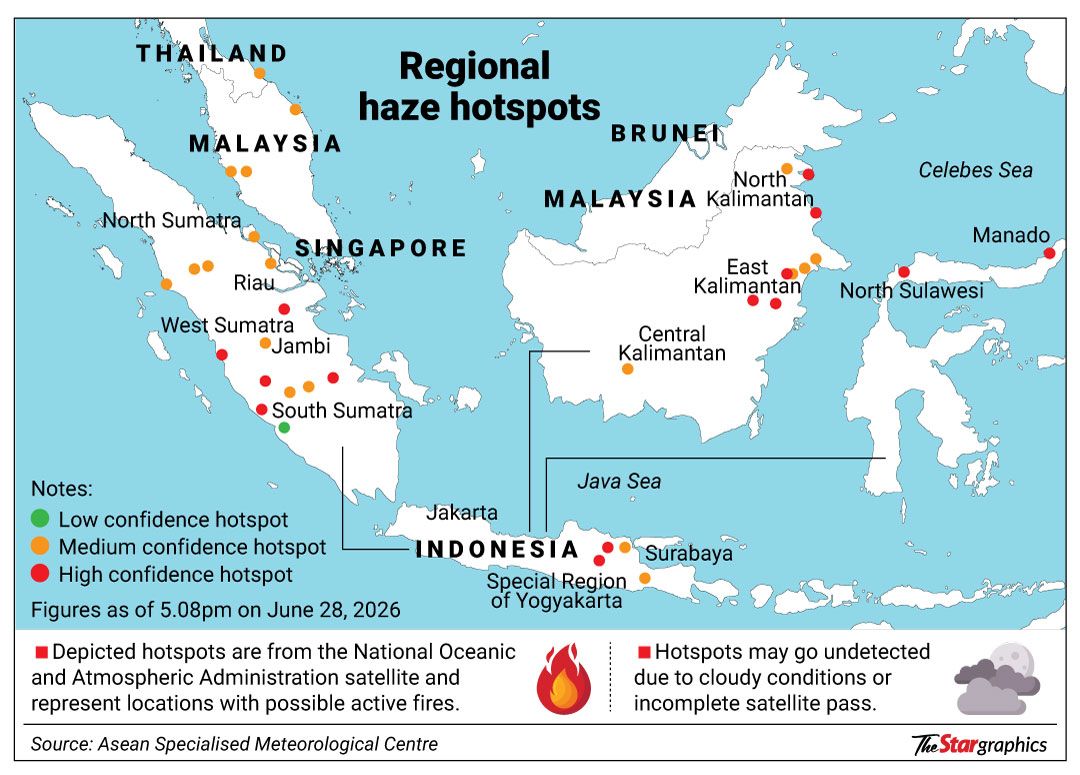
According to a National Disaster Management Agency (Nadma) press release, the El Nino cycle, currently still in a weak phase, has already begun influencing Malay-sia’s weather, coinciding with the ongoing south-west monsoon.
Emeritus Prof Tangan said that the risk of local haze episodes caused by forest fires could persist beyond Malaysia’s normal dry spell as the El Nino cycle is expected to peak later this year and continue until next year.
According to him, 2023 and 2024 ranked among the warmest years in modern history, partly due to the influence of the then El Nino, which was categorised as strong.
University Malaya meteorologist Emeritus Prof Datuk Dr Azizan Abu Samah said that while Malaysia is currently experiencing a weak El Nino phase, it still raises the potential for a drier south-west monsoon and haze risk.
“South-westerly winds during this period can carry smoke from Sumatra and Kalimantan into Peninsular Malaysia and Sarawak.
“The open burning season for Indonesia is from July to September. So there is a need to monitor the number of hot spots in Sumatera and Kalimantan that may cause this.
“If the number starts to show a trend increase then we should brace for transboundary haze,” said Emeritus Prof Azizan.
Sabah, he said, may be spared the full impact of possible transboundary haze as it sits outside the main wind paths.
He added that during the year-end north-east monsoon, winds tend to shift to easterlies or north‑ easterlies, pushing transboundary haze more towards the Indian Ocean and away from Malaysia.
Water quality and modelling specialist Dr Zaki Zainudin pointed out that haze particles do not just stay in the air.
“When it rains, the particles are pulled down into rivers and lakes, impacting water quality.
“These particles are washed onto the land surface and can then be transported by stormwater runoff into streams and rivers, introducing contaminants,” he said.
He added that rainwater can become more acidic during these periods.
“Depending on the source of the haze, the deposited particles may also carry trace metals, black carbon and organic compounds.
“These substances can affect water quality by increasing the water’s cloudiness, contributing nutrients that may stimulate algal growth and introducing contaminants that may accumulate in sediments,” he said.