
PETALING JAYA: The country’s low unemployment rate masks a persistent challenge in the labour market, with youth unemployment remaining elevated even as bosses report difficulty filling vacancies.
Just over a week ago, more than 1,000 job seekers turned up for semiconductor manufacturer Infineon Technologies’ recruitment drive in Melaka to fill up 500 vacancies.
The walk-in interviews by the leading German tech firm, resulted in queues stretching several km, with a starting salary of RM3,500 reportedly offered for operators and technicians.
ALSO READ: Employers say labour mismatch must be addressed
Universiti Teknologi Mara (UiTM) senior lecturer in economics and financial studies Dr Mohamad Idham Md Razak said the present labour market pointed to a “structural imbalance” rather than a lack of opportunities.
“The massive queue at Infineon underscores that Malaysia’s core challenge is not a pure shortage of jobs or workers, but a profound market mismatch centred on job quality and compensation,” he said in an interview.
He noted that even in low-unemployment states such as Melaka, strong turnout for specific employers suggested that many workers were either underemployed or actively searching for better pay and working conditions.
ALSO READ: Tough to find work that meets expectations
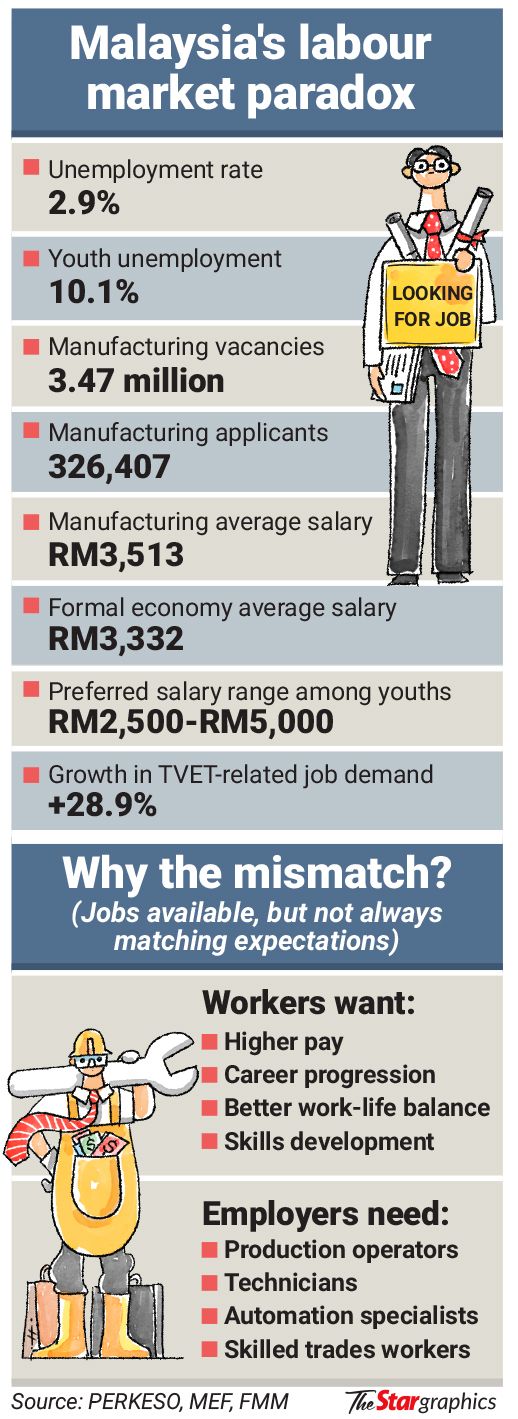
According to the Statistics Department, the country’s unemployment rate stood at 2.9% in the first quarter of the year, with youth unemployment among those aged between 15 and 24 significantly higher at 10.1%.
The Social Security Organisation (PERKESO), which operates the MYFutureJobs platform, revealed that the manufacturing sector recorded 3.47 million vacancies against 326,407 applicants, resulting in a gap of more than three million positions.
The mismatch was particularly evident among young job seekers, whose applications were concentrated in professional, information and communications technology, finance and business-related fields despite substantial vacancies in sectors such as manufacturing, construction, hospitality and food services.
PERKESO also found that vacancies offering competitive entry-level salaries, mainly in the RM2,500 to RM5,000 range, consistently attracted stronger application volumes, especially among diploma and degree holders.
Mohamad Idham said the primary friction was an expectation mismatch, where workers were willing to supply labour but only when wages, career progression and stability met their threshold.
He said factors such as wages, working conditions and location played a significant role alongside skills shortages.
“While some firms are able to draw large crowds by offering starting salaries of around RM3,500, many other vacancies still struggle to attract applicants due to lower pay, shift work and physically demanding roles,” he said.
Malaysian Employers Federation (MEF) president Datuk Dr Syed Hussain Syed Husman said the challenge was not merely the availability of jobs, but whether available jobs matched the skills, aspirations and expectations of young jobseekers.
Mohamad Idham said youth unemployment remained relatively high because many graduates faced a “skills and experience paradox”, where academic qualifications did not align with the technical requirements of modern industries.
He said stronger alignment between education and industry, expanded Technical and Vocational Education and Training (TVET) and clearer career pathways were needed to improve labour market matching.
“Without addressing job quality, skills alignment and career pathways, both youth unemployment and labour shortages will continue to coexist,” he said.