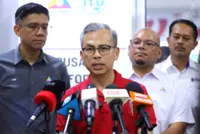
PUTRAJAYA: The government is looking to expand its medicine delivery programme nationwide, with patients no longer required to bear postal delivery costs, says Communications Minister Datuk Fahmi Fadzil.
He said the Communications Ministry and Health Ministry are finalising arrangements to strengthen the “Ubat Melalui Pos” (UMP) programme, which delivers medicines to eligible patients under the Health Ministry care.
“We have seen a model that can be supported and, in the not-too-distant future, I believe we can manage the delivery of medicines to all Malaysians who require it under KKM,” he said at the signing ceremony of a memorandum of understanding between the Health Ministry and Malaysian Communications and Multimedia Commission (MCMC) for the Persada initiative yesterday.
Health Minister Datuk Seri Dr Dzulkefly Ahmad was also present.
Fahmi said he had been informed that about 80,000 patients use the service each month.
The programme will be fully funded by MCMC and the Health Ministry, meaning patients will no longer have to pay for medicine deliveries.
“The service will be managed and borne entirely by MCMC and KKM, so patients will no longer need to pay.
“We will discuss and align several matters to make the delivery process easier.”
According to Fahmi, the initiative will be financed through Federal Government allocations, with annual costs estimated at RM5.69mil.
He said the government hopes to begin implementation as early as July across all states.
“We hope to begin in every state so that the cost does not have to be borne by any party, especially the patients. It will be fully covered by the government.”
Fahmi said the programme serves patients across various disease categories and income groups, with eligibility determined solely by the Health Ministry.
“We are not involved in selecting the patients. That is completely under the Health Ministry.
“However, since the service is provided through Pos Malaysia, which is a licensee under MCMC, we will manage the programme,” he said.
Meanwhile, Fahmi said the government plans to expand the role of National Information Dissemination Centres (Nadi) nationwide, including the introduction of telemedicine services and AI-powered health screening tools to improve healthcare access in underserved areas.
He said residents would be able to undergo preliminary health assessments closer to home, adding that several parties working with the MCMC had introduced AI-enabled devices capable of analysing retinal scans and providing basic assessments of an individual’s overall health.
On the National Digital Health Ecosystem and Connectivity Catalyst (Persada) initiative, Dzulkefly said the programme had recorded more than 4.21 million registered users and over 22.41 million digital transactions as of April 2026, averaging 75,000 transactions daily.
Later, during a press conference, Dzulkefly said outstanding treatment bills owed by foreign patients at government healthcare facilities had continued to decline over the past three years.
The issue has drawn public attention over the cost of treating foreign nationals, including Rohingya refugees.
Dzulkefly said outstanding foreign patient treatment bills stood at RM30.57mil in 2025, down from RM33.46mil in 2024 and RM34.97mil in 2023, reflecting a downward trend despite claims that the government incurs losses of RM30mil annually.