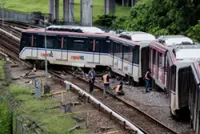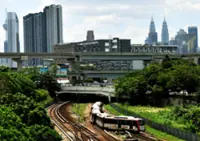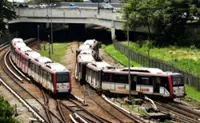
KUALA LUMPUR: The LRT train derailment near Chan Sow Lin Station calls for enhanced system engineering practices, says an association for technological sciences.
The Technological Association Malaysia (TAM) said the LRT train derailment that occurred near the Chan Sow Lin station on the Ampang/Sri Petaling line has raised concern over public safety.
"We are relieved that all 25 passengers were evacuated safely and no injuries were reported but an incident of this magnitude on a critical urban transit network highlights significant technical and operational vulnerabilities.
"We welcome Transport Minister Anthony Loke’s proactive measure in establishing a special task force to investigate the incident and directing the Land Public Transport Agency (Apad) to initiate an immediate probe.
"As an advocate for engineering and technological excellence, we urge the investigating task force and the operator, Prasarana Malaysia Bhd, to focus on a rigorous, technology-driven root cause analysis (RCA) to prevent any future recurrence," it said in a statement on Friday (May 29).
It said that from an engineering perspective, train derailments in automated transit systems typically point to isolated or cascading failures in three primary domains.
"This being the 'track geometry and switching mechanisms' where investigations must examine track alignment, gauge uniformity and the mechanical reliability of track switches (turnouts and points).
"Fatigue failures in switch rails, degraded fasteners or inadequate lubrication in the switching mechanisms can severely compromise wheel-rail interaction, forcing the wheel flanges to climb the rail.
"It could also be the 'rolling stock bogie integrity' where the structural health of the train’s bogies, including wheel tread profiles requires immediate auditing.
"Uneven wheel wear or suspension asymmetry can disrupt dynamic weight distribution during track transitions, increasing the risk of derailment," it said.
The other issue could have been 'signalling and automated train control (ATC)', as while derailments are largely mechanical, the role of the ATC system must be reviewed to ensure the train was entering the track section or switch point at the designated, safe velocity profile.
"We urge public transport operators to pivot from conventional preventive maintenance to predictive maintenance (PdM) frameworks.
"This is a proactive maintenance strategy that uses data analysis tools and techniques to detect anomalies in equipment operation and possible defects so they can be fixed before they result in failure.
"Safety and reliability in public transit are built upon the foundational principles of RAMS (reliability, availability, maintainability and safety) engineering.
"There is no room for compromise in public safety, and accountability must be tied directly to adherence to these strict engineering standards," it added.
The association also offered its technical expertise to the Transport Ministry and the special task force to assist in structural, mechanical and systems audits.
"We must collectively ensure that the public's confidence in our national rail network is fully restored through transparency and robust engineering practices," it said.
In the early hours of Thursday (May 28), a train on the Ampang/Sri Petaling Line derailed while passing through a track switch area at Chan Sow Lin Station.
The incident affected the service schedule on the line.