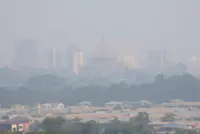
KUALA LUMPUR: The number of hotspots in Kalimantan has risen by 254 to 520 and those in Sumatra increased by 12 to 176, according to the Asean Specialised Meteorological Centre (ASMC).
Environment Department deputy director-general (development) Azuri Azizah Saedon said clusters of hotspots in West Kalimantan are generating moderate-to-dense transboundary haze drifting north towards western Sarawak.
According to her, the situation has affected air quality in several parts of the country, with unhealthy Air Pollutant Index (API) readings recorded in 10 areas across Selangor, Kuala Lumpur, Putrajaya, Negeri Sembilan, Kedah and Sarawak as of 7pm on Thursday (Aug 27).
Sri Aman and Serian in Sarawak recorded the highest API readings at 157, followed by Cheras at 156 and Johan Setia in Selangor at 153.
Other areas with unhealthy API readings were Nilai, Negeri Sembilan (138); Putrajaya and Shah Alam in Selangor (127 each); Batu Muda, Kuala Lumpur (114); Seremban in Negeri Sembilan (110); and Sungai Petani, Kedah (106).
Azuri Azizah said three hotspots had also been detected in Malaysia, one each in Terengganu, Johor and Sarawak, based on satellite imagery from the National Oceanic and Atmospheric Administration (NOAA)-20 analysed by the ASMC.
She said the ASMC's Regional Haze Map also showed dry conditions across much of southern Asean, with isolated to scattered hotspots detected in the region.
In response, she said the DOE has stepped up enforcement and daily patrols in areas at risk of open burning, as well as regular monitoring of API readings.
Azuri Azizah said the National Open Burning Action Plan and National Haze Action Plan have also been activated to coordinate government agencies' response to open burning and haze.
"This includes preparations by the National Disaster Management Agency (Nadma) to activate the Disaster Management Committee if API readings remain above 150 for more than 24 hours, as well as measures such as suspending outdoor activities, closing schools, kindergartens and childcare centres and conducting cloud seeding operations," she added.
Members of the public can check the latest API readings on the DOE's website or through the MyJAS EQMS app. – Bernama