



PETALING JAYA: Zulkifli Abd Rahman had heard the talk on the grapevine when he came into office in the morning – a plane was supposedly missing.
In the newsroom, he asked around and the colleagues from The Star Online informed him that there had been reports that the said aircraft had landed safely in China after experiencing technical problems.
“That’s good, I thought, as I began the day’s work,” said The Star’s Senior News Editor.
But Zulkifli, who was manning the newsdesk that day, was not prepared for the shock that followed on that fateful March morning.
Malaysia Airlines Flight MH370 from Kuala Lumpur to Beijing on the night of March 8, 2014 had indeed disappeared from the face of the earth, with all 239 people on board.
Twelve years on, it remains one of the greatest aviation mysteries of all time.
Even now, yet another underwater search has been mounted in the southern Indian Ocean, bringing back memories of the frantic days in the newsroom with sleepless nights and unanswered questions.
“The night before, I heard reports about the KL-Beijing flight which was believed to have gone missing from radar screens. In the morning, I did not think much of it,” said Zulkifli.
It was much later in the day that realisation and panic sank in. There was confusion all round as international news networks and social media platforms continued flashing reports about the missing MAS flight, and bewildered relatives of passengers demanding answers in Beijing.
“By noon, we still had no answers. Had the aircraft crashed? Was it on land or at sea? Were there survivors? Or had it landed somewhere else entirely?”
Reporters were assigned to contact MAS officials, aviation experts and government authorities, while others rushed to Kuala Lumpur International Airport (KLIA) to gather information from airline personnel and distraught family members waiting for answers.
“At first, it was feared it had crashed into the sea near Vietnam. Later in the day, shocking information trickled in. The plane may have turned around and headed towards Indonesia and then further south,” said Zulkifili.
At the office, it was a mad scramble. How do you report something when nothing is known?
“As the authorities started setting up command centres and preparing press conferences, senior editors all came back into the office to oversee coverage,” he said.
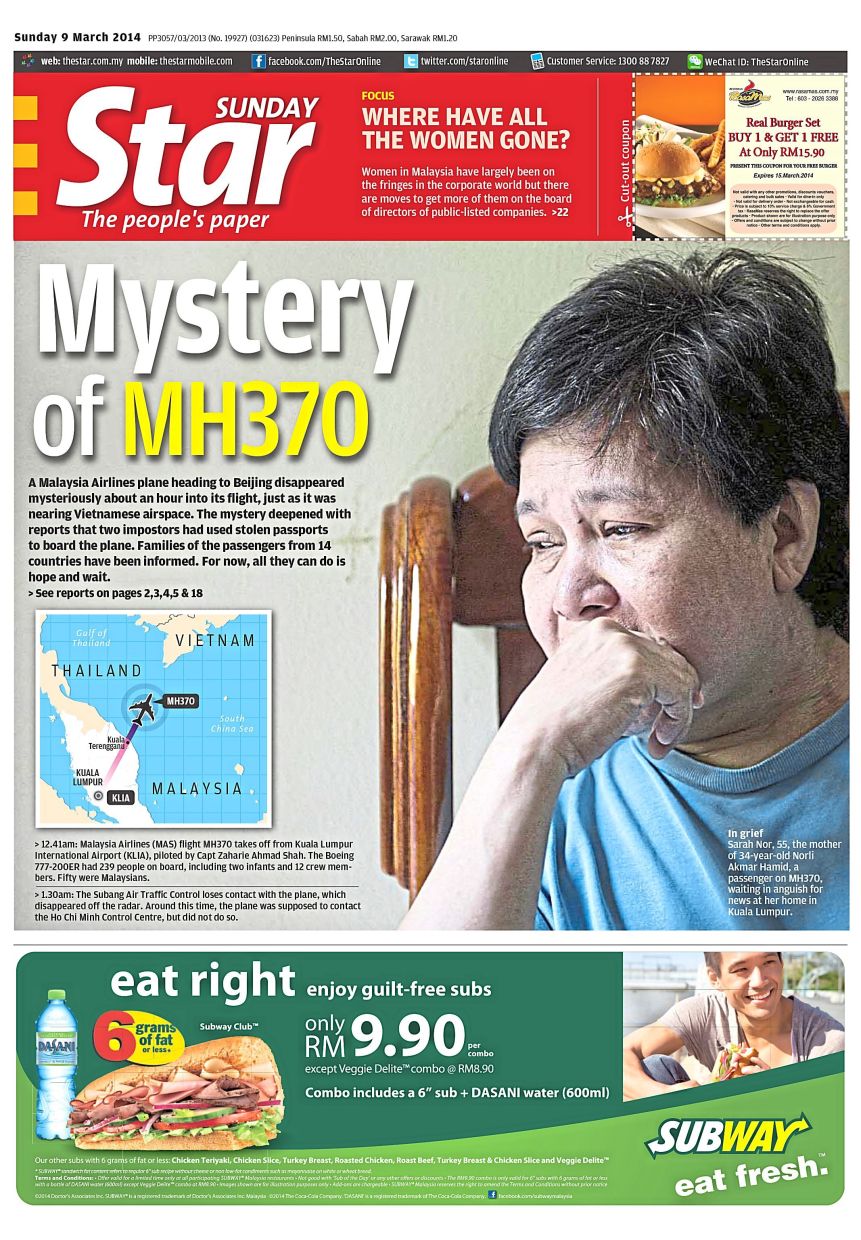
The following day, the Sunday Star carried the headline “Mystery of MH370”.
Zuhrin Azam Ahmad, then The Star’s Putrajaya bureau chief remembers the chaos at the Kuala Lumpur International Airport (KLIA) on March 9.
“When I arrived, all seemed normal, but as the day unfolded, more and more family members began gathering, waiting for any news of their loved ones on the flight.
“Journalists from many countries made KLIA, specifically Sama-Sama Hotel, their temporary home for months. They represented hundreds of news outlets,” he said.
He described the atmosphere among local and international media personnel gathered at KLIA, hotels and press centres as relentless and chaotic.
“There was a battalion of reporters. Journalists pursued officials through hotel lobbies, coffee houses and corridors, often turning brief encounters into impromptu press conferences.
“We even followed them to their cars. Never had there been such a huge presence of foreign newsmen in Malaysia,” he recalled.
Competition among media organisations was intense as reporters raced to secure updates ahead of rival news outlets. Tensions also flared among journalists trying to keep pace with competing reports, as the officials had little to offer.
“The conversation was always about who had the story first and why others did not,” he said.
The round-the-clock coverage also introduced many journalists to unfamiliar aviation and satellite communication terminology, including ATC (Air Traffic Control), Inmarsat, ACARS (Aircraft Communications Addressing and Reporting System.), waypoint IGARI (specific aviation location) and satellite “handshakes”.
“Some updates came in at 3am,” he said, adding that uninterrupted sleep became a luxury.
Many learnt all about Diego Garcia, an atoll used by the United States as an airbase, with the plane said to have landed there and the passengers held hostage.
There were also wild rumours about the plane being found, about bodies floating in the Malacca Strait, and of supposed press conferences to announce such findings.
“Journalists not only had to chase actual stories but also overcome wild rumours floting around, especially on social media,” said Zuhrin.
For many journalists who covered the tragedy, the disappearance of MH370 remains one of the most emotionally draining and professionally challenging assignments of their lives.
For the first two weeks, there was always hope. The plane would be found, there would be survivors, the rescuers believed.
However, two weeks later, everyone was finally resigned to the fact that the plane was gone and the passengers were probably lost forever.
Then Malaysian prime minister Datuk Seri Najib Razak mouthed the sombre words on March 24: “The aircraft likely ended in the southern Indian Ocean.”
On March 25, The Star produced another iconic cover, with the names of all the people on board the plane in the shape of the words MH370.
A huge search operation was carried out from just after the plane’s disappearance until May the following year. Several other searches were also conducted over the years in the southern Indian Ocean.
The latest search operation for the missing aircraft, conducted by marine robotics company Ocean Infinity, scanned more than 7,500 sq km of seabed in the southern Indian Ocean in two phases between March 2025 and January 2026. Again, it failed to locate the wreckage.
A total of 28 operational search days were completed across both phases, covering approximately 7,571 sq km of seabed within the designated search area.
But to this day, that Sunday Star headline remains relevant: The “Mystery of MH370” remains just that.

