
PETALING JAYA: The high-tech and digital sectors continue to see robust hiring despite a cautious economic outlook and the recent increase in job losses, say human resources experts.
The figures, they said, are not a reflection of a weak job market but instead reveal a growing need for skilled workers as the nation moves away from traditional sectors.
CnetG Asia and Kestria managing partner Raj Kumar Paramanathan said traditional sectors such as manufacturing and retail are seeing layoffs, while technology-driven industries continue to hire actively.
“Companies in AI, data analytics and digital infrastructure are facing a real shortage of talent,” he said yesterday.
He noted that some employers are struggling to fill roles in data science, AI development, cybersecurity and digital marketing due to the limited availability of specialised talent.
“Many job seekers have traditional qualifications but do not have the technical skills employers want most now.”
He added that companies are now placing greater emphasis on practical experience, adaptability and problem-solving skills.
“Companies now care more about practical experience and the ability to adapt to new challenges,” he said.
It was recently reported that 7,057 workers lost their jobs in April, up from 5,855 in March, though still below January’s 10,658.
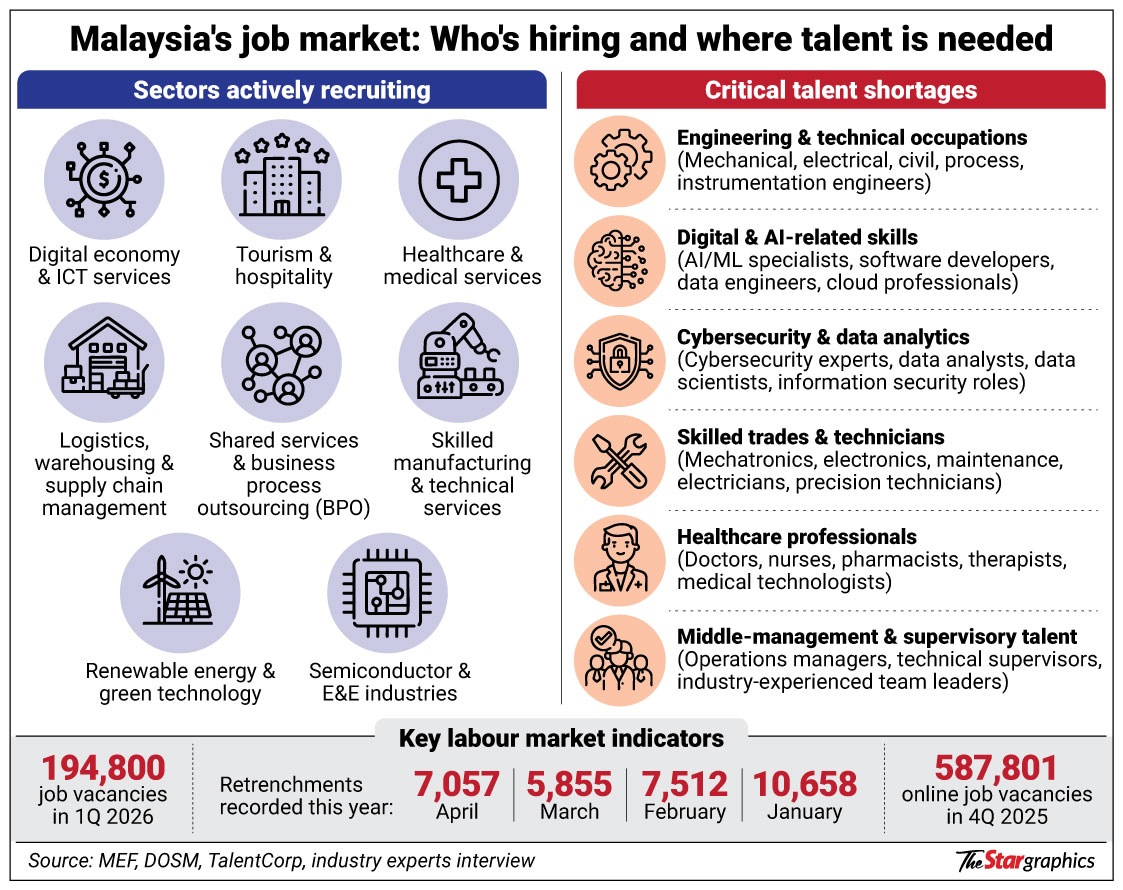
In its latest report, the Social Security Organisation said manufacturing remains the hardest-hit sector, accounting for more than a quarter of total job losses in April, followed by wholesale and retail trade as well as vehicle repair services.
Meanwhile, Meca Employers Consulting Agency chief executive officer Dharmen Sivalingam said investments in data centres, AI and semiconductors are already creating hiring demand.
He noted that this demand is centred on supporting ecosystems and specialised technical roles.
Dharmen added that digital capabilities are increasingly becoming necessary even outside traditional technology jobs.
“The market is moving toward tech-enabled roles, not only pure tech jobs.”
Dharmen said workers in areas such as sales, finance, marketing, operations and administration are increasingly expected to use AI tools.
He advised workers and graduates to build practical digital capabilities early while gaining hands-on exposure through internships and project work.
Tunku Abdul Rahman University of Management and Technology economist Prof Dr Foo Lee Peng said the latest job loss figures should be viewed with moderation.
“What Malaysia appears to be facing is not simply broad weakness but a sectoral mismatch.
“Some firms are reducing headcount due to cost pressures, automation, supply-chain disruptions or softer demand,” she said.