

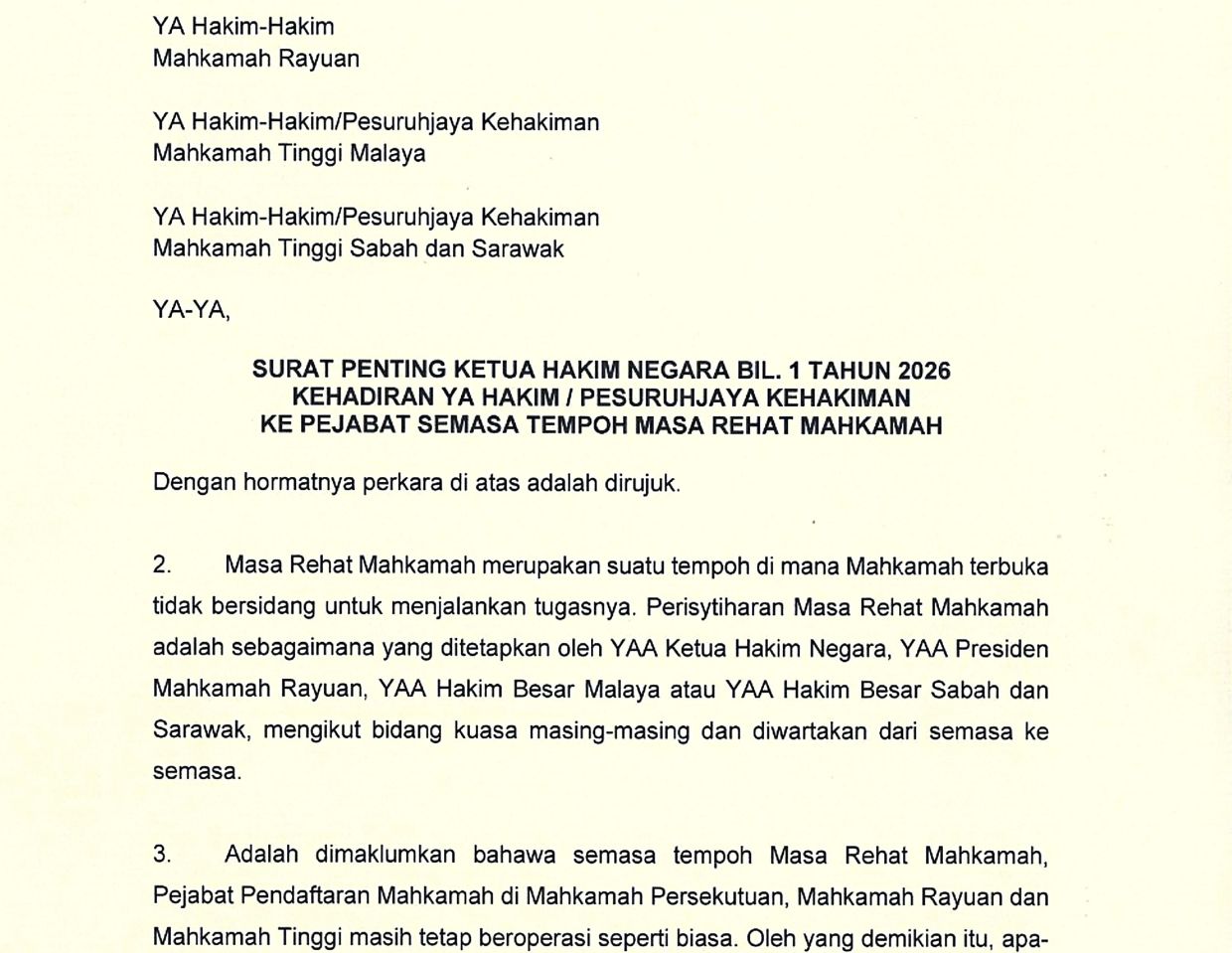
In the circular issued on Thursday, the Chief Justice stressed that court recess is not a form of leave but a period during which judicial responsibilities continue even when court sessions are paused.
Registry offices at the Federal Court, Court of Appeal and High Courts will continue to operate as usual, with urgent proceedings to be handled by designated duty judges during the recess period between June 1 and June 12.
ALSO READ : Lawyers welcome work-during-court-vacation directive
In Malaysia, a court vacation is a scheduled break in the court calendar when regular hearings and trials are largely paused, but the courts are not actually closed.
The vacation, usually around May to June and November to December, is to give judges time to write judgments, do research and clear backlogs.
All judges and judicial commissioners are required to attend to their regular duties during this period unless officially on approved leave.
The directive, which takes effect immediately, emphasised the need for judges to use the break to write grounds of judgment, conduct research and ensure cases are handled efficiently.
The Malaysian Bar, in a circular to its members on April 21, said that it has been informed by the Office of the Chief Justice about the upcoming vacation and that Federal Court judges Datuk Lee Swee Seng and Datuk Collin Lawrence Sequerah have been appointed to hear urgent applications during the vacation period.
A highly placed source in the judiciary said that the circular was “an internal memo meant for judges to be in court during court vacation”.
“They have to continue working, including doing their research and planning for upcoming trials or hearings,” said the source.
The move is in line with the policy set by Wan Ahmad Farid in January this year during his inaugural speech at the opening of the Legal Year 2026, in which he warned fellow judges against delays in delivering written judgments. He had also said that judges should step down if they fail to do so.
“Writing judgments is part and parcel of a judge’s craft.
“Our duty to give reasons for our decisions ensures that parties, especially those who are dissatisfied with the outcome, are able to understand why they won or lost their case.
“Where appropriate, they can exercise their right of appeal,” he was quoted as saying in the speech.
Wan Ahmad Farid acknowledged the frustration of litigants who may wish to file an appeal, only to discover that the written judgments were not ready within the stipulated eight-week timeframe.
Despite his strong words, he gave his assurance that the judiciary would be assisting judges struggling to write their decisions instead of penalising them.
“Having said that, I am aware of the increasing number of the unwritten grounds of judgment at the High Courts,” said Wan Ahmad Farid, adding that apart from dispensing justice without fear or favour, a judge must also do it without undue delay.
“A judge who carries a backlog of 10 or more outstanding grounds of judgment is carrying a heavy burden, not just for the system, but on their own conscience.
“You know who you are,” he added in his speech.