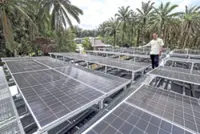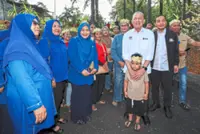
KLUANG: Kampung Orang Asli Berasau has made history as the first remote Orang Asli settlement in Malaysia to receive a 24-hour electricity supply through an integrated solar system.
The project, implemented by the Ministry of Energy Transition and Water Transformation (Petra) under its Madani Adopted Village initiative, also includes a solar-roofed community hall that serves as a local activity hub.
More than 20 households in the village, located far from major roads, benefit from this initiative.
The system uses off-grid solar photovoltaic (PV) technology with a capacity of over 50 kilowatt-peak, supported by a 516 kilowatt-hour battery storage system.
This provides a continuous electricity supply to an area that previously relied on generators.
The project was carried out by Petra in collaboration with the Sustainable Energy Development Authority (Seda), the Public Works Department (JKR), and several federal and Johor state agencies, as part of efforts to expand access to clean energy in rural areas.
Round-the-clock electricity has transformed daily life for residents, particularly families and young people, who previously relied on generators.
Berasau Orang Asli community chief Sari Achu, 51, said villagers can now enjoy basic amenities they have long waited for.
“For many years, we relied solely on generators, with electricity available for just a few hours each night. Now we are grateful that our village finally has a continuous electricity supply,” he said after attending the project’s launch yesterday, Bernama reported.
He said the facility has had a direct impact on children’s education and the villagers’ small-scale economic activities.
“Children can now study more comfortably at night. Those of us who work as inland fishermen can also store our catch more effectively,” he said.
He added that the solar-powered community hall has created space for activities such as education programmes, residents’ meetings and social events.
Earlier, Deputy Prime Minister Datuk Seri Fadillah Yusof, who is also the Energy Transition and Water Transformation Minister, launched the Madani Adopted Village project at the site.
He said the off-grid solar system was chosen because extending the conventional grid would require crossing forest reserves and private land and would take significantly longer to complete.
He added that the project could serve as a model for similar initiatives in other Orang Asli settlements, particularly in remote areas that still lack a stable electricity supply.
Meanwhile, senior electrical engineer and project team leader Dr Abdul Muhaimin Mahmud from JKR said the project involved installing 85 solar panels and constructing the building and energy storage unit.
The project began in January 2025 and was completed ahead of schedule in October 2025.
“The biggest challenge was access to the site due to its remote location, as well as ensuring the installation met all technical requirements. It was completed thanks to the cooperation of all parties, including the local community,” he said.
He added that after nearly six months of operation, the system has performed well and is delivering clear benefits to residents who previously relied on limited generator-based power.