
PETALING JAYA: Nick was surfing the Internet for a part-time job when he found something that raised a red flag.
The 18-year-old discovered an advertisement for a data entry job to boost products sold online.
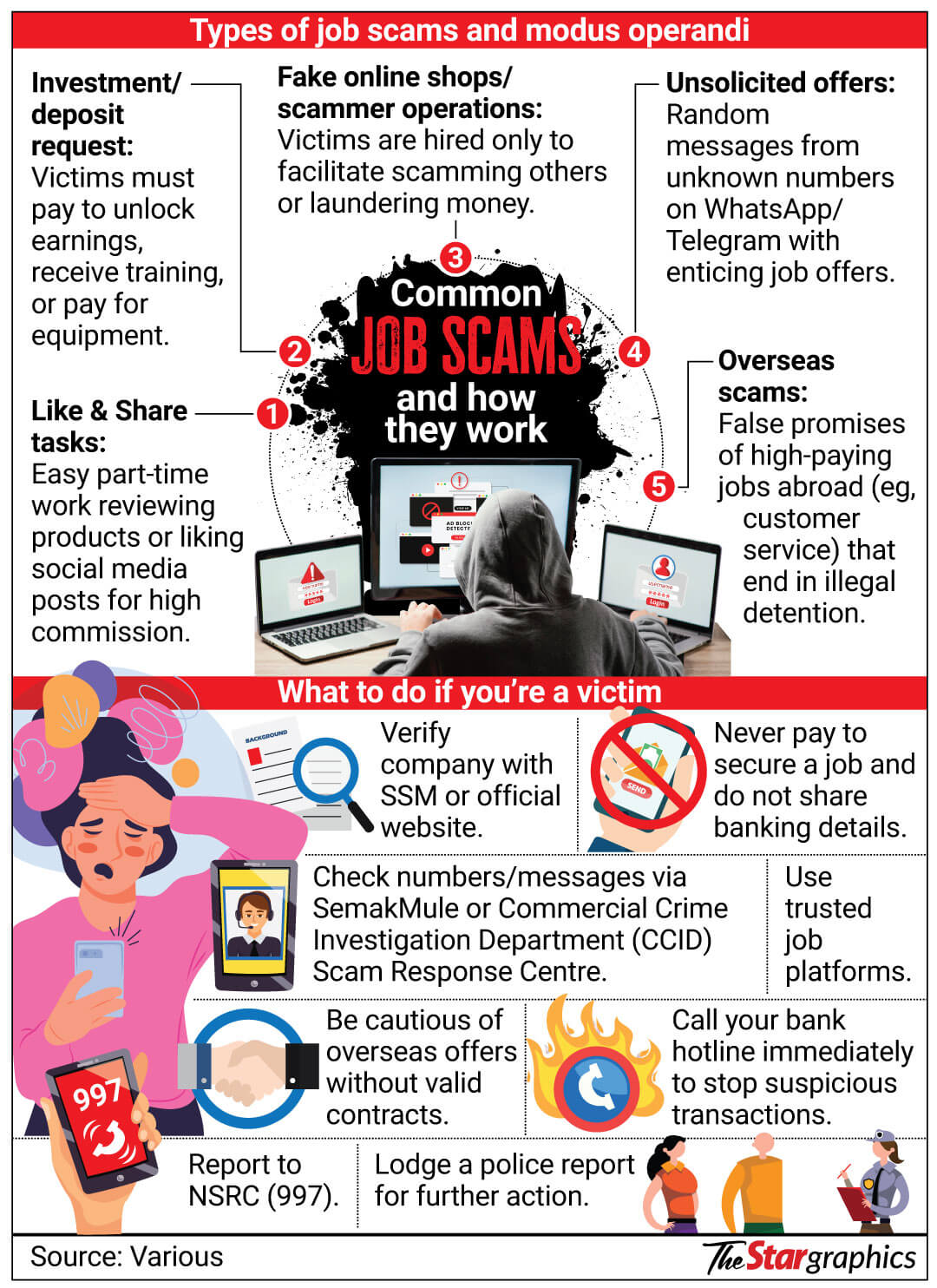
However, he became suspicious when the email communications between him and the would-be-employer was through personal email and not a verified company email.
He was also asked for an upfront payment of RM200.
“I immediately blocked the conversation after seeking advice from other people,” he said.
Kirubah, a 21-year-old student from Johor, came across an online job offer for a typing job. It seemed fine, but she was shocked at the salary offered, which was about RM7,000.
Suspecting a scam, she feigned interest in the offer to find out more about their tactics.
“After contacting the main recruiter, I was passed to another person to facilitate my application, and then another person to receive my ‘payment’.
“I was required to send a typed document, after which I would get my payment. But then I was asked to pay a fee of RM220 to receive my salary, which turned to be an ‘employee’ ID card, before I can get my salary,” she said.
Kirubah stopped responding after she discovered that the account originated from Nigeria.
She subsequently shared her experience on social media to raise awareness about online job scams.
A 2024 study by Universiti Sultan Zainal Abidin (UniSZA), which surveyed 482 secondary school students, found that about 84.6% of them had never attended any workshop or seminar on scams, while half reported receiving scam-related emails or SMS messages.
Several school-leavers interviewed said job scam education in schools is important to prepare students for the real world.
Amiroel Hakeem Mohd Firdaous 19, a student from Sentul, said his school never specifically taught subjects about job scams.
“There were a few occasions where teachers briefly touched on online safety during assemblies, but it wasn’t really focused on job scams.
“Honestly, I felt only half prepared. There’s still a lot to learn like handling people, interviews and real workplace situations.
“Job scam awareness is important and many young people are becoming victims. If schools teach this subject at the early stage, students will know the basics of how to protect themselves from being scammed,” he added.
Nidaa’ Insyirah Khairatul Azuan, 19, from Shah Alam, said her school only briefly touched on general online safety issues.
“Job scam awareness should be part of school lessons. This can help reduce the risk of students becoming victims and teach them to make better decisions.
“If I want to see whether a job offer is real or fake, I would check the company name, look for online reviews and see if they have an official website or social media accounts. Their email should be professional-looking as well.”
Student Muhammad Fahim Zahran Mohd Fazli, 19, said job scam education should be informal and involve discussions between teachers and students, not through any structured programme or lessons.
“Most of what we learn in school is still quite academic, so there’s a gap when it comes to understanding how things actually work in a real-world setting,” he noted.