

Among the standout exhibitors were four pupils from SJKC Yuk Chai in Petaling Jaya – Ong Jirng Ying, Jesslyn Tan, Yin Keng Him and Tee Enyi – who developed Safe IoT, a satellite-based tracking device designed to locate missing hikers and monitor their vital signs.
Explaining the inspiration behind the invention, 12-year-old Jirng Ying said the team was motivated by the rising number of hikers reported missing each year.
“According to our research, the number of reportedly missing hikers keeps growing every year due to victims struggling to receive cell signals in forested areas.
“To solve this issue, we have created our new invention called Safe IoT,” she said.
The device, which costs about RM260 to build, is placed in a hiker’s backpack and equipped with sensors that measure heart rate, environment temperature and humidity.
The data is transmitted via satellite to a receiver, allowing rescue teams to track the hiker’s location even in areas without mobile coverage.
“After the satellite receives the message, it sends it back down to a platform where rescue teams can view the hiker’s vital signs on a website.
“If anything is wrong, for example, if the heart rate is abnormal, it can send a message to alert them,” she said.
The pupils, aged 11 or 12, also developed their own website to display the data.
Jirng Ying noted that the project took about four months to complete, with the team handling both the hardware assembly and coding.
The pupils tested the prototype in areas with dense tree coverage to simulate mountainous terrain.
“We tested it in the forests where the cell signals are weak,” Jirng Ying said, confirming that the system successfully traced the user’s location and environmental conditions.
Currently powered by a power bank, the team hopes to enhance the design with solar energy in the future to improve portability and sustainability.
“I hope it can become a real thing so we can save other people’s lives,” she said.
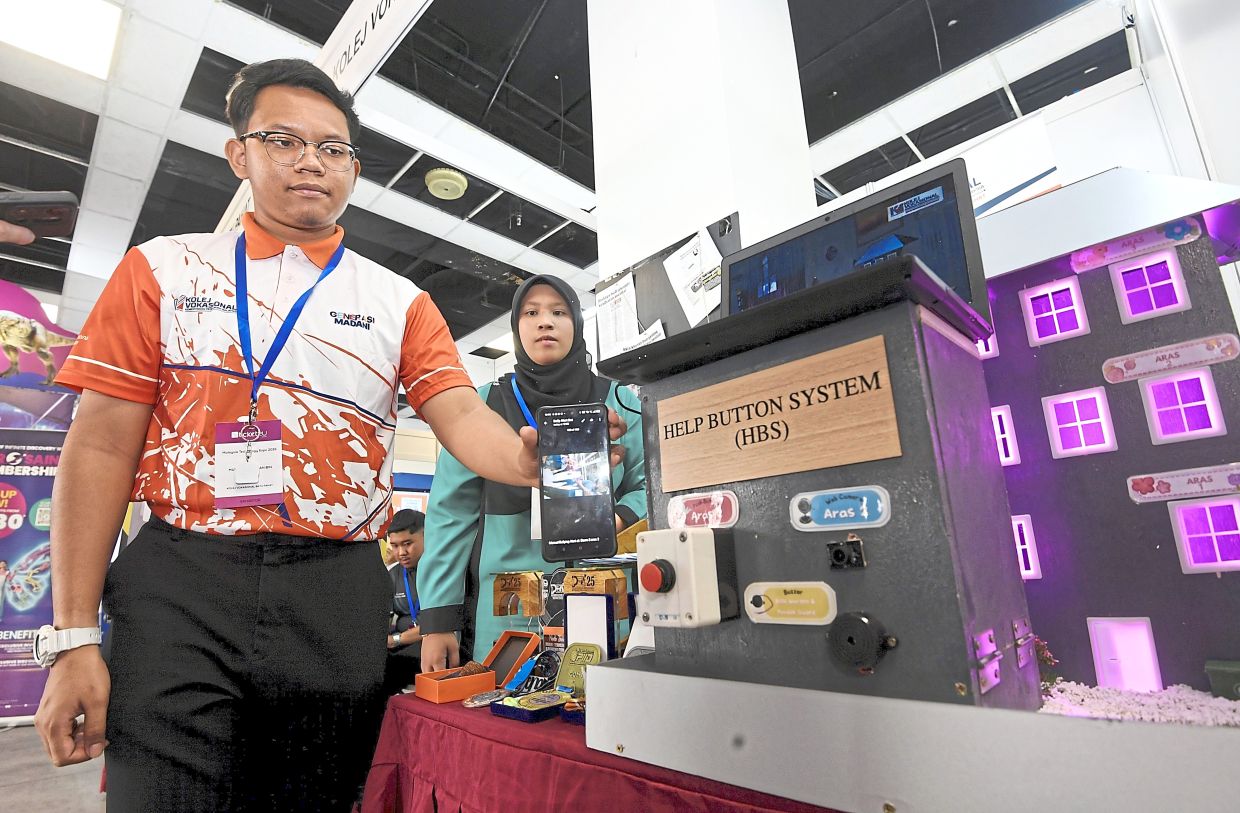
Meanwhile, students from Kolej Vokasional Batu Pahat introduced a Help Button System aimed at enabling faster intervention in bullying incidents at school dormitories.
Muhammad Razan Ismail, 19, said the system was created to address delays in reporting bullying cases to wardens.
“If there is a case of bullying in the dormitory, the warden will only know after a student goes to inform them. This takes time and can be dangerous.
“With this system, students can press a button and the warden will be alerted immediately,” he said.
The prototype integrates a push-button alert with a buzzer and a camera placed outside the dormitory to maintain students’ privacy.
The system is enhanced with artificial intelligence, which can detect sharp objects or violent behaviour and automatically send images and location details to the warden via Telegram.
“This helps reduce the risk of serious injury or even death because the warden can respond immediately. It can also be used during other emergencies, such as when a student faints,” said Razan.
Developed over three months as part of their final-year project, the system costs around RM320. Future enhancements include adding lighting to make the button visible in the dark and enabling continuous video recording.