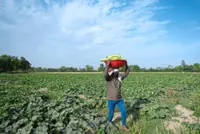
PETALING JAYA: Farmers are calling for government intervention to minimise the impact of rising production costs on vegetable prices if disruptions to the global supply chain persist.
Kuala Lumpur Vegetable Wholesalers Association president Wong Keng Fatt said higher diesel and fertiliser costs have already led to lower harvests and a rise in prices for several types of vegetables.
“Farmers are afraid to grow their usual volume of vegetables due to higher costs.
“If this continues, production will drop further and prices will go up in the coming weeks,” he said in an interview yesterday.
Bok choy prices have risen from about RM1.50 per kilo to RM3-RM4, while the prices of Japanese cucumbers have surged from RM1.50-RM2 to as high as RM6.50-RM7 per kilo.
The prices of baby French beans have increased from RM12-RM14 to RM20-RM25 per kilo, while mustard greens prices have jumped from RM1-RM2 to RM6-RM7 per kilo.
Wong said the supply squeeze is partly due to farmers taking a cautious approach amid uncertainty over production costs.
“They are worried that costs could rise further, so they are cutting back on planting,” he added.
Although larger farms in Cameron Highlands with access to fuel subsidies continue to deliver about 30 lorries of vegetables to Kuala Lumpur daily, he said some smaller operators have begun reducing shipments.
When asked, Wong said access to subsidies is uneven, with some farmers able to benefit while others, particularly smaller or unregistered operators, are left out.
“Those who are registered can apply and receive it but those who are not registered, especially those using farm vehicles that are not formally documented, are unable to do so,” he said.
He noted that vegetable prices are still largely determined by supply and demand rather than input costs alone.
“When supply is high, prices will still drop, even if costs are high. But now we are seeing supply shrinking,” Wong said.
Meanwhile, Malaysian Padi Farmers Brotherhood Organisation (Pesawah) secretary Nurfitri Amir Muhammad said operating costs in the sector have risen by between 50% and 55%.
He said mechanisation service rates in Selangor, including straw cutting, had risen from RM130 to RM165 per lot, while land levelling has increased from RM270 to RM325 per lot.
Other cost hikes include liming the fields, up from RM150 to RM205 per lot, and harvesting, which has increased from RM85 to RM110 per tonne.
Nurfitri, who is also Malaysia Food Sovereignty Forum head coordinator, noted that the padi sector is not included under the government’s targeted diesel subsidy system.
“Unlike other eligible groups, padi farmers do not receive the RM200 monthly cash assistance under the Budi Madani programme,” he said.
He added that aid, if any, is channelled indirectly and done inconsistently.
Under the current framework, cash assistance of RM200 per month is provided to eligible smallholders under the Budi Madani scheme, while fleet cards offer subsidised diesel for registered transport operators.
“We call on the government to include the padi sector directly under the diesel subsidy scheme to ease cost pressures.
“If costs continue to rise without proper support, farmers will be forced to cut back and that will eventually affect supply,” he added.