PETALING JAYA: Malaysia has about four years to establish itself as a globally competitive artificial intelligence (AI) nation, but gaps remain in talent and industry adoption, says National AI Office (NAIO) head Sam Majid.
He said there are significant gaps between ambition and readiness, particularly in the adoption of AI among Malaysian businesses.
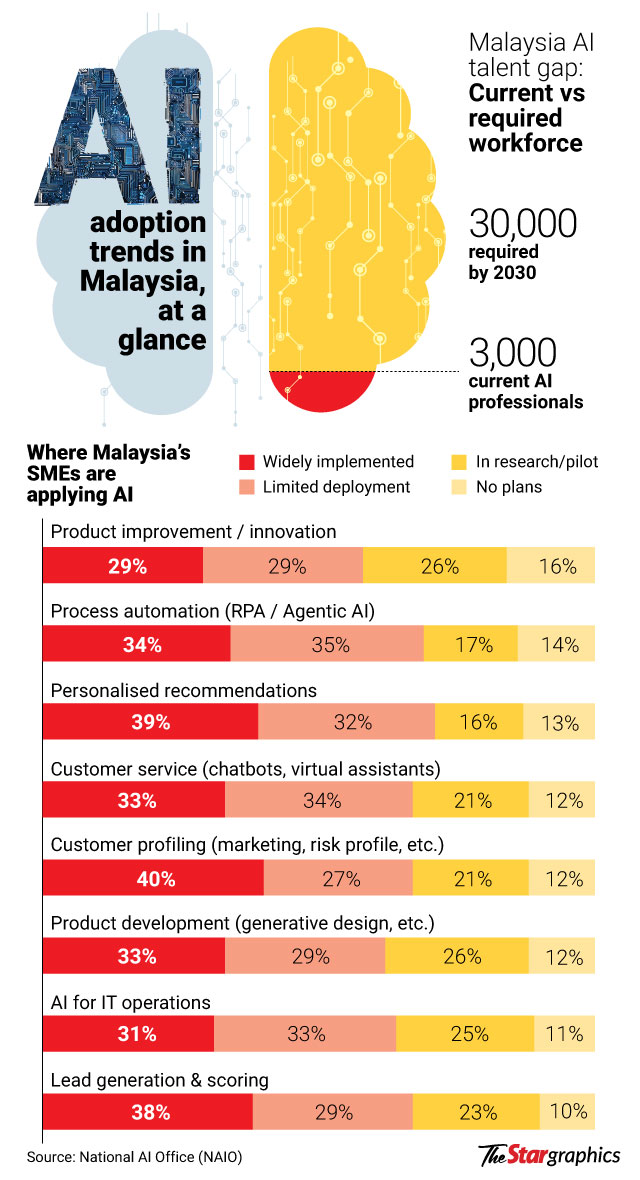
“Although 69% of micro, small and medium enterprises (MSMEs) are aware of AI, only 26% have adopted it due to high implementation costs and a lack of technical expertise.
“We have about 3,000 AI professionals, but we need 30,000,” he said.
“If we do not close these gaps, we risk remaining merely an AI consumer rather than becoming an AI producer,” he told The Star.
The NAIO, which was established in August 2024 by the government, is tasked with positioning Malaysia as a regional leader in AI and a global driver of digital transformation.
To bridge the current gaps, Sam said NAIO is rolling out Malaysia’s National AI Action Plan 2026-2030 through a phased strategy to accelerate the country’s push in becoming a globally competitive AI nation by 2030.
Rather than wait, he said the agency tasked with accelerating AI adoption in Malaysia would implement the plan through a phased approach, namely Ignite, Scale, and Transform, with pilot projects already underway to test real-world applications and reduce market barriers.
“By 2030, we aim to achieve a 0.8 to 1.2 percentage point gross domestic product uplift driven by AI, alongside upskilling and reskilling around 700,000 workers for high-skilled, AI-enabled roles.
“By breaking a massive 2030 vision into short-term execution sprints, we ensure continuous accountability.
“It allows us to pivot quickly and demonstrate tangible, everyday value to the people and our investors at every step of the journey,” he said.
Sam said that Malaysia is also moving quickly to update regulatory frameworks to keep pace with AI development, as the government recognises that traditional, monolithic legislative processes are too slow for the speed of AI.
“Therefore, we are executing a rapid, agile adaptation strategy across four concrete tracks.
“These include the Personal Data Protection Act, the Data Sharing Act, and the Cybersecurity Act, along with a hybrid-tiered AI governance model and an AI Governance Bill targeted for tabling this year,” he said.
He also said NAIO is introducing AI toolkits for MSMEs, launching the Talent Pipeline @ Scale initiative to reskill 700,000 workers, and establishing AI Growth Zones to match industry challenges with researchers and venture builders.
In the public sector, he said AI is being guided by a human-centred framework aimed at improving efficiency rather than replacing jobs.