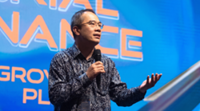
PETALING JAYA: The government is helping small and medium enterprises (SMEs) to increase their productivity, says Entrepreneur Development and Cooperatives Minister Steven Sim.
“When we do not have competitive advantage on pricing, then that is where value and productivity comes into play,” he said.
He was speaking at the Star Outstanding Business Awards (SOBA) 2025 Gala Night event on Wednesday, where he was the guest of honour.
The awards pay tribute to SMEs that have achieved outstanding business success and achievements.
He pointed out that the current geopolitical climate is “messy and chaotic”, as the world today is “multipolar”.
Using the imagery of a traffic roundabout, Sim alluded that it is not the biggest vehicle that will have the advantage, but “the driver that has a clear plan and the ability to adopt and adapt to situational change”.
He warned that Malaysia is facing what he termed a “two-in-one global conflict situation” as the country shifted from being a net petroleum exporter to a net importer.
This exposes the country to global energy volatility, he said.
Sim revealed that monthly fuel and energy subsidies have surged from RM700mil previously to between RM4bil and RM5bil.
“That means we have a huge fiscal challenge to deal with,” he said.
However, he stressed that reforms implemented over the past two years have helped cushion the impact.
Among them were anti-corruption efforts that recovered more than RM15bil, as well as targeted diesel subsidies.
“There will be pains in reform. But today, we have more money to help the people and the economy – about RM15bil was recovered in the last two years,” he said.
Sim noted that private vehicle owners continue to pay RM1.99 per litre of petrol, more than 50% below retail market prices, while over 400,000 commercial vehicles pay about RM2.15 per litre for diesel compared to the pump price of RM6.02 (April 2 to 8).
He cited a recent report by JP Morgan, which assessed Malaysia and China as the least vulnerable in Asia to the current global energy shock.
“That must mean something,” he said, attributing the resilience not only to government policy but also to cooperation from the business community.
For SMEs, Sim acknowledged that rising costs and supply chain uncertainty are already being felt.
“You feel like it is business as usual unless you are in business. Then your supplier is telling you next month or the month after, prices will increase,” he said.
Against this backdrop, Sim said he has narrowed his ministry’s agenda to a single mission: “To make Malaysian businesses great”.
“I’ve consistently called for our growth model in Malaysia to be transformed from a low cost, low price, into a high value, high growth made by Malaysia model,” he added.
He outlined his “A-B-C-D” strategy, in which “A” is to accelerate productivity; “B” to reduce bureaucracy; “C” to make capital accessible; and “D” to drive greater market access.
Under the “Power Up 10,000” campaign, the ministry first plans to release up to RM15bil in low-cost financing into the SME market this year, up from RM10bil previously.
The campaign also aims to help at least 10,000 Malaysian businesses scale up, while RM100mil will be deployed to train 100,000 entrepreneurs in governance and capacity building.
“When I talk to the banks and the capital markets, they say they want to help SMEs, but governance is a problem. The paperwork is not in place and decision-making is confusing,” he said.
“That is why we are investing in capacity building.”
The broader target is to raise the SME sector value-added to beyond RM750bil from slightly over RM600bil currently.
In the medium term, Sim also outlined plans for a “100 x 100 Madani Club” to help at least 100 Malaysian companies achieve RM100mil in revenue.
“We are not going to waste time on other things. We are going to focus our attention to make Malaysian businesses great,” he said.
In a volatile global environment, Sim’s message to SMEs was clear: stay alert, adapt quickly and leverage the support being rolled out.