
Most blazes linked to electrical faults, poor maintenance
PETALING JAYA: Michele Lin had just parked her car and walked into her house when the smell of burning plastic hit her.
“When I went back outside to investigate, I could hear crackling sounds near my car. I thought someone was setting off firecrackers,” she recalled.
Suddenly, the bottom of her car’s bonnet burst into flames.
Panicked, Lin shouted for help.
Her family members and neighbours rushed to douse the fire.
An investigation by forensics experts from the Fire and Rescue Department later found that the fire was caused by faulty electrical wiring.
ALSO READ: Car on fire? Turn off the engine and run
“The damage to my car was so severe that I ended up claiming total loss,” Lin said.
Hers is not an isolated case.
Some 12,288 vehicle fires have been reported nationwide since 2023.
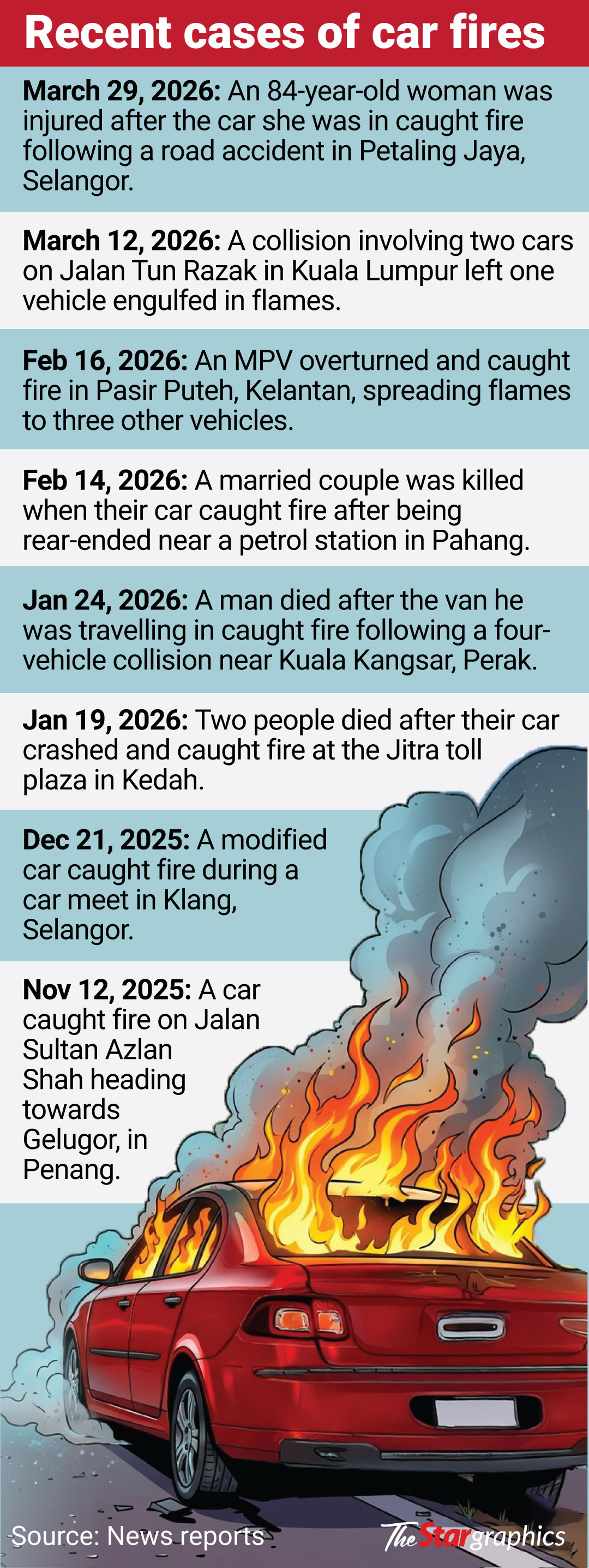
According to the Fire and Rescue Department, Selangor recorded the highest number of cases between 2023 and February this year at 3,348, followed by Johor (1,680), Perak (1,331), Pahang (806), Negri Sembilan (690) and Kuala Lumpur (683).
Kedah recorded 674 cases, followed by Sarawak (628), Sabah (618), Penang (608), Kelantan (420), Melaka (354), Terengganu (347), Perlis (49), Putrajaya (34) and Labuan (18).
Such cases have been increasing over the years, said Fire and Rescue Department director-general Datuk Seri Nor Hisham Mohammad.
In 2023, there were 3,530 cases in total, with the number rising by 11% to 3,906 cases in 2024 and then another 6% to 4,132 cases in 2025.
This year alone, 720 cases have been recorded as of February.
Nor Hisham said there is a need for continuous monitoring and intervention, especially in highly-urbanised and densely- populated areas where vehicle ownership and usage is significantly higher.
“Residential neighbourhoods remain the most common areas for vehicle fires, followed by highways.
“Many fires occur when vehicles are parked or inactive. These are potentially linked to factors like electrical faults, fuel- system leaks or a lack of regular maintenance,” he told The Star.
Nor Hisham said vehicle fire incidents are not confined to high-risk road environments but also in daily living spaces.
He listed several key contributing factors like resistance heating, followed by friction and impact or accidents.
Resistance heating is the leading cause of vehicle fires, he noted, accounting for 44% of such cases.
“This occurs when electrical current flows through a partially obstructed path.
“Common causes include loose wiring, corroded battery terminals and undersized wires.
“The resistance generates intense localised heat, which melts insulation and can ignite nearby materials such as upholstery, plastic panels or fuel vapours,” he said.
Nor Hisham said most vehicle fires are preventable with proper maintenance and greater awareness.
“Check regularly for fuel odours or damp spots near the fuel rail of the vehicle.
“Another leading cause of fires is shoddy aftermarket electrical work that bypasses fuses or uses improper wire gauges which can lead to short circuits,” he noted.
He said one should never leave their vehicle idle or parked over dry grass or piles of leaves.
Only recently, a viral video showed a car backing into a parking area with dry grass.
The grass caught fire due to the heat under the car.
Although the driver managed to drive away, other cars parked in the area were destroyed in the fire.
“The catalytic converter under the car can reach temperatures exceeding 500ºC, which is hot enough to ignite dry vegetation instantly,” said Nor Hisham.