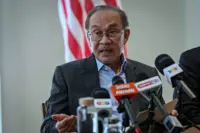
KUALA LUMPUR: Malaysia must accelerate a decisive shift towards more sustainable, diversified and cost-effective energy sources, says Datuk Seri Anwar Ibrahim.
The Prime Minister said this is not merely an environmental necessity but also part of a broader strategy to navigate growing global uncertainty.
Anwar acknowledged that Malaysia remains exposed to global energy disruptions but stressed that the government is taking steps to cushion the impact on households.
“For Malaysia, this means acknowledging that we are not immune to disruptions in global energy supply.
“We remain firmly committed to safeguarding the wellbeing of our people.
ALSO READ: Malaysia expanding partnerships beyond traditional suppliers, says PM
“In the immediate term, my government has taken steps to manage exposure to volatility, balancing the need to ensure adequate supply with the imperative of mitigating pressures on the cost of living,” he said.
Anwar said this in his keynote address at the Kuala Lumpur-Ankara Dialogue 2026 here on Tuesday (April 7).
He said long-held assumptions about the resilience of the global economic system have been fundamentally challenged, particularly as geopolitical tensions intensify in key regions.
“For too long, we assumed that the foundations of the global economy were resilient by default.
“That assumption has now been decisively challenged.
“When tensions intensify in a region as strategically vital as the Gulf, the consequences are felt far beyond the immediate theatre of conflict,” he said.
Drawing parallels with past crises, Anwar said today’s risks are more complex due to the interconnected nature of modern economies.
“The oil shocks of the 1970s were not merely episodes of energy disruption. They triggered inflation, constrained growth, and reshaped the global economic order.
“Yet today, the risks are more profound and pernicious. Our economies are more integrated, more digitised and far more dependent on uninterrupted flows than at any point in the past,” he said.
He warned that any sustained disruption in the Gulf, particularly at the Strait of Hormuz, would have far-reaching consequences.
“The Gulf, and in particular the Strait of Hormuz, remains central to global energy security.
“Any sustained disruption would not simply raise prices. It would reverberate across production systems, supply chains and the daily cost of living for hundreds of millions across both advanced and developing economies,” he added.
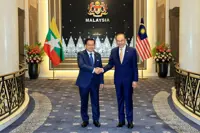
Highlighting the importance of long-term partnerships, Anwar cited a Turkish proverb to underscore the value of sustained cooperation.
“A Turkish proverb, 'Minareyi yaptırmayan yerden bitmiş sanır', reminds us that ‘he who did not help build the minaret thinks that it merely sprouted from the ground.’
“Our partnership did not emerge by chance. It is built on sustained effort and commitment to deepen cooperation.
“It is a profound conviction that has grown from the foundations of mutual trust, respect and shared values,” Anwar said.
He added that diplomacy must extend beyond governments to ensure its benefits are widely shared.
“Diplomacy must therefore extend beyond governments. It must be carried forward by our institutions, our industries and our people, so that its benefits are widely shared,” he said.
Anwar also posed a broader question on how nations should respond to rising global challenges.
“Ultimately, the question before us is simple. Do we act, collectively and with purpose, to avert a crisis whose consequences will be felt across generations?
“Or do we allow short-term calculations for quick gains that would eventually lead us to long-term instability?”
He stressed that lasting peace requires sustained and collective effort.
“Peace is not sustained by silence, nor secured by force alone, but by the quiet, persistent work of those who refuse to accept that conflict is our destiny,” he said.