PETALING JAYA: The sharp rise in bankruptcies involving corporate guarantors over the past four years among SMEs is partly due to financial stress from the pandemic, say industry groups.
Banks, explained Kuala Lumpur and Selangor Indian Chamber of Commerce and Industry (KLSICCI) president Nivas Ragavan, usually require directors or owners of these businesses to provide personal guarantees when approving loans.
“This is very common because many SMEs may not have sufficient collateral or long financial track records.
“As a result, the business owner signs a personal guarantee, often without fully anticipating the long-term risks should the business face difficulties,” he said in an interview.
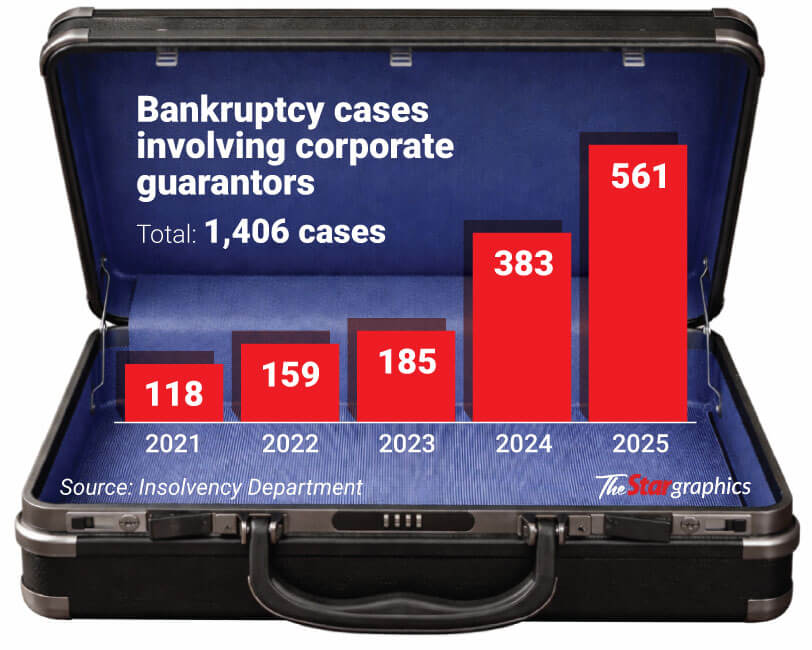
According to the Insolvency Department, bankruptcies involving corporate guarantors have almost quadrupled – from 118 cases in 2021 to 561 in 2025 – an indication that more individuals who guaranteed business borrowings are being pulled into bankruptcy as their companies struggle.
Based on the his company's recovery work, Nivas said the cases often follow a familiar pattern – companies initially service the loans but later default due to cash-flow disruptions, delayed receivables, rising costs or an economic slowdown.
Banks then pursue the guarantor, escalating the matter into personal legal and financial jeopardy.
Many owners, said Nivas, do not realise that personal guarantees are immediately enforceable, exposing them to legal action, asset seizure and eventually bankruptcy.
Typical steps explored for debt recovery include restructuring or settlement negotiations with banks, structured repayment plans, disposing of assets as well as seeking legal mechanisms for protection or discharge.
He attributed the rising trend of such bankruptcy cases to post- pandemic stress, weak cash flow, overleveraging, limited awareness of guarantee risks, inefficiencies in debt recovery and rising operating costs.
Small and Medium Enterprises Association (Samenta) president Datuk William Ng said SMEs are dealing with a “double blow” of cost inflation and geopolitical uncertainty, with thin-margin sectors such as food and beverage, retail and construction finding it hard to pass higher costs on to consumers.
“The surge in corporate guarantor bankruptcies in just four years is the direct result of years of pandemic-era borrowing,” he said, adding that earlier figures might have been cushioned by loan moratoriums and a higher bankruptcy threshold.
As those protections ended, he said, the impact became more visible.
Many SMEs, said Ng, have borrowed during the pandemic to bridge lockdown-related cash flow gaps but are now struggling to service debt as labour and raw material costs rise.
He urged business owners to seek help early and engage lenders to explore restructuring options, including debt advisory services such as those offered by the Credit Counselling and Debt Management Agency.
The data, Ng pointed out, also underscore a broader structural issue: heavy reliance on personal guarantees.
“For Malaysia to maintain its entrepreneurial drive, there needs to be a shift towards more sophisticated credit assessment by banks, relying less on collateralising the business owner’s personal future and more on the actual viability and cash flow of the enterprise,” he said.
SME Association of Malaysia president Dr Chin Chee Seong said the rise is a serious warning sign that financial distress is no longer confined within companies but increasingly “spilling over” onto the owners personally.
Once entrepreneurs sign personal guarantees, he said “any prolonged business stress can quickly become a personal financial crisis”.
Banks, claimed Chin, would routinely insist on personal guarantees even for limited liability companies.
“Even if you’re a Sdn Bhd, the bank still wants you to sign.
“People assume limited liability protects them, but once you sign a personal guarantee, you’re directly responsible for the debt,” he said.
Chin attributed the financial pressure to lingering post-pandemic hardship and the cumulative squeeze of rising operating and input costs, weaker demand and slower debt collection across supply chains.
“Costs go up, revenue drops and collections slow – that’s what breaks cash flow,” he said, explaining that when customers delay payments, businesses struggle to meet overheads and repay loans on schedule.
Chin urged business owners to act early at the first signs of tightening cash flow.
“Engage the bank early before it turns critical and legal action starts. Stronger collection efforts and open discussions with suppliers and customers can help stabilise cash flow.”
He also cautioned entrepreneurs against borrowing to service existing loans.
“Don’t take another loan to cover another loan,” Chin said, warning that distressed businesses may end up turning to costly private financing.
Owners, he added, should instead consider lower-cost support schemes, including government- backed facilities, to prevent otherwise viable firms from tipping into bankruptcy.