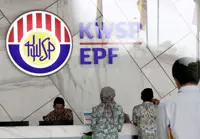
PETALING JAYA: Financial experts believe the Employees Provident Fund’s (EPF) dividend payout at 6.15% is a reflection of a solid performance amid global market volatility.
Bank Muamalat Malaysia Bhd chief economist Dr Mohd Afzanizam Abdul Rashid told The Star that the rate remains respectable despite being lower than last year. He said the dividend still outpaces the long-term inflation rate of 2.5% and effectively gives members a real return of 3.65%.
“What it means is that EPF members are still better off after taking into consideration the inflation rate. Considering market volatility, the EPF has delivered a respectable performance,” he said.
Looking at the investment profile, Mohd Afzanizam said that while 38.3% of total assets are in overseas investments, they contributed 50.4% of total investment income.
“This trend has persisted in the past years, where overseas investment income has been greater despite commanding a lower share in terms of asset allocation.
“The fund’s increasing share of global investments has been a valid move, which contributed a larger portion to total investment income.
“Perhaps these are structural issues between investing overseas and domestically that policymakers would need to consider. Perhaps the current share in overseas investment of 38.3% would need to be relooked at,” he said.
As for the growth of voluntary contributions, Mohd Afzanizam said Malaysians are becoming more financially literate and savvy, and policymakers should in turn focus on building financial resilience among society.
Financial adviser A. Devadason said that, although contributors were expecting a higher dividend than 2024’s 6.3%, the 6.15% delivered by EPF is still solid.
“Getting returns in excess of 6% simply translates to twice the rate of fixed deposit. If returns stay at 6%, your money could double in 12 years,” he said, noting that recent strength in the ringgit against the US dollar had also led to the higher expectations.
Devadason said EPF’s records showing a rise in voluntary contributions, particularly from those not required by law to contribute, such as the self-employed, is an indicator that more Malaysians are showing interest and taking charge of their financial well-being.
Economist Prof Dr Choong Chee Keong of Universiti Tunku Abdul Rahman (UTAR) said being a conservative fund, the EPF has performed very well with the 6.15% dividend payout.
He believes the EPF will be more cautious this year with ongoing global uncertainties, especially in the Middle East, which may result in lower returns for 2026. Choong also said the rise in voluntary contributions is due to the EPF’s reputation as a safe egg nest.
“Most Malaysians are unfamiliar with investing wisely. Hence, channelling savings to the EPF is an excellent option. Moreover, the i-Saraan initiative introduced by the government for gig economy workers is another attractive scheme that has encouraged Malaysians to save,” he added.
To a politician’s suggestion that the 2025 EPF dividend be fully channelled to Account 3 for Hari Raya use, all three financial experts agreed it was an imprudent move.
Mohd Afzanizam said EPF members should bear in mind that their savings are meant for a financially secure retirement.
Agreeing, Devadason said dividends should not be channelled to Account 3, as they are crucial in building long-term savings.
Choong noted that early withdrawals would lead to long-term losses, as the compounding effect would be lost, resulting in lower savings.