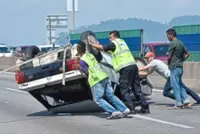
Training and equipment access remain vital alongside new laws, say experts
PETALING JAYA: A Good Samaritan law could help reduce fear among bystanders during emergencies, but experts and civil society groups say equally important are first aid training, wider access to life-saving equipment, and sustained public awareness.
Alliance for a Safe Community chairman Tan Sri Lee Lam Thye said many Malaysians hesitate to help not because they are unwilling, but because they are unsure of what to do and are afraid of making things worse.
“People worry about doing the wrong thing or being blamed (for something) later.
ALSO READ: Ministry seeks feedback on emergency assistance
“That hesitation often comes from a lack of confidence and knowledge, not just legal uncertainty.
“Basic preparedness, such as knowing emergency numbers, recognising warning signs and understanding simple first response steps, can make a crucial difference,” he said.
Lee stressed that while a Good Samaritan law could reassure the public of a legal protection, it must go hand-in-hand with practical measures that empower people to act.
“A law alone cannot teach someone how to perform CPR or use an automated external defibrillator (AED).
“These are skills that must be learnt and practised,” he said.
Lee said that legal protection should support, not replace, public education and skills development.
“A truly effective Good Samaritan culture is built when people feel confident, prepared and supported.
“Training, awareness and access to lifesaving tools are what ultimately turn good intentions into saved lives,” he said.
ALSO READ: Vital to know basic first aid procedures, say expert
Public health medicine specialist Datuk Dr Zainal Ariffin Omar said immediate bystander intervention is often the deciding factor between life and death.
This is especially so in cases of cardiac arrest, severe bleeding or choking.
“For cardiac arrest, survival chances fall by seven to 10% for every minute without CPR or defibrillation.
“Bystander CPR can double or even triple survival rates.
“Sometimes ambulance response times can take eight to 15 minutes in many urban areas,” he said.
He said expanding CPR and basic first aid training in schools, workplaces and community programmes is critical, alongside increasing the availability of AEDs in public spaces such as malls, transport hubs and residential areas.
Civil lawyer Ananthan Moorthi said fear of legal repercussions is often disproportionate to the actual legal risk.
ALSO READ: Untrained public discouraged from giving first aid
Although Malaysia does not have a specific Good Samaritan law, existing provisions already offer some legal protection for acts done in good faith.
“Successful lawsuits against people who genuinely try to help in emergencies are extremely rare.
“Courts understand the urgency and difficulty of such situations and do not expect perfection,” he said.
However, Ananthan cautioned that any future Good Samaritan law must be carefully drafted to avoid encouraging reckless or negligent behaviour, particularly by untrained helpers who act beyond their abilities.
“The protection should cover honest mistakes made while trying to help, but not serious carelessness, reckless actions or intentional harm.
“That is how similar laws work in other countries, and it helps address worries about untrained people causing harm without meaning to.
“It should also take into account who is helping.
A member of the public should not be judged by the same standards as a trained doctor or medic,” he added.