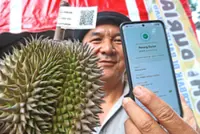
GEORGE TOWN: Penang has cultivated more than 200 durian varieties, and to the untrained eye, they all look similar – and it may be hard to believe that sellers can actually distinguish them.
But seasoned sellers say they can recognise each variety through sight and touch alone.
“We can tell the variety by whether the fruit is elongated or round, the thorn pattern, stem thickness, flesh colour and the structure at the bottom of the durian.
“For example, orh chi (Black Thorn) has a concave base, while Musang King is more bulged at the bottom.
“Both may have a spike, or none if it has fallen off,” said durian seller Choo Wei Hao, 35, when met at his stall along Jalan Burmah.
Choo, who sells about 20 popular varieties, acknowledged that convincing customers of a durian’s authenticity can be challenging.
“Regular customers trust us and experienced durian eaters usually know the variety even before we offer the fruit to them,” he said.
Checks at several stalls around the city found that sellers all had similar practices aimed at building customer confidence.
Durian lovers, meanwhile, continue to be cautious when buying premium varieties such as Black Thorn, Musang King and Ang Heh (Red Prawn), which at their height cost between RM90 and RM130 per kg.
A glut, however, has brought prices down in recent days.
Chinese tourist Karl Zhang, 30, from Sichuan, is one such durian lover who has been eating at least one whole fruit each day since arriving.
“Durians in Penang are fresh from the orchard, unlike those in China, which are stored in chillers,” he said.
Businessman Gerald Foo, 42, said he had been cheated in the past and was sold lower-grade durians at a high price.
“I suspect they were not even Penang durians but I had nowhere to vent my frustration at the time,” he said.
“Today, sellers are more careful because complaints on social media can spread quickly. If customers are unhappy, it can damage the sellers’ reputation.”
Durian Manufacturers Association president Eric Chan Yee Hong said that in the past, some traders near the northern border imported Thai durians during the off-season.
However, he said such practices have declined in recent years as local production has improved.