
Youths need safe space to fight silent epidemic
PETALING JAYA: Relational and social bullying are the most common forms of bullying among young people, revealed Siti Anisah Muhamad Johan, project lead for the Buddy Bear Child helpline.
Siti Anisah, a clinical psychologist, said relational bullying, often seen among girls, involves a bully trying to hurt a peer’s standing within a group.
Social bullying uses various means to damage someone’s social relationships.
She noted that many children confide about being excluded, ignored or targeted by name-calling and gossip. While this form of bullying may not leave visible bruises, its impact can be profound, eroding a child’s sense of belonging and leading to sadness, loneliness and anxiety.
“Over time, these experiences may affect multiple areas of development. Emotionally, children may struggle with low self-esteem, self-doubt or difficulty coping with the painful emotions.
“Socially, they may find it harder to build trust, develop friendships or feel confident in group settings,” she said.
In Malaysia, bullying remains a growing concern, with cases reported in both urban and rural schools. It takes many forms, from name-calling to insults, threats, spreading of harmful rumors, vandalism of belongings and all the way to physical violence, she said, in addition to cyberbullying in an increasingly digital world.
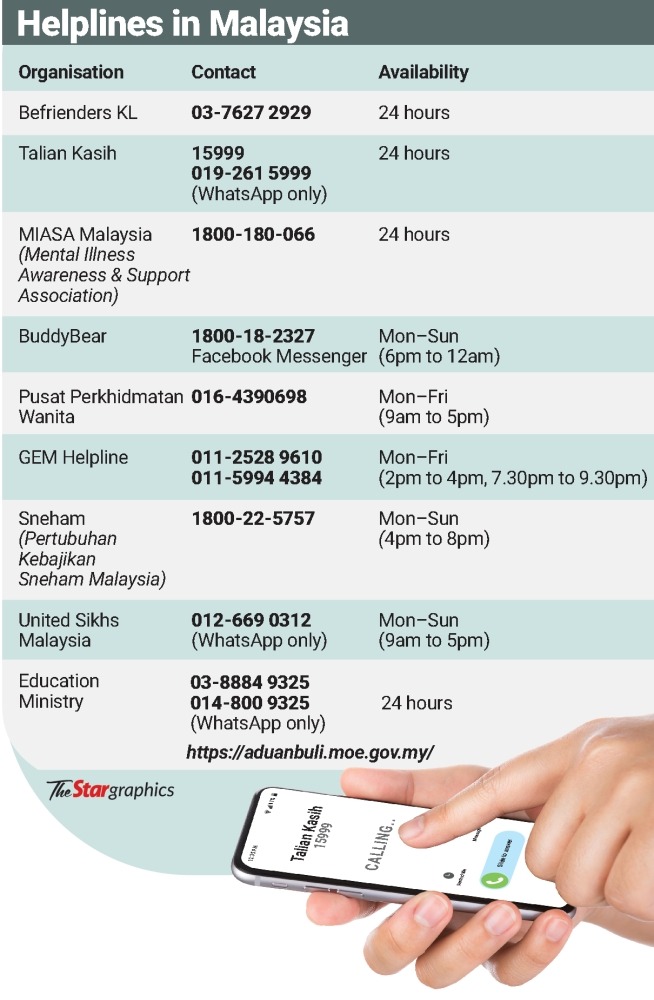
To address this, the Buddy Bear Helpline offers a safe, confidential space for children to express their feelings without judgement, empowering them to find coping strategies and reach out to trusted adults.
“Addressing bullying requires more than individual support; it requires a whole-system response.
“For children who are bullied, speaking up to a trusted adult, whether a teacher, parent, counsellor or elder sibling is the first critical step in receiving help and protection.
“For children who witness bullying, reporting incidents to a teacher or trusted adult can make the difference between silence and safety for their peers.
“For adults, it is essential to take every report seriously and act without dismissing or minimising the child’s experience.
“Schools, too, must play their part by strengthening anti-bullying policies, ensuring clear reporting systems and equipping teachers and counsellors with the skills to intervene effectively.
“There must be zero tolerance for bullying,” said Siti Anisah.
Befrienders Kuala Lumpur publicity director Joan Chen echoed these concerns, stating that the effects of bullying often leave a lasting impact on self-esteem and emotional well-being.
She confirmed that more young people are reaching out to helplines for a safe space to talk about struggles with loneliness, low self-worth and friendship difficulties.
“Many feel overwhelmed and unsure who to turn to, which is why having a confidential space matters.
“In recent years, we’ve seen an increase in the number of young people reaching out to Befrienders KL.
“With greater awareness around mental health and the challenges faced by children today, more are turning to helplines for support,” she said.
“While we do not take formal reports or intervene directly, our role is to allow children to express themselves without judgement.
“Our trained volunteers listen with empathy, validate their feelings and help them explore possible coping strategies.”
She also said parents and teachers play a key role in recognising distress early and creating awareness to guide them on the different avenues for help, should their kids come to them with issues such as this.
Recently, Malaysia was shocked by the death of a student at a fully-residential religious school in Sabah that was believed to be linked to bullying.
The demise of 13-year-old Zara Qairina Mahathir on July 17 sparked widespread solidarity movements and peaceful assemblies.