
The South China Sea continues to act as a lightning rod for competing claims among regional powers. In the final of a three-part series, Fan Chen investigates how Beijing is responding to the wake-up call on what is needed to win the narrative battle.
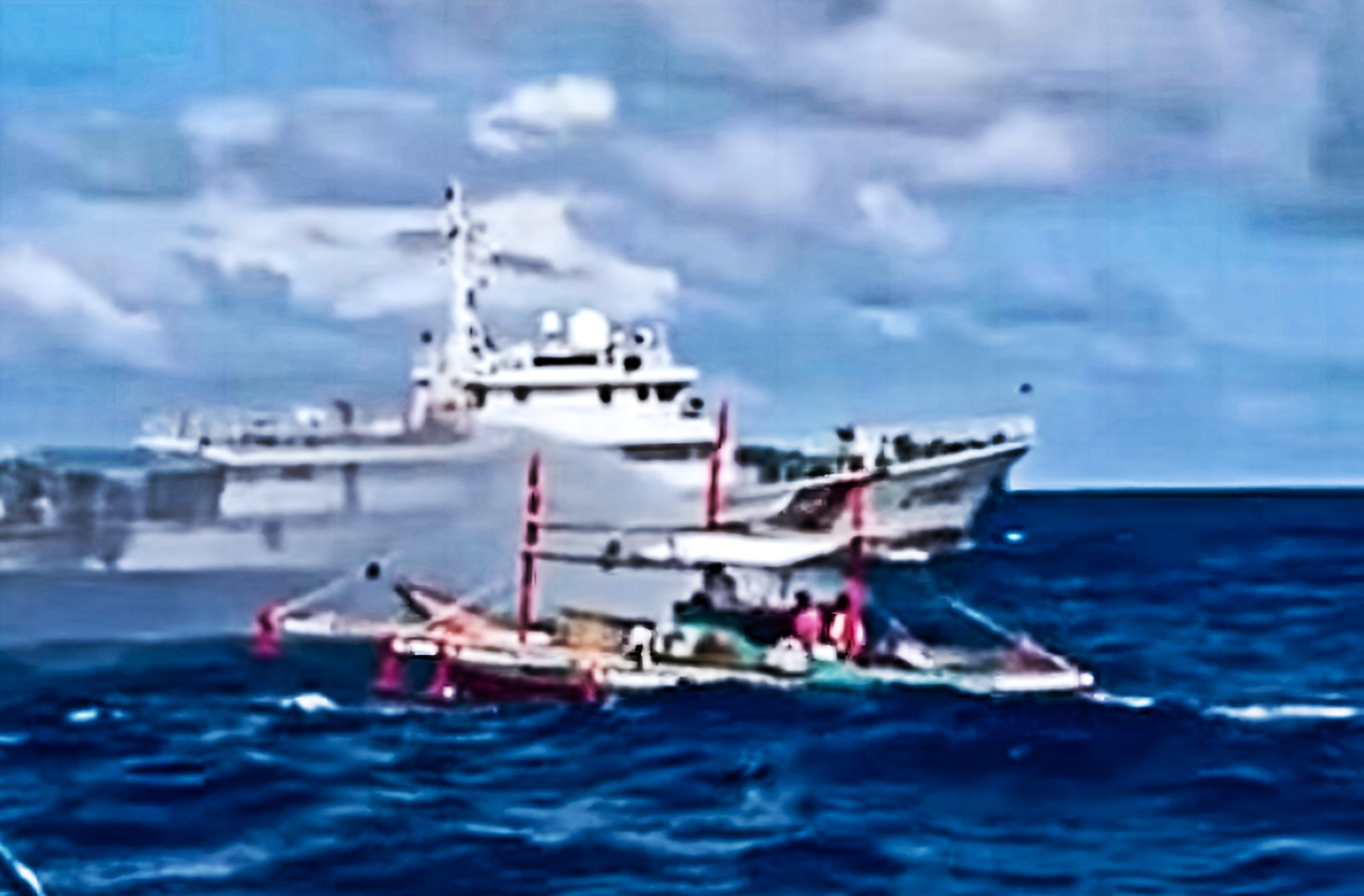
A video shared by the Philippine coastguard gained wide attention in December. It showed a ship from its Chinese counterpart deploying water cannon towards a smaller vessel, but the footage was used to tell two starkly different stories.
According to Manila, the Chinese vessel was harassing and jeopardising the lives of “innocent fishermen”, with three of them reportedly sustaining bruises, cuts and other injuries in the confrontation near Sabina Shoal in the disputed South China Sea.
Meanwhile, Beijing contended that the targeted vessels “under the guise of fishing” were there “in an organised and premeditated manner to provoke trouble”. The foreign ministry said China’s coastguards were threatened with knives and noted that they acted with “restraint” during the encounter.
The clash was the latest in a series of incidents that reflect a broader, years-long tug of war between Beijing and Manila as both seek to control the narrative in the South China Sea.
But while Beijing seeks to shape the talking points around the infringement of its sovereignty and regional peaceful cooperation, Manila is employing a publicity strategy that frames China as a coercive aggressor.
The fight to control the narrative and use it as a weapon in support of their respective claims could influence diplomatic alignments, but it also risked deepening regional mistrust, according to observers.
While the Philippines had been successful in building international support, its approach might lead to public fatigue and could be used to deflect from domestic problems, they warned.
China, for its part, was still refining its messaging strategy, with the aim of promoting a fundamentally different view of the issues surrounding the contested waters to a global audience, the analysts said.
Manila’s policy of “assertive transparency” in the South China Sea has been spearheaded by Philippine President Ferdinand Marcos Jnr since 2023.
Unlike the previous administration’s quieter overtures, the approach seeks to document and publicly expose what Manila calls China’s coercive grey-zone tactics to block Philippine access to the disputed waters.
At the core of Manila’s “naming and shaming” strategy is the widespread dissemination of information, starting with the prompt public release of photos, videos and detailed accounts of incidents as they occur.
The Philippine coastguard also regularly embeds local and international journalists with its vessels on missions to disputed areas of the South China Sea like Scarborough Shoal and Second Thomas Shoal.
Jaime Naval, an assistant professor in political science at the University of the Philippines Diliman, said the main achievement of the media-forward approach was not theatrics but evidence-based accountability.
“It documents incidents, narrows space for denial and helps third parties assess competing claims against observable facts,” Naval said.
“That, in turn, strengthens deterrence by raising reputational and diplomatic costs for unsafe conduct without requiring the Philippines to escalate militarily. Over time, transparency also improves crisis management by reducing misinformation and clarifying what actually occurred.”
The policy has overwhelming domestic backing, with 94 per cent of Filipinos agreeing that the government should “keep rapidly and truthfully exposing China’s coercion of Philippine vessels and fishermen”, according to a nationwide survey in September.
The strategy has also been successful in gaining international support for the Philippines, especially among the Group of Seven (G7) industrialised democracies – Canada, France, Germany, Italy, Japan, Britain and the United States.
The joint statement issued by the G7 foreign ministers at their summit in November expressed “serious concern over the use of dangerous manoeuvres and water cannons in the South China Sea”.
The statement also reaffirmed the 2016 arbitration ruling by an international tribunal at The Hague against Beijing’s sweeping claims in the South China Sea as a binding and “significant milestone” for the region.
China refused to take part in the arbitration process – initiated by the Philippines in 2013 – or accept the ruling, arguing that the tribunal did not have the jurisdiction to rule on the sovereignty disputes.
Manila has subsequently used China’s stance on the ruling as a way to highlight its concerns over Beijing’s commitment to international law.

Beijing claims most of the islands and rocks in the South China Sea and rights over their adjacent waters, leading to territorial disputes with several neighbouring countries and competing claims over Exclusive Economic Zones (EEZs).
Hugo Santos, an analyst at the Asian Century Philippines Strategic Studies Institute, said Manila’s strategic transparency was effective initially, but neighbours and domestic observers were showing signs of fatigue by the second half of 2025 over the repeated “projection of itself as a victim” and China as the bully.
“Asean neighbours are getting tired of this because it’s not really helping the regional [aims of] shared prosperity and navigating these issues together, and experts and academics in this field know what’s happening and things are being magnified by the media,” he said.
Santos warned there was a risk that the strategy could be politicised and used to rally nationalist sentiment and deflect from mounting domestic pressure, particularly with the administration embroiled in a corruption scandal over flood control projects.
In the battle of narratives with Beijing, it would be a “win” for Manila to attract the attention of its Western allies and “divert people’s attention to the South China Sea instead of the real drama [of domestic politics]”, he said.
With the Philippines about to take over the Association of Southeast Asian Nations’ rotating chair, Santos predicted Manila would have to “recalibrate itself a little” and rebalance a narrative which “might not look well with Asean countries and China”.
Manila faces high expectations, with 2026 also the deadline set to finalise the long-stalled South China Sea code of conduct. Marcos has repeatedly called for its completion but hopes are fading as the deep-seated rifts among claimant states appear difficult to settle.
The proactive narrative strategy is widely seen as being less effective in deterring China, while also creating unease among the Philippines’ fellow Asean members who favour a more cautious, quieter diplomacy.
For Manila’s approach to remain sustainable – rather than a spectacle – it must be disciplined, institutional, evidence-based and avoid exaggeration, according to Naval from the University of the Philippines.
According to experts, China lacks a narrative framework as cohesive as the Philippines’ but its messaging strategy has grown increasingly sophisticated, in direct response to Manila’s public condemnation.
Ding Duo, an associate research fellow at the National Institute for South China Sea Studies, a government-sponsored think tank, said Beijing’s narrative remained largely reactive with its core resting on two pillars: defining the true nature of the issue and asserting what actually happened in its waters.
“The essence of the South China Sea issue is not about ‘securitisation’ or narratives of bullying and threats as framed in international discourse, but rather about infringement,” he said.
“The fundamental difference is that the Philippines constructs its narrative through the lenses of the US-Philippines strategic alignment, geopolitical confrontation and the securitisation of broader regional issues, while China builds its narrative from the perspective of addressing disputes over territorial sovereignty and maritime jurisdiction.”
Ding also pointed out that confrontations in the contested waters were highlighted, while collaborative efforts among the coastal states were largely overlooked, including search and rescue, sea turtle conservation, fishery resource surveys and ecological preservation.
“This leads to a widespread perception that the South China Sea is in total chaos when in fact the region is generally peaceful and stable,” Ding said, adding that Beijing needed to amplify its narrative on successful maritime cooperation.
Beijing in recent years has stressed the importance of consolidating its own discourse power over the South China Sea issues and of telling China’s maritime governance story well.
In a notable tonal shift, Beijing has increasingly emphasised collaboration over confrontation, envisioning the waterway as a “sea of peace, cooperation and friendship” – a phrase championed by many top officials. Information releases have also become more efficient.
According to Naval, China’s target audiences now include not only the Asean governments but also its domestic public, Global South partners and international business communities concerned with stability.
While China’s messaging appeared “increasingly sophisticated”, at times it was “internally contradictory – emphasising de-escalation while reframing incidents as routine law enforcement”, he said.
“The key question is whether this evolution in messaging will be matched by corresponding behavioural change – particularly in avoiding dangerous manoeuvres and respecting lawful activities within other states’ EEZs.”
Wu Shicun, founding president of the National Institute for South China Sea Studies, said China had not countered enough the “pseudo-narratives” of the 2016 tribunal decision, calling it “a completely one-sided ruling that equates arbitration with international law”.
According to Wu, the biggest challenge that China faced in promoting its perspective was the West’s “oppose-everything-Chinese” mentality.
“In reality, it is Vietnam that is conducting illegal land reclamation on islands and reefs, and the Philippines that violated the DOC [Declaration on the Conduct of Parties] by grounding a vessel at Renai Jiao,” he said, referring to Second Thomas Shoal.
“Yet, the narrative has been flipped to suggest that China is ‘abusing force’ or ‘bullying the small’.
“When you lack discourse power and hold no advantage, the maritime rights protection and enforcement actions can easily be undermined by negative international public opinion.”
He stressed that Beijing had yet to develop an “effective and widely accepted narrative framework” on its South China Sea research, identifying three notable shortcomings in a commentary published by the Chinese journal World Affairs on Monday.
Historical findings were not disseminated widely enough internationally; legal research lacked diversity and innovation; and China had not prioritised the promotion of its maritime rights protection practices, he wrote.
Beijing needed to leverage social media and create more English-language content based on historical facts in the South China Sea. This would require more interdisciplinary academics with broad knowledge, high policy acumen and a wealth of practical experience.
Chinese scholars must improve their international communication skills and better understand global public opinion and the unique cognitive frameworks of Western audiences, according to Wu.
Collin Koh, a senior fellow at the Institute of Defence and Strategic Studies at the S. Rajaratnam School of International Studies in Singapore, observed that Beijing struggled in the narrative space because of tight state control over messaging.
“Manila has the advantage of a free and open domestic and international press to help it push a narrative, whereas in the case of China it appears to be constrained very much by the way it tries to tightly control its narrative at the state level,” he said.
“I think that in a way explains the difference between the two. And it also, in a large way, explains why one appears to be more successful and one is not so successful.”
Another point of contention is the BRP Sierra Madre, a crumbling World War II-era landing ship deliberately grounded by the Philippines on an outcrop of Second Thomas Shoal in 1999 to assert its territorial claims.
Beijing has repeatedly urged Manila to remove the ship, which houses a crew of Philippine marines. Interceptions of resupply missions to the shoal have led to a series of clashes and rising tensions.
Last year, China accused the Philippines of causing environmental damage to the shoal, with state broadcaster CGTN airing footage in March that appeared to show smoke billowing from a warship at the site.
This followed a 2024 investigation report by the Chinese government that detailed the damage inflicted by the vessels on the shoal’s coral reef ecosystem.
Manila rejected the CGTN report and dismissed the claims as propaganda, with the Philippine Navy calling them “part of the deceptive messaging of the Chinese Communist Party”.
According to Koh, meaningful progress on South China Sea issues could depend on whether Beijing would be willing to reassess the legal basis of its claims and use that as a foundation for dialogue.
“I think that will mark the start of what I tend to see as a more meaningful and sustained dialogue mechanism and I think that could help to change the narrative more favourably towards China’s direction,” he said.
“If not, then China will continue to assert itself physically as a compensation for what it lacks on the narrative front. And that, I think, further forecloses other opportunities for more discussions.
“I think that also contributes to the further deepening of mistrust between Beijing and Manila. And by extension, it might also deepen that level of mistrust between Beijing and other Southeast Asian parties.”
-- SOUTH CHINA MORNING POST