



KUALA LUMPUR: A joint initiative between the Wildlife and National Parks Department (Perhilitan) and enforcement agencies has made significant headway since its launch in 2019 in the battle against poaching of wildlife, says director-general Datuk Abdul Kadir Abu Hashim.
As of July this year, he said, their operations made seizures worth over RM39.3mil and saw 1,089 people held for various offences in 778 cases.
He said the joint initiative, named Ops Bersepadu Khazanah, involved Perhilitan, the police, Customs Department, Forestry Department, Immigration Department, state agencies and wildlife conservation non-governmental organisations.
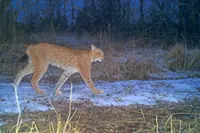
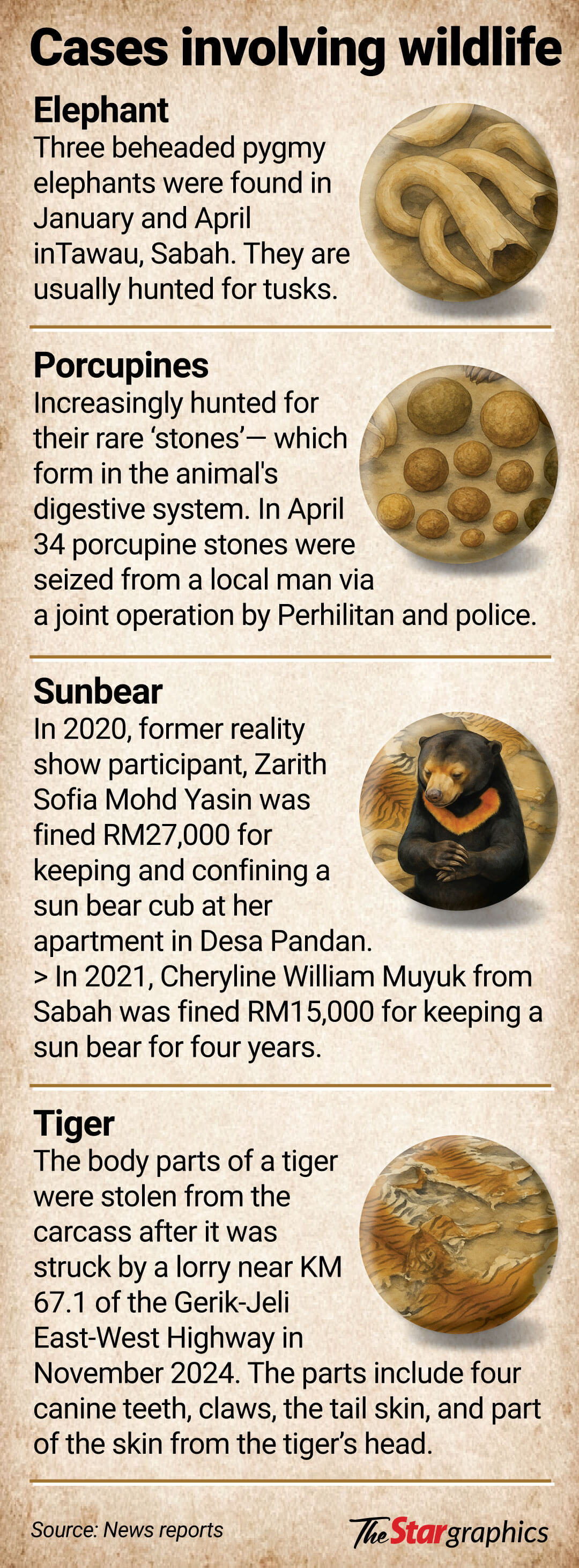
In an interview with The Star, Abdul Kadir said the Malayan tiger, leopard, sun bear and elephants, which are sought for their tusks, are among those most susceptible to poaching due to their high value and demand in the black market.
Poachers are also snatching monkeys, white-rumped shamas, siamangs and slow lorises from the wild, and selling them to exotic pet enthusiasts, he said.
ALSO READ: More boots and funds needed to deter poachers
Abdul Kadir reminded those who intend to keep any protected wildlife species as pets that they must obtain the animals from a licensed dealer authorised by Perhilitan and also secure a permit from the department.
He said the permit, or “licence to keep wildlife”, can be obtained either from the department’s licensing counter or through the myPERHILITAN online portal.
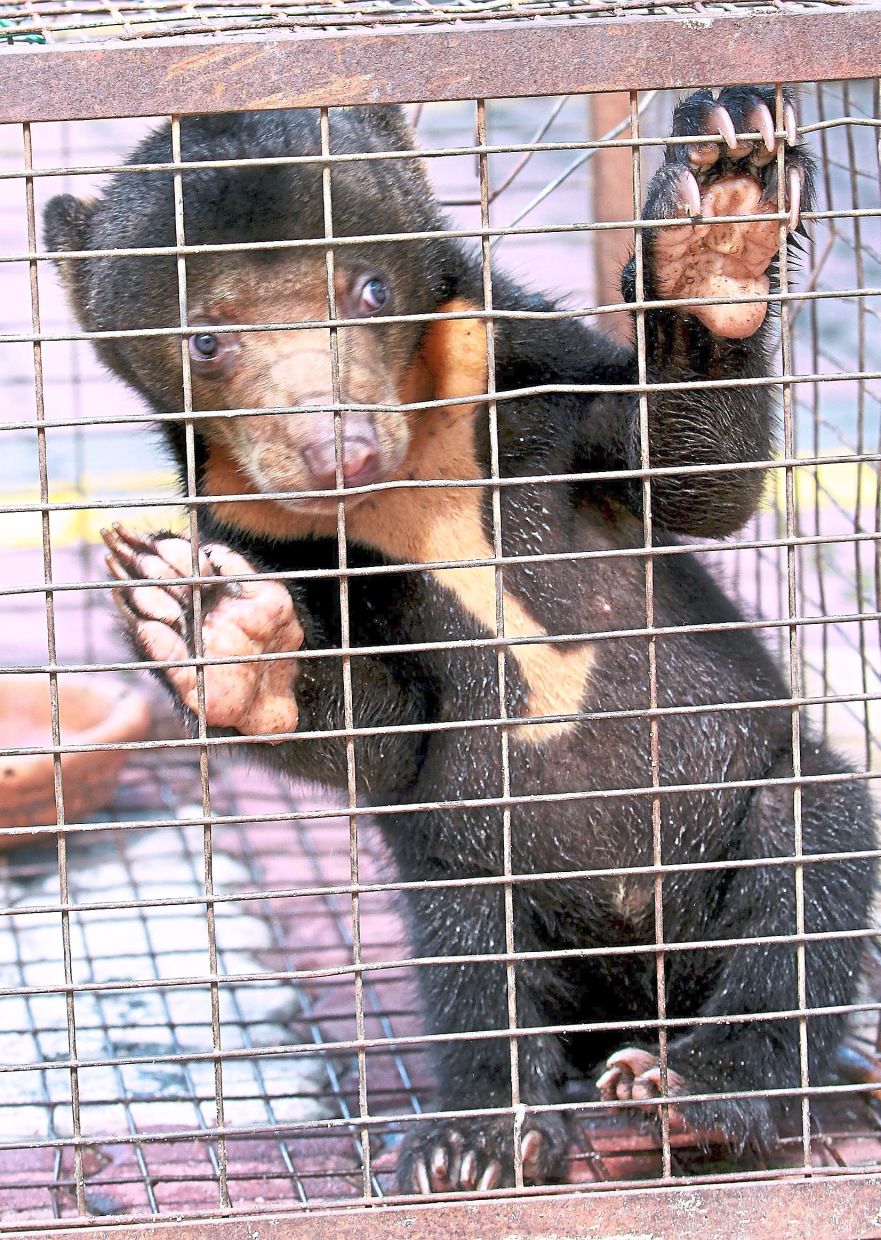
Abdul Kadir said those caught keeping protected wildlife species listed under the Wildlife Conservation Act 2010 without a permit face fines of up to RM50,000 and jail terms of three years, while possession of totally protected wildlife carries fines of RM50,000 to RM500,000.
He said the white-rumped shama, blue-crowned hanging parrot, sun conure, Indian star tortoise, African spurred tortoise, ball python, grey parrot and iguana are among the protected wildlife species popularly sought by pet enthusiasts.
On cruelty towards wildlife, he said the problem is often linked to smuggling, with animals confined in tight containers, suitcases and even stuffed into PVC pipes when discovered at airports.
“One notable case of cruelty that occurred in Perak in 2019 was when someone confined a long-tailed macaque in a cage and later shot the animal,” he said.
Between 2019 and July this year, the perpetrators in 14 cases were charged in court for cruelty to wildlife under Section 86 of the Wildlife Conservation Act.
As for developments of a case in June where a man was caught on video spray-painting a caged monkey in Shah Alam, Abdul Kadir said investigations are ongoing.
He said the findings of the case have been referred to the Attorney General’s Chambers and a directive to probe further was ordered.
Abdul Kadir also spoke about habitat loss from deforestation for agriculture and infrastructure projects, attributing them to the frequent human-wildlife conflicts in recent years.
Large mammals such as elephants are the most visible victims of human-wildlife conflict as their habitats shrink and they end up being translocated when they stray into plantations and villages, he said.
In May, the Natural Resources and Environmental Sustainability Ministry said there was a significant increase in human-wildlife cases involving monkeys, elephants, wild boars, tigers and tapirs totalling to 66,825 reports between 2020 and 2024.
The conflicts resulted in losses amounting to RM46.5mil.
Abdul Kadir said the agricultural sector has introduced improved management practices, including the use of electric fencing, to protect crops while ensuring wildlife is not harmed.
As a long-term strategy, he said the National Elephant Conservation Action Plan had emphasised on protecting critical habitats, restoring ecological corridors such as the Central Forest Spine and training villagers to deter encroaching animals in non-lethal ways.
He said local communities are being enlisted as partners in anti-poaching and conservation work.
Abdul Kadir said wildlife corridors remain central to the strategies with the National Policy on Biological Diversity 2016-2025 providing the framework to reduce habitat fragmentation.
He said the policy specifically emphasises the identification, restoration and protection of key terrestrial and marine ecological corridors.
“Viaducts and culverts are being built strategically along highways to allow wildlife to safely cross beneath or above these stretches.
“This will help mitigate roadkill and maintain wildlife populations while the Central Forest Spine project focuses on reconnecting fragmented landscapes for species like the Malayan tiger, Asian elephant and Malayan tapir,” he said.


