
Cloud seeding operation creates rain to save critically low Perak dam
PETALING JAYA: A cloud seeding exercise has helped increase the critically low water level at the Bukit Merah Dam in Semanggol, Perak, caused by the dry spell, says Datuk Seri Dr Ahmad Zahid Hamidi.
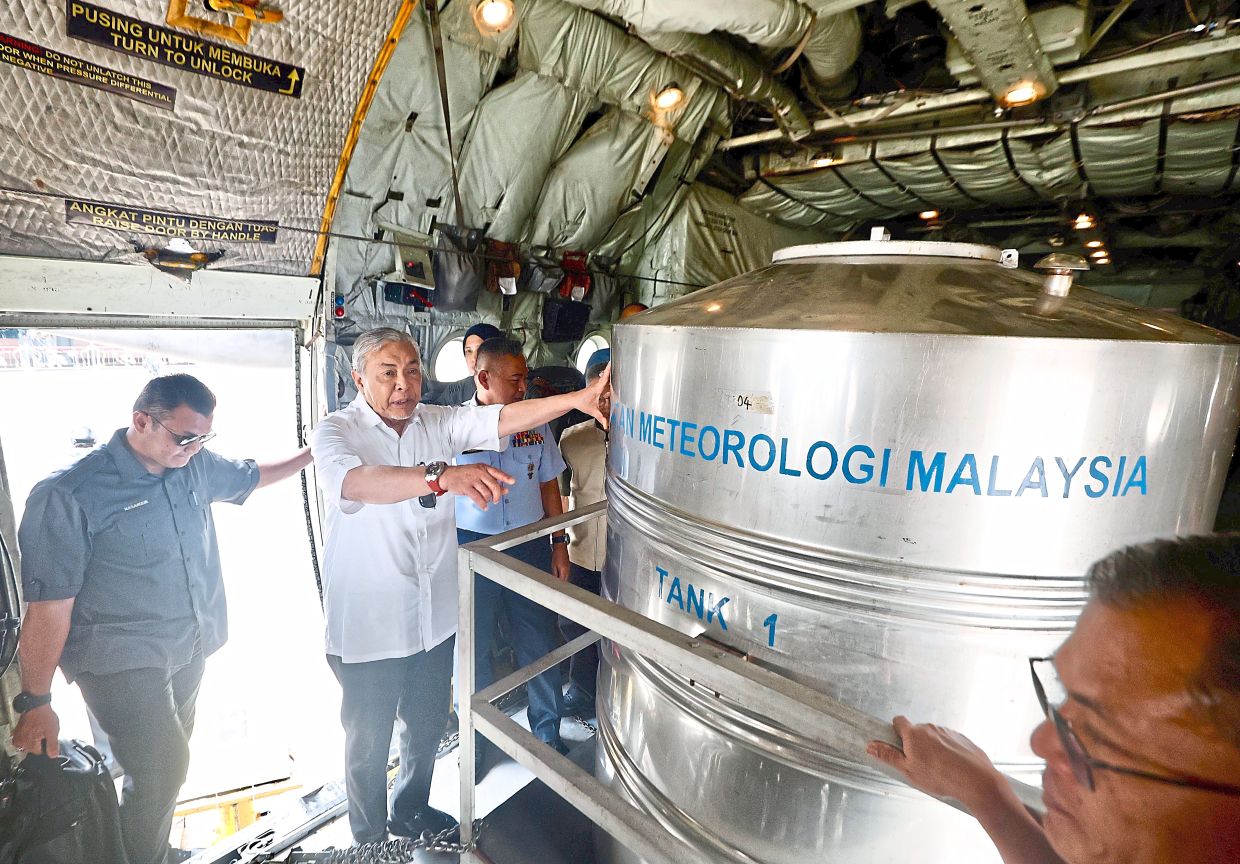
The Deputy Prime Minister said a downpour occurred just 45 minutes after 6,000 litres of salt solution was sprayed into cumulus clouds to generate rain at noon yesterday.
He said the operation was conducted by a Royal Malaysian Air Force (TUDM) C-130 Hercules aircraft, which took off from its base in Subang at about 11.30am.
Ahmad Zahid, who also joined the flight with the TUDM crew, said the dam’s water level stood at about 6m in depth, a mere 12.21% of its capacity.
“The dam level was below 30% of its minimum capacity.
“According to the Malaysian Meteorological Department (MetMalaysia), there were cumulus clouds over the Straits of Malacca moving from the west towards the mainland.
“The clouds were sprayed with the solution at altitudes of between 5,000 and 8,000 feet. I was informed during the return flight to Subang that precipitation occurred 45 minutes later.
“With this scientific method and the help of God, we hope the water level issue will be overcome,” he said to reporters after the cloud seeding operation yesterday.
Ahmad Zahid, who is also the National Disaster Management (Nadma) committee chairman, said the dam is not only a water source for households, but also provides water to padi plantations and fish farms.
He said failing to promptly address the water shortage could have a ripple effect that may affect food supply, income of rural folk and the stability of the local ecosystem.
Ahmad Zahid revealed that the Perak government and the Agriculture and Food Security Ministry had sought the assistance of Nadma in mid-July to conduct cloud seeding operation to increase the low water level at the dam.
He also said the districts of Bandar Baharu (Kedah), Selama (Perak), Temerloh (Pahang) and Limbang (Sarawak) as well as Tenom and Pitas, both in Sabah, had recorded high temperatures of between 35°C and 37°C for three consecutive days since Aug 1.
“We will monitor these areas and see if there is a need for cloud seeding to be carried out there.
“However, our priority is to ensure there is adequate supply at water dams,” he said.
Ahmad Zahid noted that with the southwest monsoon season, rainfall is scarce and the climate is hot, adding that the dry spell is expected to end in mid-October.
“In the meantime, the Fire and Rescue Department has been directed to prepare the 3,000 tube wells we have to mitigate fires, especially in peat-soil grounds and forests.
“The Health Ministry has also advised outdoor activities, especially among children, to be postponed during this season.”
Also present were TUDM chief of flight operations Lt Jen Datuk Masro Kaliwon, Nadma director-general Datuk Abdul Halim Hamzah and MetMalaysia deputy director-general Zunaidi Mat.