
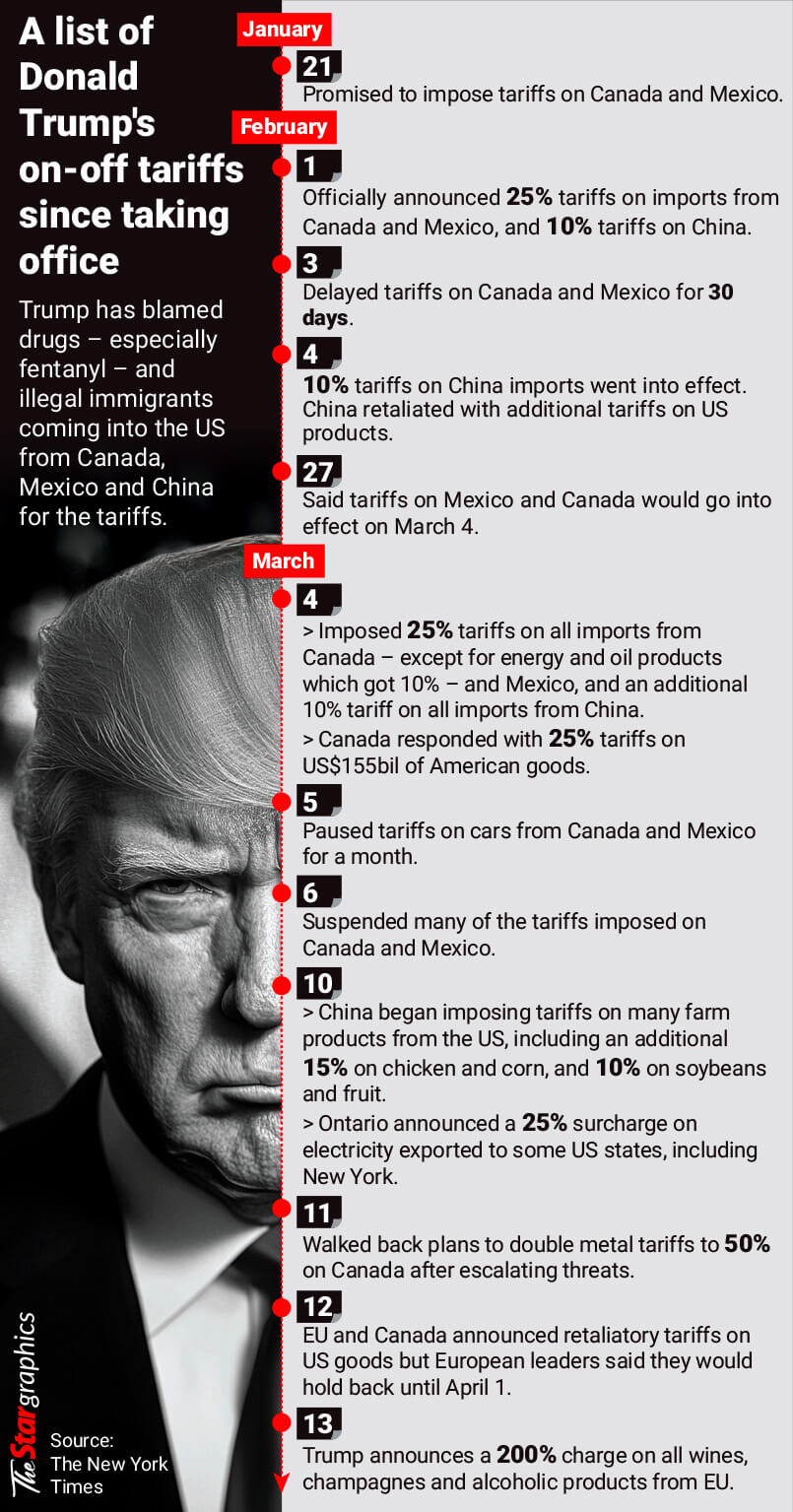
PETALING JAYA: In just under two months, US President Donald Trump’s shifting tariffs on key trade partners have shaken global markets, raising concerns for Malaysia, which relies heavily on trade with the United States and China.
Amid fear of the impact of rising tariffs, trade leaders are urging the government and businesses to fortify Asean ties and explore non-traditional markets.
Malaysian Consortium of Mid-Tier Companies president Martin Ang said such shifting tariffs leave short-term and long-term impact on international trade.
“Restructuring of supply chains away from some tariff-affected countries will happen, and as with most tariffs, this will hamper global trade growth, possibly shifting towards regional trade blocs,” he said yesterday.
Addressing the specific implications for Malaysia, Ang said higher tariffs will directly impact Malaysian manufacturers, one way or another.
“Both the United States and China are among Malaysia’s top five trading partners,” he said.
When asked about the potential disruptions to global supply chains, Ang advised Malaysian businesses to “adapt and adjust your sails”.
“Manufacturers should always look at how to be more cost-efficient and effective. We must consider having free trade agreements (FTAs) with some ‘non-traditional trading countries’ and explore new markets,” he said.
Ang urged Malaysian companies to remain agile and adaptable.
“In a VUCA (Volatile, Uncertain, Complex, Ambiguous) world, there are always opportunities.”
Ang called for Malaysia to lead regional trade and investment collaboration this year.
“We hope that with Malaysia’s leadership role this year, we will be able to do more to promote intra-regional collaborations in trade and investment,” he said.
SME Malaysia president Chin Chee Seong called on small and medium-sized enterprises (SMEs) to diversify their export markets amid growing uncertainty over potential disruptions from evolving US tariff policies on key trading partners, including China, Canada and Mexico.
Although no immediate effects have been observed, Chin cautioned SMEs against complacency.
“We are worried it will hit us sooner or later. Hopefully, nothing serious happens, but over the next three to six months, it’s uncertain,” he said.
SMEs, he said, should reduce reliance on traditional markets like the United States and China and explore opportunities in emerging markets, particularly within BRICS and Regional Comprehensive Economic Partnership (RCEP) member countries.
“China remains a major trading partner, especially in electronics, but it’s time to look beyond. Companies should explore BRICS and RCEP nations.
“We’ve seen how the United States is behaving, and it’s likely to continue for the next few years. That’s why we must act now to expand into other markets,” he said, noting that Malaysia External Trade Development Corporation (Matrade) is working to promote trade with alternative markets such as Brazil, Argentina and Mexico.
While some sectors, like solar panels, have faced temporary setbacks from trade issues, Chin expressed particular concern for the electronics and electrical (E&E) sector.
“Electronics – that’s where the real risk lies. Ultimately, it’s up to the government to negotiate effectively with trading partners. There’s only so much businesses can do on their own,” he said.
Chin also highlighted Asean as a vital trade bloc for Malaysia.
“Asean countries are important, and we already have significant trade with Singapore.
“Surprisingly, Singapore is a small country, yet their trade volume is extremely high. Much of that trade is redirected to other countries. If we can identify where those goods are ultimately going, we could target those markets directly,” Chin said.
Small and Medium Enterprises Association national president Datuk William Ng said that as a trading nation, Malaysia needs to monitor developments in policy volatility closely.
“Even if these tariffs are not directly targeting our producers, we will still see the impact as part of the supply chain.”
Ng noted that a significant portion of Malaysia’s exports go to American companies outside the United States, making direct impacts less clear, necessitating frequent scenario planning.
“The potential dumping by larger producer countries – both into Malaysia as well as into markets where we supply will have a real and fast impact on the volume and price of our own goods,” he said.
Despite longstanding US-China trade tensions, Ng said Asean, including Malaysia, has benefited from the “China + 1” policy.
“Businesses need to diversify clients and supply sources to reduce disruption and losses,” he said, adding that SMEs can consider relocating overseas plants and sourcing domestically.
Reflecting on trade agreements, Ng affirmed that ratifying the CPTPP (Comprehensive and Progressive Agreement for Trans-Pacific Partnership) and RCEP was wise, providing access to alternative markets amid potential tariff targeting.
“SMEs must double down on both digitalisation and R&D, to cut our reliance on workers and support our margin. This will give us room to navigate any costs or price pressure,” he said.