SEPANG: The newly-formed Malaysian Border Control and Protection Agency (AKPS), is not only tasked to strengthen security at the country’s land, sea and air borders and gateways, but also to make the movement of goods and travellers more seamless and faster, says Deputy Prime Minister II Datuk Seri Fadillah Yusof.
The latest entity under the Home Ministry unifies several agencies comprising the Customs Department, Immigration Department and the police among others, under a single chain of command.
Speaking at the launch of AKPS at Kuala Lumpur International Airport Terminal 1 yesterday, Fadillah said the government hopes to see a more seamless movement of travellers and trade into the country through its international entry points. This smooth and efficient border control framework is important for trade and tourism given the country’s position as an entry point into the region, he added.
Fadillah said the government wants to see changes in service delivery by authorities at international gateways and with minimum bureaucracy.
“With services provided using simpler procedures and minimal wait times, travellers and businesses will have a better experience,” he said, adding that this will spur economic growth and strengthen Malaysia’s position in the global arena.
Fadillah said travellers entering the country would undergo layers of inspections under the purview of different agencies, which could cause delays and confusion.
“With the single border control agency in place, we intend to provide a more seamless experience for travellers where they can undergo all inspections at one place and it would not be complicated,” he said, adding that this would also reduce wait time.
He said streamlining all agencies under a single chain of command would address issues related to efficiency, overlapping of duties and communication.
Fadillah acknowledged that forming AKPS was not without its challenges. However, it has been proven that working in silos and the “territorial mentality” that was associated with the civil service could be overcome when the nation’s interests were put above everything else.
While AKPS is important to ensure Malaysian airports and ports remain competitive, he assured the public that there would be no compromise on security, adding that AKPS would employ advanced technology and data sharing to strengthen its security framework.
He also said the use of artificial intelligence is critical for border security and would allow officers to identify and mitigate any threats and challenges.
In line with Visit Malaysia Year 2026, AKPS will ensure efficiency at the borders. As the Asean Chair, this initiative will help strengthen Malaysia’s commitment to regional integration and cooperation as well ease cross-border travel within the region, Fadillah said.
“AKPS’ operations will be more challenging as delegates from Asean countries will come to our country to attend meetings.”
The Home Ministry website cites that the role of AKPS includes inspecting and controlling the movement of people, goods, vehicles, wildlife and food, health-related items, drugs and poisons as well as implementing quarantine controls.
Home Minister Datuk Seri Saifuddin Nasution Ismail, who was also at the event, said having a single border control entity will strengthen national security, provide better economic protection as well as public health and safety.
“If the borders are not well protected, then national security will be at stake and exposed to criminal elements,” he said.
“We will be able to form stronger accountability and oversight. There will be clear responsibilities and it will be easier to enforce policies.”
He said AKPS will reduce administrative overhead costs, avoids duplication of efforts and reduces resource wastage.
Saifuddin Nasution said no new hiring was made and manpower was brought in from the agencies under the new entity instead. The agency is targeting 12,000 personnel for full operations.
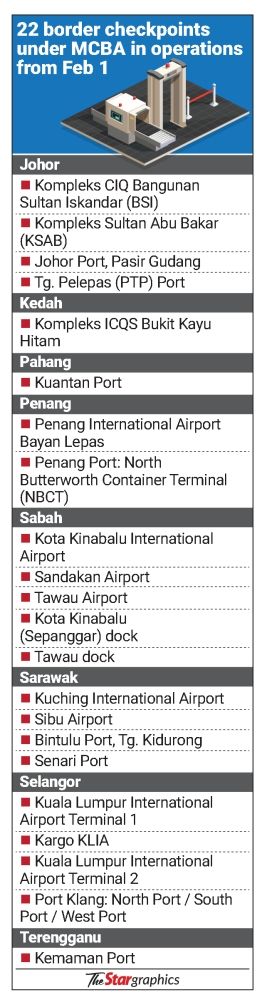
He said AKPS operations would be expanded to more entry points, adding: “The busiest (airport) will be prioritised with KLIA at the top of the list, followed by Penang and Kota Kinabalu. Although the Deputy Prime Minister II (Fadillah) is from Sarawak, he asked for Kota Kinabalu to be prioritised, and only then Kuching and others.”