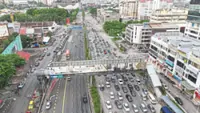
PETALING JAYA: Public transport users are asking for greater walkability in our cities for the new year as many of them have to brave poorly maintained walkways or tread in between moving traffic to arrive at public transport hubs.
Transport consultant Wan Agyl Wan Hassan, the principal of Agyl & Partners, a consultancy based in Kuala Lumpur and also former official at the now-disbanded Land Public Transport Commission, said that pedestrian safety everywhere needs serious attention.
“It’s clear that our urban planning is still too focused on cars, leaving pedestrians with unsafe pathways.
“Walkable pathways to train stations are crucial. If we want people to leave their cars at home, the walk to the station must be safe, comfortable and convenient,” he said.
He said better pedestrian walkways should start at the high risk areas first, such as near schools, public transport stations, and commercial hubs, as these are accident-prone areas.
“These locations need proper lighting, better crossings and smooth walkways as soon as possible,” he stressed.
Wan Agyl also said that these walkways should be wide and free from obstructions like parked cars or street vendors, and include shelter from rain and heat.
Adequate lighting in the walkway, he said, is important as people feel unsafe walking in poorly lit areas.
Assoc Prof Dr Law Teik Hua, head of the Road Safety Research Centre at Universiti Putra Malaysia’s Engineering Faculty, expressed concern towards high incidence of pedestrian-related crashes, which highlights the urgency for pedestrian safety.
He referred to statistics published by the Works Ministry in July 2024, which said that pedestrians are the third highest fatality group after motorcyclists and car riders.
It has also said that there are 542 pedestrian deaths a year, which equates to 45 people a month.
He said that clearly marked pedestrian crossings are needed, particularly in areas near public transport stations and high-traffic zones.
“These crossings should be equipped with traffic signals that give pedestrians priority and enough time to cross safely.
“Better signage and increased visibility are essential, especially at night. Elevated pedestrian crossings and well-lit areas would further improve safety,” he said.
Law also suggested pedestrian bridges and underpasses in high-traffic or fast-moving areas, which will remove pedestrians from road level.
Many areas of the Klang Valley, he noted, currently have narrow, poorly maintained sidewalks that don’t accommodate heavy foot traffic, which is a serious deficiency considering that many will be using upcoming rail lines such as the Shah Alam LRT (formerly known as LRT3) by September.
Law also stressed the need for stronger enforcement of traffic law, especially in school zones and busy intersections, with significant penalties for violating pedestrian’s right-of-way to deter reckless driving.
Universiti Tun Hussein Onn Malaysia Faculty of Engineering Technology Senior Lecturer Dr Nurrul Hafeezah Sahak said that public campaigns on pedestrian safety are very important.
She said that pedestrians should be educated to follow traffic rules, and drivers should respect pedestrians.
“Drivers need to know that pedestrians are the most vulnerable group on the road,” she said, while also suggesting for the creation of pedestrian-only zones at busy areas of the city.
Earlier this week, Kuala Lumpur police chief Datuk Rusdi Mohd Isa said on Buletin TV3 that discussions are ongoing with stakeholders to evaluate the feasibility of turning part of Jalan Bukit Bintang in the city to be a pedestrian-friendly zone by restricting vehicles.
On Dec 30, a 50-year-old male pedestrian died from a hit and run in Klang.
Earlier last month, a six-year-old girl was injured in Johor Baru from a hit-and-run accident.