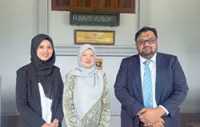
GEORGE TOWN: The Education Ministry will incorporate the Reproductive and Social Health Education (PEERS) module into the 2027 school curriculum to address the rising number of teenage pregnancies in the country, says its minister Fadhlina Sidek (pic).
The decision also has the support of the Women, Family, and Community Development (KPWKM) Ministry, she added.
“Our concern is the same as KPWKM’s when it comes to the issue of out-of-wedlock pregnancies. We are focusing on education, particularly on reproductive health,” she told reporters here, Bernama reported.
“... from time to time, we conduct advocacy programmes on reproductive health issues, including joint programmes with KPWKM to address sexual harassment, girls’ health, safe touch bad touch,” she said after attending the closing ceremony of the Science, Technology, Engineering and Mathematics (STEM) Week at Universiti Sains Malaysia (USM).
Fadhlina added that the PEERS module would empower teachers and students with the necessary information about the issue.
The module will be incorporated into the curriculum under health education, starting from preschool to secondary school, where students will be provided with information and psycho- social skills to make informed decisions.
Earlier, Women, Family and Community Development Minister Datuk Seri Nancy Shukri expressed concern over the continued occurrence of teenage pregnancies, child marriages, baby dumping and unsafe abortions.
Citing data from the Health Ministry, Nancy said 44,263 cases of teenage pregnancies were recorded over the past five years, with 17,646 cases involving unmarried teenagers.
In another development, Fadhlina urged school counsellors to play a vital role in advising students and providing them with information and encouraging them to choose the STEM stream.
She added that MOE had conducted intervention sessions between school counsellors and STEM industry players to ensure they have up-to-date information before passing it on to students.
The USM STEM Week saw the participation of the university’s 15 STEM schools from three campuses – the main campus, the engineering campus, and the Advanced Medical and Dental Institute – along with six collaborators.
A total of 350 lecturers, graduate and postgraduate students conducted various interactive STEM-themed activities with 600 students from more than 30 schools in Penang.