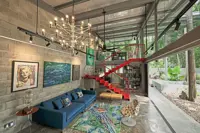
GEORGE TOWN: The double- storey bungalow stands proudly alongside other “old wealth” houses on the cool, tree-lined Jalan Ayer Rajah, now renamed Jalan Tunku Abdul Rahman.
Walking through the house is like stepping back in time.
The bungalow embraces the splendour of British design within its white interior with brown flooring. Its walls in the living room are lined with portraits of the country’s first prime minister, Tunku Abdul Rahman Putra Al-Haj, with other leaders and government officials.
This was Tunku’s home after he retired from office in 1970 until his death in 1990. The grand 1929 heritage mansion, named Rumah Takdir, now stands proud as a symbol of unity in diversity.
The well-kept grounds were also where Tunku, a Kedah prince, hosted large gatherings.
He bought the house for RM180,000 from his gratuity payment after retiring as prime minister.
Rumah Takdir, a two-bedroom, three-bathroom bungalow, has a land area of 64,472 sq ft and a built-up area of 9,867 sq ft.
Reliving the memories of the historic bungalow, Tan Sri Mohd Yussof Latiff, president of the Penang Malay Association (Pemenang), said he was among Tunku’s closest friends who witnessed how Tunku transformed the house into a base to foster racial unity.
Mohd Yussof, who was then in his 50s, recently recounted to Bernama: “After his retirement, Tunku chose to stay in Penang because he felt very close to the state.
“He initially stayed in a terrace house in Jalan Western but was later offered by a friend to move to another house in Jalan Ayer Rajah.
“At that time, Tunku had just received his gratuity from the government after his retirement as prime minister. He immediately bought the house and named it Rumah Takdir.”
Mohd Yussof said there was never a quiet moment at Rumah Takdir as it was always bustling with visits from people of all races as well as prominent local and foreign leaders.
“The most joyous occasion was observed annually on Feb 8, when people from various races dressed up in colourful traditional attire and brought food to Rumah Takdir to celebrate Tunku’s birthday.
“Tunku himself was happy that Rumah Takdir played a significant role in fostering racial unity. At every event, Tunku would always drive home the message that the people should remain united.
“Tunku also reminded the people that unity was their fundamental strength as a people and nation, that it was why Malaysia was able to achieve independence and that they should preserve the spirit of unity for the next generation,” he added.
He said he was told that the house, which was inherited by Tunku’s daughters, was eventually sold to a buyer who had some repair work done to the property.
He called on the Federal Government to buy the house from the owner and restore the historic landmark.
“The house is Tunku’s legacy and should be preserved as a fitting tribute to his struggles and immense contributions to the nation,” Mohd Yussof added.
Heritage activist Khoo Salma Nasution said that besides serving as a venue for fostering racial unity, Rumah Takdir was also a gathering place for Muslim converts.
“The house should continue to be a symbol of racial unity for all, especially the younger generation, lest they forget that what the country has achieved today was brought about by racial unity forged by past generations,” said Khoo Salma, who is also Penang Heritage Trust vice- president.
Besides proposals to convert Rumah Takdir into a museum, recent reports said the property is for sale at RM62mil or for rent at RM25,000 a month to private individuals or organisations.
Already a subscriber? Log in
Get 20% OFF The Star Digital Access
Cancel anytime. Ad-free. Unlimited access with perks.